
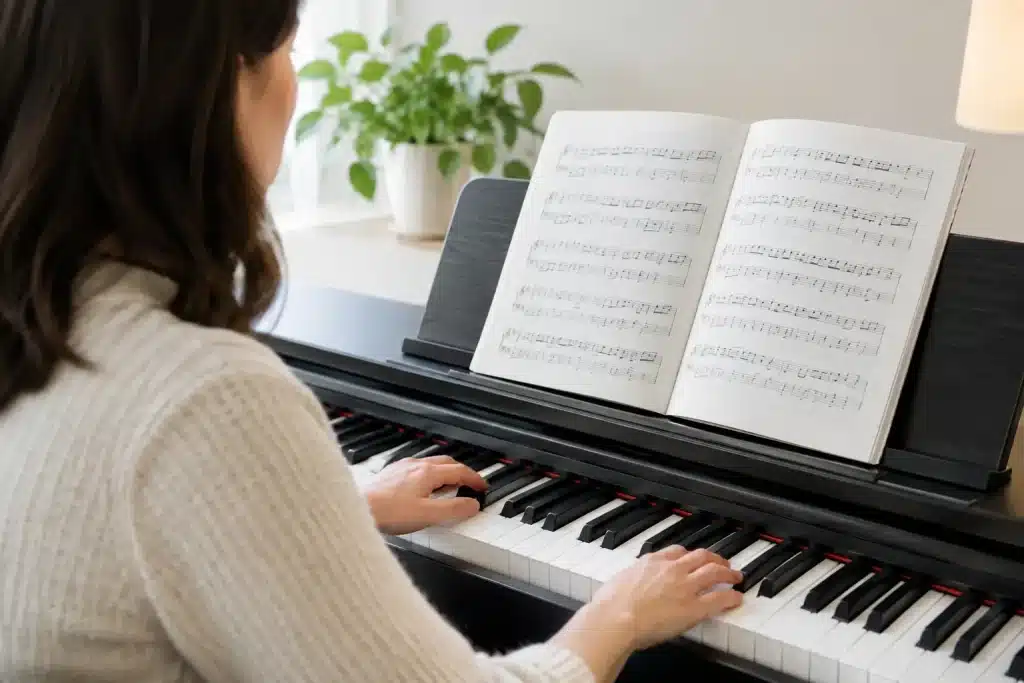
A familiar song can make the first weeks at the keyboard feel much less like homework. The right piano sheet music for adult beginners gives you a tune you already know, a clear path through the notes, and a reason to sit down for another 15 minutes tomorrow. The wrong arrangement can make a favorite song feel impossible before you have played the first full page.
Adults do not need to begin with music they do not enjoy. You do need music that respects where your hands, eyes, and reading skills are right now. Choosing individual arrangements by difficulty, then practicing them in small sections, is often a more satisfying route than working through a large book filled with songs you may never want to play.
Start With Songs You Want to Hear Again
Motivation matters more than people sometimes admit. Piano takes repetition, and repetition is easier when the melody means something to you. A ballad, a movie theme, a classic pop chorus, or a simple holiday favorite can all work well if the arrangement matches your level.
That does not mean every favorite song is a good first choice. A recording may sound relaxed while the piano part contains big leaps, dense chords, quick rhythms, or a left hand that moves constantly. Look at the page before you commit. If both hands are packed with notes from the opening measure, save that version for later.
For your first few songs, choose arrangements with a steady pulse, a clear melody, and chord patterns that repeat. Repetition is helpful, not boring. When a pattern returns, you spend less time decoding notes and more time developing timing, hand position, and confidence.
What Beginner-Friendly Piano Music Actually Looks Like
A beginner arrangement is not defined only by how many notes appear on the page. It should give you enough musical detail to recognize the song without asking you to manage five new skills at once.
A manageable right hand
The right hand often carries the melody. Early on, it helps when the notes move mainly by steps or small skips instead of jumping across the keyboard. A melody with repeated rhythms also gives you more room to focus on finding notes accurately.
Do not worry if you cannot identify every note instantly. That speed comes with regular reading. What matters is that you can work through a short phrase without losing your place or feeling overwhelmed by every measure.
A simplified left hand
Many adult beginners can play a melody before they feel comfortable adding accompaniment. That is normal. Look for left-hand parts built from single bass notes, simple intervals, or basic chords held for a full measure or two.
A fuller accompaniment can sound impressive, but it also creates more coordination work. If you are learning your first songs, a simpler left hand is usually the better trade-off. You can always move to an intermediate arrangement of the same song once the melody and harmony feel familiar.
Clear rhythm and sensible page layout
Rhythm can be harder than pitch for new readers. Friendly arrangements use common note values, clear rests, and a tempo that can be slowed down without losing the character of the song. A layout with readable note spacing and natural phrase breaks is also easier to practice than a crowded page.
If an arrangement includes chord symbols above the staff, treat them as useful clues. You do not have to play every chord symbol immediately. Over time, they can help you see how a song is built and give you options for creating a simpler accompaniment.
Choose the Right Version of the Same Song
Popular songs are often available in more than one piano format. That is good news, but it can be confusing when you are deciding what to buy.
A piano solo arrangement is designed for one player and usually includes the melody and accompaniment together. For a beginner, this works best when the accompaniment is clearly simplified. Piano, vocal, and guitar arrangements often place the vocal melody on the staff and include lyrics and chord symbols. They can be a strong fit if you want to sing while playing or use a lighter piano part.
Easy piano arrangements are typically the most direct starting point. They may use fewer notes, friendlier keys, and simplified rhythms while keeping the song recognizable. The trade-off is that they may not reproduce every detail of the original recording. At the beginning, that trade-off is usually worth making. Playing a complete, musical version is more rewarding than getting stuck halfway through a more elaborate score.
Pay attention to the key signature, too. A song with no sharps or flats is not automatically easy, and a song with one or two is not automatically too hard. Still, keys with fewer accidentals can reduce the number of decisions you must make while reading. When you are building basic fluency, less visual clutter helps.
Use Digital Sheet Music to Match Your Practice Time
Adult practice often happens in the gaps between everything else: before work, after dinner, during a quiet weekend hour. Immediate online access removes one unnecessary delay. When you find a licensed arrangement that suits your level, you can view it online, print it at home, and begin while your interest is still fresh.
Printing can be especially practical for beginners. You can write finger numbers above a tricky passage, circle a repeated pattern, mark where a hand position changes, or make a note about counting. Those markings are not cheating. They are part of turning a page of notation into something your hands understand.
Keep your printed pages organized in a small folder or binder. Put songs you are actively learning at the front, and keep finished pieces behind them. Returning to an older song every few weeks is a satisfying way to hear your progress. A song that once required slow, careful counting may eventually become something you can play while watching the page less and listening more.
FreshSheetMusic.com is built around this kind of focused practice: choosing a specific licensed song arrangement, accessing it digitally, and using it at home without waiting for a physical book to arrive.
A Simple Way to Learn Each New Piece
Trying to play straight through a new song from measure one to the end is tempting. It is also one of the fastest ways to practice mistakes. A better approach is to make the piece smaller before you make it faster.
First, listen to the song and notice its main sections. Then study the key signature, time signature, tempo marking, and any repeated signs. Find a short phrase, perhaps two to four measures, and play the right hand alone. Say the counts out loud if the rhythm is uncertain. Next, practice the left hand alone until its movement feels predictable.
When you put the hands together, go much slower than you think you need to. A steady slow tempo builds coordination. A fast tempo with frequent stops does not. If one measure keeps breaking down, isolate only that measure, then connect it to the measure before and after it.
Use a metronome when your notes are mostly correct but the rhythm drifts. Start at a speed where you can play the passage cleanly two or three times in a row. Raise the tempo in small steps. If accuracy falls apart, lower it again. That is not moving backward. It is how reliable playing is built.
Avoid the Most Common Buying Mistakes
The biggest mistake is buying by song title alone. Before choosing piano sheet music for adult beginners, check the instrument label and the stated difficulty. A favorite song can have a beginner version, a full piano solo, a vocal arrangement, and an advanced transcription that all look similar at a glance.
Another mistake is assuming simplified means childish. A well-written easy arrangement can still sound polished and expressive. Your goal is not to impress the page. Your goal is to develop skills while making music you enjoy.
Finally, do not collect more songs than you can reasonably practice. Having a few pieces in progress is useful: one very easy piece for confidence, one current challenge, and one song you already know well. Buying a new arrangement is exciting, but finishing even a simple song gives you the feedback that keeps your playing moving forward.
Choose one song that feels possible this week, print it, and give yourself permission to play it slowly. Every phrase you learn turns the keyboard from an unfamiliar set of keys into a place where your favorite music lives.
Frequently Asked Questions
What should an adult beginner look for in piano sheet music?
Choose easy piano sheet music for beginners with clear notation, a comfortable range, and familiar piano songs. A beginner piano book or piano sheet music book made especially for adults can help you learn the basics without feeling overwhelmed.
Can I learn piano as an adult with a book or digital download?
Yes. A piano method for piano for adults can guide your learning with short lessons, exercises, and easy piano pieces. Many resources are available as a digital download or PDF, so you can print the sheet music or read it on a device.
Do I need to read music before starting beginning piano?
No. Sheet music for beginners often introduces music reading step by step, including the music staff, note reading, piano keys and notes, and basic music theory. Letter notes or a cheat sheet can provide extra support as you learn how to read music.
Should I take piano lessons or use a tutorial?
A piano teacher can offer feedback on piano technique and piano playing, while a tutorial or self-paced piano lesson can help you practice independently. Choose the approach that fits your goals and schedule.
What should I practice first?
Start with a few notes, a simple scale, and short exercises. Regular piano practice helps build coordination and confidence. As your skills progress, add more repertoire, including classical pieces such as Beethoven’s “Für Elise” or a familiar carol.
Can I use these materials with a digital piano or keyboard?
Yes. Most beginner piano sheet music works for both piano and keyboard. Check the edition for features such as large print, play-along audio, interactive exercises, or lead sheets to find what best supports your learning.