
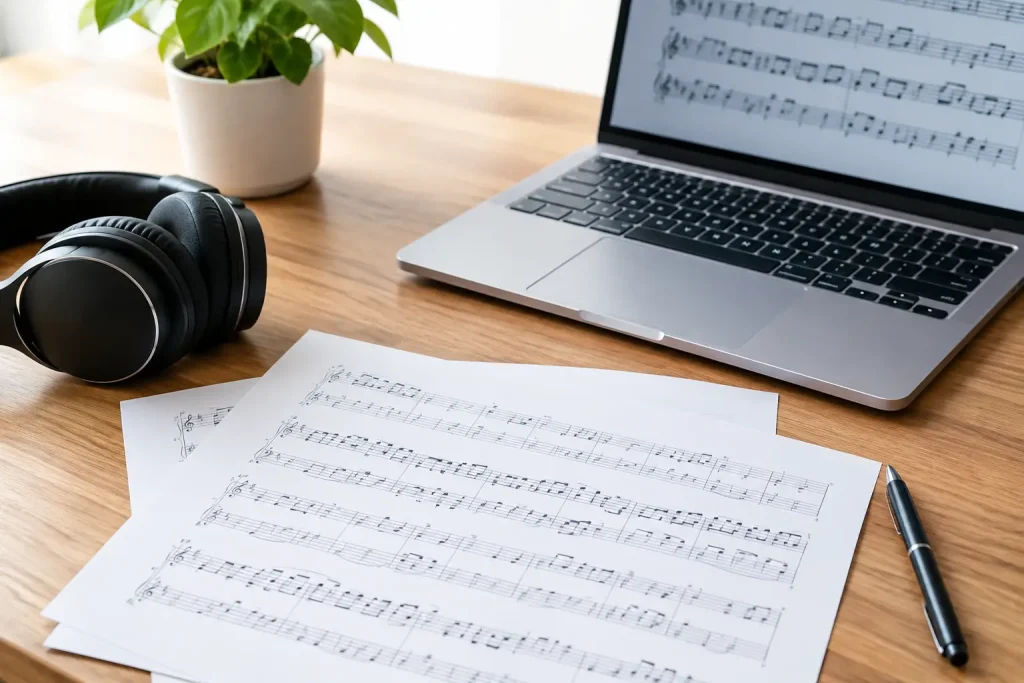
A favorite song can become part of your practice routine in minutes: find an arrangement for your instrument, purchase it, open it online, and print a copy at home.
Song licensing makes that experience legal, helping publishers and authorized retailers offer different types of music while ensuring songwriters, composers, and copyright owners are paid.
For musicians, understanding musicians and music copyright clarifies what a license allows and why a properly licensed arrangement is preferable to an unverified copy.
FreshSheetMusic.com is a source of Licensed Digital Sheet Music, with arrangements available for purchase per song and licensed for printing per copy, according to the applicable terms.
Licensing supports the wider music ecosystem; it is distinct from streaming services such as Apple Music, and some uses may require licensing or involve digital performance royalties. Choosing authorized sheet music can make easy song licensing part of a responsible music practice.
What Song Licensing Means for Sheet Music
A song is protected by copyright from the moment its original music and lyrics are created and fixed in a tangible form. The writer or rights holder controls how that work is reproduced, distributed, arranged, printed, and shared. Buying a recording does not automatically give someone the right to create or sell the notation for it.
Song licensing is the permission that allows an authorized publisher or retailer to make a specific song available as sheet music. That permission may cover a piano solo, piano-vocal-guitar arrangement, guitar tab, lead sheet, or another approved format. It helps turn a copyrighted song into notation musicians can legally purchase for personal use.
The arrangement matters here. A pop song may be available in several versions, from a simplified piano piece for a newer player to a fuller arrangement that preserves more of the original harmony, rhythm, and vocal phrasing. Each version is created and cleared for a particular use. The title may be the same, but the level, instrumentation, page count, and playing experience can be very different.
When you purchase licensed digital sheet music, you are usually purchasing personal access to that specific arrangement, along with the viewing and printing permissions described with the purchase. You are not buying the copyright to the song itself. That distinction keeps expectations clear for everyone involved.
What a Licensed Purchase Usually Lets You Do
For most home musicians, the value is straightforward: you can use the music to learn, rehearse, teach within the stated terms, or prepare for an appropriate performance. Digital delivery also means there is no wait for shipping and no need to buy a large book just to get one song you want to play this week.
A licensed purchase commonly supports personal use, online viewing, and printing for your own practice. The exact number of prints or devices, if limited, depends on the permissions attached to the individual arrangement. Before purchasing, it is smart to review the product details rather than assume every title has identical terms.
That is especially useful if you are planning for a recital, a lesson, or a regular gig. A pianist preparing a one-time performance may need a different arrangement than a singer building a set list or a guitar student looking for accurate chords and tabs. Choosing the right format first can save time and avoid buying music that does not fit the way you play.
What a Sheet Music Purchase Does Not Include
For most home musicians, a licensed purchase lets you learn, rehearse, teach within the stated terms, or prepare for an appropriate performance. With digital music, there is no wait for shipping or need to buy a large book just to find an easy song to play this week. Keep in mind that sheet music permissions differ from song licensing for recording, streaming, or using music in video; those uses may require you to obtain a license, such as a sync license, and get permission from copyright owners.
A licensed purchase commonly supports personal use, online viewing, and printing for your own practice. Any limits on copies or devices depend on the permissions attached to the individual arrangement. Review the product details rather than assuming every title has identical terms. For example, if you plan to record a song or create a new version of a song, cover song licensing may apply, and you may need to get a mechanical license for distribution in digital formats. Proper licensing helps ensure royalties are collected and distributed to music creators.
This is especially useful when planning a recital, lesson, or regular gig. A pianist preparing for a one-time performance may need a different arrangement than a singer building a set list or a guitar student looking for accurate chords and tabs. Live music venues may also need to obtain public performance licenses, such as an ASCAP license, depending on the music and circumstances. Choosing the right format first can save time and help every music user understand the permissions required for their intended use.
How to Choose the Right Licensed Arrangement
The best arrangement is not always the most detailed one. It is the one that matches your instrument, current skill level, and reason for learning the song.
If you are a beginning pianist, look for a version with manageable rhythms, comfortable hand positions, and a clear melody. A simplified arrangement can help you build confidence without losing the character that made you want to play the song. Intermediate and advanced pianists may prefer fuller textures, more original-style accompaniment, or a transcription that gives both hands more to do.
Singers should check whether the listing includes vocal melody, lyrics, chord symbols, and piano accompaniment. This can be a practical choice for working on phrasing at home, preparing with an accompanist, or leading a rehearsal. Guitar players should confirm whether they need chord charts, standard notation, tabs, or a combination of these formats.
It also helps to consider the original key. A song that sits well for one voice may strain another. If a different key is necessary, check whether an appropriate transposed version is available or whether the arrangement can be used comfortably with the adjustment you have in mind. The answer depends on the specific title and format.
Fresh Sheet Music focuses on individual licensed arrangements, so you can select the song you actually want instead of sorting through a collection that may only include one useful piece. That approach works well when a new song catches your ear, a student requests a current favorite, or an upcoming performance calls for a particular title.
Song Licensing and At-Home Printing
At-home printing is one of the most useful parts of digital sheet music. You can purchase a song when inspiration strikes, print it before your next practice session, and add it to a binder or folder of active repertoire. For teachers and learners, that speed makes it easier to respond to a changing lesson plan.
A few simple habits make printed music easier to use. Print on clear, high-quality settings so accidentals, lyrics, and smaller markings remain readable. Check that all pages have printed before sitting down at the instrument. If the arrangement runs across several pages, organize it in a way that makes page turns realistic, such as using a binder, tablet viewing option, or a planned repeat section.
Personal annotations are often the difference between merely owning a score and actually learning it. Mark tricky rhythms, circle repeated patterns, write in fingerings, or highlight a modulation that tends to catch you off guard. These notes turn the page into a practical practice tool while keeping the purchased music within its intended personal use.
When You May Need Additional Permission
Some musical situations go beyond personal practice and a standard sheet music purchase. If you plan to distribute copies to a choir, band, classroom, or large group, you may need enough authorized copies or separate permission. Recording and releasing a cover, pairing music with video, making an advertisement, or using a song in a commercial project can involve different rights and licenses.
The details depend on how the music will be used, where it will be shared, and whether the project earns money. A casual performance at home is not the same as publishing a video series, and a private lesson is not the same as supplying music to a whole studio. When the use extends beyond your own purchased arrangement, check the relevant permissions before moving forward.
That does not have to take the joy out of making music. It simply means matching the permission to the project. For everyday players, a licensed, song-specific arrangement is often exactly what is needed: accurate notation, quick access, and a legal copy ready for the music stand.
The next time a song motivates you to practice, choose an arrangement you can realistically play, print it clearly, and give it a place in your weekly routine. A page of music becomes much more valuable once it starts collecting your own notes, repetitions, and small victories.
Song Licensing FAQ: Music Licenses, Cover Songs, and Royalties
What is song licensing?
Song licensing is the process of obtaining permission to use copyrighted music. The required music license depends on how you plan to use a song, such as recording a cover, playing music in a business, or adding music to video. A musical work—the melody and lyrics—and a sound recording are separate works, so different copyright owners and permissions may be involved.
Do I need a license to record a cover song?
In the U.S., you generally need a mechanical license to record and distribute a cover song after the musical work has been released publicly with the copyright owner’s authorization. This license covers the composition, not the original master recording. If you use that recording, you’ll need permission from the owner of the master recording as well. Rules can vary by use and distribution method, so confirm which licenses are required before you release your version.
How do I obtain a mechanical license?
You can obtain a mechanical license through a music publisher, a licensing service, or—when applicable—the Mechanical Licensing Collective for eligible U.S. digital uses. The Harry Fox Agency also administers certain mechanical licenses. Check who controls the song’s mechanical rights, identify the formats and territories you plan to distribute in, and secure the license before releasing the recording.
Do streaming services cover the licensing for my cover song?
Streaming services and streaming platforms may handle certain licenses for their own operations, but that does not automatically clear every right for an artist or label releasing a cover. Your obligations can depend on whether you’re distributing a cover through a platform, selling digital downloads, or issuing CDs or vinyl. Verify that the necessary mechanical licensing is in place for your release and distribution method.
What license do I need to use a song in a video?
To pair music with visuals, you generally need a synchronization license from the owner or administrator of the musical work. If you want to use an existing sound recording, you’ll usually need a separate license from its master recording owner, often a record label. A cover recording may avoid the need to license the original master, but you still need permission for the composition and any other applicable rights.
Do I need a public performance license to play music in a business?
Businesses and venues that publicly perform music may need a public performance license. This can apply to playing recorded music, hosting live music, or using music in other public settings. Performing rights organizations such as ASCAP and BMI license public performance rights for the works they represent; a blanket license may cover a catalog, but it may not cover every song or type of use. Check the terms and repertoire before playing music.
What is the difference between a musical work and a sound recording?
A musical work is the underlying composition, usually including the lyrics and melody. A sound recording is a particular recorded performance of that composition. These are separate types of copyright, and each may have different copyright owners. For example, covering a song involves rights in the composition, while sampling or using the original recording may also require permission from the master recording owner.
Who receives royalties from song licensing?
Royalties are paid to the parties entitled to income under the relevant license, which may include songwriters, music publishers, recording artists, and record labels. Mechanical royalties relate to licensed reproductions or distributions of a composition, while public performance royalties are generally collected and distributed by performing rights organizations such as ASCAP and BMI. The type of use, agreement, and rights involved determine who is paid.
Can I legally cover a song without permission from the copyright holder?
Some U.S. cover recordings may qualify for a statutory mechanical license once the song has been released under the conditions set by law. That is not blanket permission for every use: you may need separate permission for video synchronization, changes to the composition, use of the original master recording, or other uses outside the license. Identify the rights involved and obtain the correct license before release; the Music Modernization Act and other copyright rules may affect how certain licenses are administered.