You found the exact song you want to play, chose an arrangement for your instrument, and want to start practicing tonight. Digital music licensing is what makes that quick, legal path possible. It connects songwriters, publishers, arrangers, and musicians so you can purchase authorized notation for a specific song, view it online, and print it for personal use at home.
For players, licensing may feel like a behind-the-scenes detail. In practice, it is the reason a popular song can be offered as a legitimate piano score, vocal arrangement, chord sheet, or guitar tab instead of an unverified copy with missing measures or questionable accuracy.
What digital music licensing means for musicians
A song is protected by copyright. That protection applies to the music and lyrics, and it gives the copyright owner control over how the work is copied, arranged, distributed, and used. When a retailer offers an authorized digital arrangement, it has permission to make that specific piece of notation available under defined terms.
Your purchase gives you access to the arrangement described on the listing. Depending on the product, that may include piano notation, vocal lines, lyrics, chords, guitar tabs, or a combination of these elements. It also typically includes the ability to view the music online and print it for your own practice, learning, or personal performance.
That is different from buying ownership of the song itself. You are purchasing a licensed copy for the use allowed by that purchase. The songwriter and publisher still retain their copyright, and the arrangement remains protected too.
This distinction is good for musicians as well as creators. Licensed notation supports the people who wrote and published the songs you love while giving you a clear, reliable way to learn them.
Why licensed sheet music is worth choosing
A free file can look tempting when you want to play a song immediately. But not every file posted online is authorized, complete, or written for the instrument named in the title. A piano arrangement may leave out the vocal melody. A guitar version may use inaccurate chord names. A lyric sheet may have no permission to reproduce the words at all.
Licensed digital sheet music is designed to be a usable musical product, not just a collection of notes copied from somewhere else. The listing should help you understand what you are getting before you buy: the song title, available instrumentation, arrangement details, and the format you will use for viewing and printing.
Accuracy still depends on the arrangement level. A simplified piano arrangement will not contain every detail from a studio recording, and a lead sheet is intentionally different from a full piano-vocal score. That is not a flaw when the format matches your goal. A beginner may need clear chord changes and a playable left hand. An advanced pianist may want fuller accompaniment and more of the original texture.
The value is in choosing an arrangement that helps you make music now, with permission to use the copy you purchased.
What a personal sheet music purchase usually allows
Digital music licensing is often tied to a personal-use license. In simple terms, that means the purchased arrangement is for you, not for broad sharing or resale.
You can generally use your copy to practice at home, learn a song, prepare for a lesson, or perform it personally. You may be able to print the permitted copy for your music stand, mark fingerings and dynamics, and return to the online music when you need a clean view of the score. The exact terms can vary by product and publisher, so the product details and purchase terms are always the best place to check.
Personal access does not normally mean posting the notation in a public group, emailing it to a choir, uploading it to a shared drive, or selling printed copies. A single song purchase also does not automatically give a teacher permission to make copies for every student or a bandleader permission to distribute parts to the whole group.
Those limits are not meant to make learning harder. They make it possible for authorized arrangements to keep reaching musicians at a reasonable song-by-song price.
Printing for your own setup
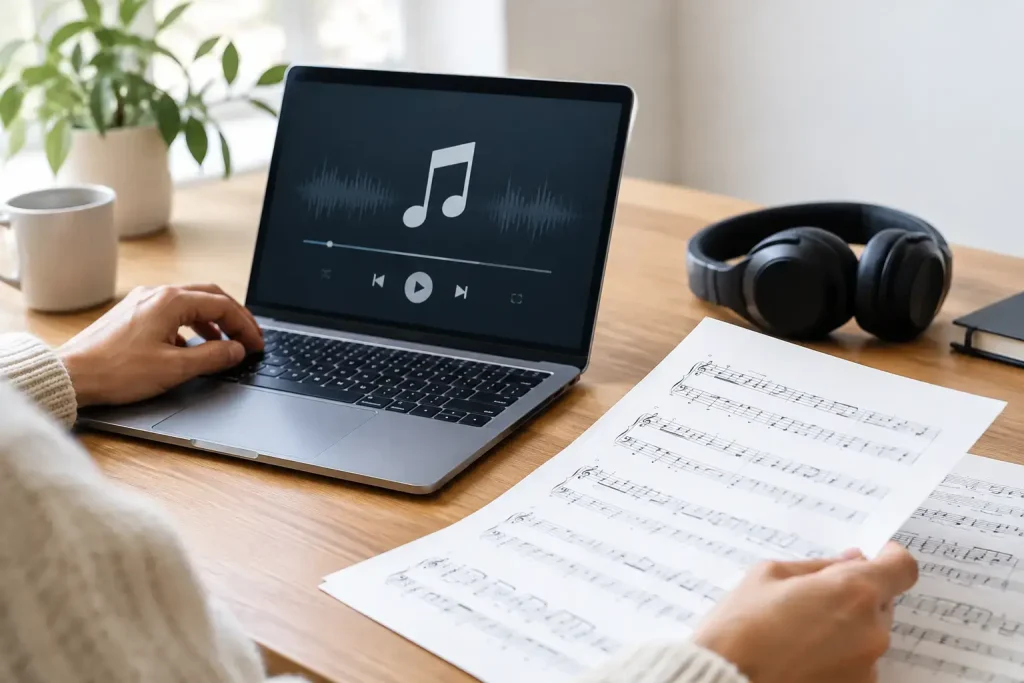
At-home printing is one of the most practical benefits of digital sheet music. You can print a copy for the piano bench, place pages in a binder, or write your own reminders directly on the page. If you are learning a challenging passage, having the score in front of you is often faster than switching between a recording, a lesson video, and a phone screen.
Still, print only within the access and printing rights included with your purchase. If you need copies for a classroom, ensemble, worship team, studio, or event, the right solution may require additional permissions.
Sharing songs versus sharing your copy
There is a big difference between recommending a song and sending someone your purchased notation. You can tell a friend which arrangement worked for you, compare practice ideas, or play the song together. But each musician who needs a copy should obtain authorized access to their own arrangement.
That keeps the process simple. Everyone receives the correct version, each player can print for their own use, and the songwriters and publishers are compensated for the work.
Digital music licensing is not the same as every music right
The word “licensing” covers several different rights in music, which can cause confusion. Buying sheet music primarily concerns the rights to reproduce and distribute the written arrangement. It does not automatically cover every possible use of the underlying song.
For example, recording a cover song for release, adding a song to a video, streaming a performance, or using music in a business can involve separate permissions. A venue, school, church, social platform, or event organizer may have its own licenses for public performance. The answer depends on where the music is used, how it is shared, and whether it is monetized.
For everyday practice and personal performance, a properly licensed arrangement is usually the straightforward place to start. If you are planning a commercial release, a large public event, or a video series, check the requirements for that specific use rather than assuming your sheet music purchase covers it.
How to choose the right digital arrangement
Before buying, start with the role the song will play in your routine. A pianist accompanying a singer needs different notation than someone playing a solo instrumental cover. A guitarist may only need chords and lyrics for a casual session, while a developing player may benefit from detailed tab.
Look at the instrument or format first, then the difficulty and arrangement style. If you are learning by ear, a chord-based version can provide a useful structure. If reading notation is part of your goal, a scored arrangement lets you connect what you hear to what you see and play. When a song feels too difficult, choosing an easier arrangement is often more productive than forcing your way through an advanced version.
It also helps to think about printing before you purchase. If you practice away from a desk or prefer handwritten notes, a printable score is more convenient than trying to keep a screen awake on the music stand. If you are working through several songs for a recital or lesson, individual licensed arrangements let you build a focused set without buying a large book for one title.
FreshSheetMusic.com is built around that kind of direct choice: find a licensed song-specific arrangement, purchase access, view it online, and print the music you need for your next practice session.
A better habit for everyday music making
Licensed digital sheet music removes a common delay from learning popular songs. Instead of waiting for a store trip or settling for an unclear copy, you can choose a format that fits your instrument and begin working on the real musical task: playing the song well.
Use the score actively. Listen to the original, identify repeated sections, circle tricky chord changes, and practice one phrase at a time. If a tutorial or cover version helps you understand the rhythm or feel, use it alongside the notation. The page gives you the structure; your practice turns it into music.
The next time a song stays in your head after you hear it, give yourself a clean starting point: choose a licensed arrangement you can print, put it on the stand, and let the first few measures become part of your routine.
Digital Music Licensing: Frequently Asked Questions
What is digital music licensing?
Digital music licensing is the process of obtaining permission to use musical works and sound recordings on digital platforms, including websites, mobile applications, streaming services, and podcasts. A musical composition and its master recording are separate forms of intellectual property, and each may have different rights holders. Before using music, identify how the work will be used and which licenses you need.
What licenses might I need to stream or download music?
A mechanical license may be required to reproduce and distribute a musical composition, while a performance license covers certain public performances or digital transmissions. In the U.S., statutory and compulsory licensing rules may apply in specific situations, including some eligible non-interactive services. Requirements vary by business type, use, and platform, so get permission from the relevant rights holders or a qualified service provider rather than assuming one license covers every use.
Do I need a license to use music in a video or on a website?
Often, yes. Using music in a video generally involves synchronization rights for the musical composition and permission to use the sound recording. Music licensing for websites can also involve performance rights when music is played or transmitted to visitors. Check with music publishers, record labels, or other rights holders, and review the terms of any digital services you use. Copyright law applies even when a video or website is nonprofit or the music is used briefly.
What do ASCAP, BMI, SESAC, and SoundExchange do?
ASCAP, BMI, and SESAC are performing rights organizations that license certain public performances of musical works and collect performance royalties for affiliated songwriters and publishers. ASCAP or BMI may offer blanket licenses that cover eligible works in their catalog, but coverage depends on the license and repertoire. SoundExchange collects digital performance royalties for featured artists and sound recording copyright owners in certain qualifying uses. These rights organizations do not necessarily clear every right needed for every digital use.
How do I know who owns the rights, and how do licensing fees work?
Rights may be split among a composer, music publishers, performers, record labels, and other rights holders. Search reliable catalog information and contact the relevant parties to confirm ownership, allowed uses, territory, and term. Licensing fees depend on factors such as audience, duration, distribution, market value, and whether the use is commercial. You may need to negotiate terms and secure separate permissions for the musical composition and master recording.
What happens if I use music without permission?
Using protected music without the required license can constitute infringement and may expose you to takedown requests, financial claims, or legal action. Credit, payment to a streaming service, or the availability of a track online does not automatically grant permission for a new use. If you have questions about music, document how the work is used and consult a qualified licensing professional or attorney before publishing.
How can I develop a music licensing strategy for digital projects?
Start by listing each use, such as streaming, broadcast, karaoke, podcasts, or music in a video. Identify the musical works and sound recordings involved, determine which intellectual property rights apply, and confirm whether existing blanket licenses cover your use. Then contact rights holders or a service provider, compare licensing opportunities, and budget for licensing fees. This process can help digital service providers and independent music creators manage permissions and generate royalties more reliably.
FreshSheetMusic.com is an official licensed digital sheet music provider. It can help you find and access licensed digital sheet music for lawful use, making it easier to work with authorized editions rather than relying on unverified copies. For projects involving performances, recordings, videos, or other digital distribution, remember that a sheet music license may not include every separate performance, synchronization, or sound recording right you need.