
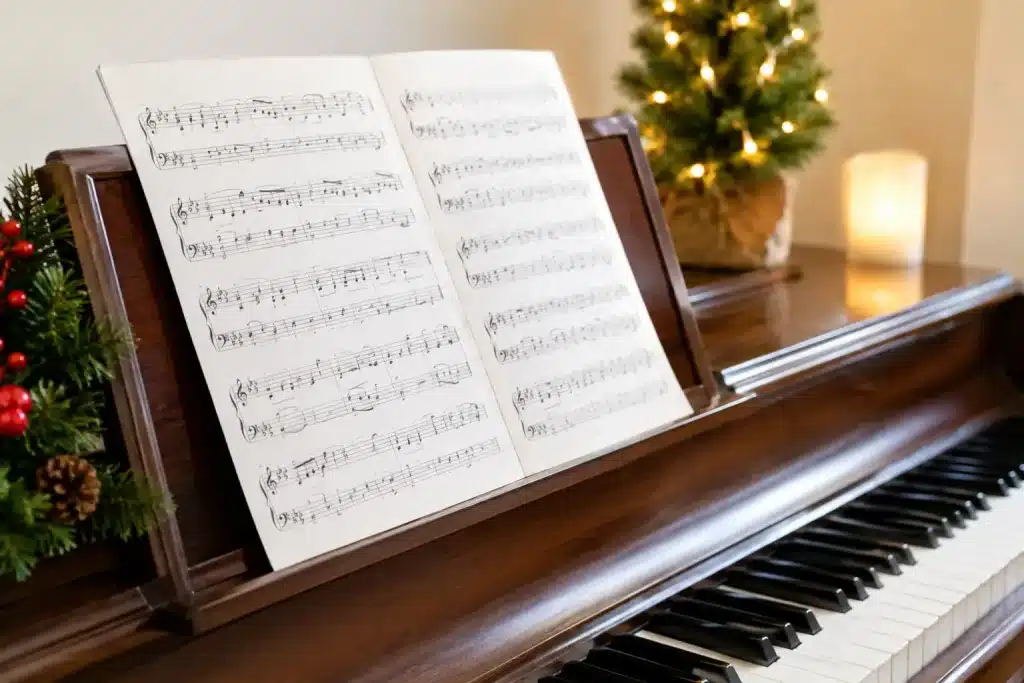
A holiday song becomes much easier to enjoy when the music is in front of you, at the right level, in a format you can use right away. With christmas piano sheet music printable at home, you can choose a song for a family gathering, a school performance, or a quiet evening of practice and start playing without waiting for a book to arrive.
The best option is not always the most elaborate arrangement. A recognizable melody, comfortable fingering, and a page layout you can read confidently often matter more than flashy runs or dense chords. Choosing individual digital arrangements lets you build a holiday repertoire around the songs you actually want to play.
Why Printable Christmas Piano Music Works So Well
Christmas music tends to arrive with a deadline. Maybe you volunteered to play at a party next weekend, your child needs a piece for a lesson, or guests are coming over and the piano suddenly needs to earn its place in the room. Digital sheet music fits these moments because you can purchase a licensed arrangement, view it online, and print it from home when you are ready.
Buying a single song also keeps your music collection practical. A large holiday book can be worthwhile if you plan to learn many standards, but it may leave you paying for dozens of pieces you will never open. Song-specific arrangements let you spend your practice time on familiar favorites that fit your style, ability, and occasion.
Printing has another everyday advantage: you can mark up your own working copy. Pencil in finger numbers, circle a tricky rhythm, write a reminder about dynamics, or highlight the spot where the verse changes to the chorus. These small notes turn a page of notation into a practice tool built around how you learn.
Choosing Christmas Piano Sheet Music Printable for Your Level
Start by being honest about what feels comfortable under your hands. A beginner can make a holiday piece sound warm and complete with a melody-led arrangement, steady rhythms, and simple left-hand support. An intermediate player may want fuller chords, moving accompaniment patterns, and an arrangement closer to the original recording. Advanced pianists might look for richer harmony, an independent left hand, or space for personal interpretation.
The label on an arrangement is useful, but it is not the whole story. Two pieces marked intermediate can feel very different. One may sit naturally in a familiar key with repeated chord shapes, while another may include wide leaps, syncopation, or several key changes. Before committing your practice time, consider the tempo, the number of pages, the amount of hand movement, and whether the rhythms look familiar.
It also helps to match the arrangement to the setting. For background music during dinner, a flowing solo that does not demand your full concentration may be the better choice. For a recital, church service, or sing-along, look for a clear melody and a dependable structure. If other people will sing, piano-vocal arrangements with lyrics can make entrances and verses easier to follow.
A simpler arrangement is not settling. Playing a piece with steady tempo, clean notes, and musical phrasing will usually make a stronger impression than struggling through an arrangement that is just beyond your current level.
How to Print Music for a Better Practice Session
A good printout should help you play, not create another obstacle. Standard letter-size paper works for many arrangements, and printing at 100 percent usually preserves the intended spacing. If the notation feels cramped, avoid shrinking it further. Instead, use a larger print setting if your printer and the arrangement allow it, or view the score on a tablet during practice.
Before printing every page, check the print preview. Make sure no staff lines are cut off at the edges and that page breaks do not create an awkward turn in the middle of a busy passage. For a multi-page piece, printing double-sided can save paper, but single-sided pages are often easier to lay flat or place side by side on a music stand.
For reliable at-home use, keep these details in mind:
- Use black ink at a clear, readable setting rather than a light draft mode.
- Print on paper that is substantial enough to turn easily without curling.
- Keep pages in order and secure longer arrangements in a binder or folder.
- Write practice notes in pencil so you can update them as the piece improves.
If you are printing a purchased digital arrangement, follow the personal viewing and printing permissions included with that music. Licensed sheet music supports the writers, composers, and publishers behind the songs while giving you a legitimate copy for your own practice and performance needs.
Turn a New Holiday Arrangement Into a Playable Song
Do not begin by trying to perform the entire piece from start to finish. First, look over the score away from the piano. Notice the key signature, time signature, repeat signs, tempo marking, and any sections that appear more than once. Holiday music often has familiar patterns, and spotting them early makes the page less intimidating.
Then learn the piece in short sections. Play the melody alone until it feels natural, especially if the tune is one your listeners will recognize immediately. Add the left hand slowly and aim for a steady pulse before worrying about full tempo. If a measure repeatedly causes mistakes, isolate it, practice the hand movement without the rhythm, then put it back into context.
A metronome can be especially useful for seasonal music because players often rush when they know the tune well. Start below the printed tempo, even if it feels almost too easy. Increase the speed only after you can play the section correctly more than once. This approach builds confidence faster than repeatedly restarting after an error.
As the notes become more secure, add the details that make the performance feel festive: softer dynamics under a vocal line, a slight lift at the end of a phrase, or a clear contrast between verse and chorus. If you are accompanying singers, leave room for them. Your role is to support the melody and keep the group together, not to overpower the room.
Make a Small Holiday Set Instead of Learning One Long Piece
For many home performances, three short songs are more enjoyable than one difficult arrangement. A small set gives you variety and lets you recover if one selection feels less comfortable on the day. You might begin with a gentle, familiar tune, follow it with something brighter, and finish with a song everyone can sing.
Choose pieces that have different energy but similar technical demands. That balance helps you move from one song to the next without needing a long reset. It is also smart to include one arrangement you know extremely well. When nerves show up, that reliable piece can settle your hands and help you enjoy the moment again.
FreshSheetMusic.com makes this song-by-song approach practical by offering licensed digital arrangements that are available for immediate online access and at-home printing. You can focus on building a set that fits your playing rather than hunting through a collection for the few pages you need.
A Better Way to Prepare for the Season
The goal of printable holiday music is not to fill a binder as quickly as possible. It is to put a song you love within reach of your hands and give it enough attention that you can share it comfortably. Pick an arrangement that suits your level, print a clear copy, and give yourself a few focused practice sessions. By the time the room fills with people, the page on your stand can feel less like sheet music and more like an invitation to make the season sound like yours.
Christmas Piano Sheet Music Printable: FAQs
Where can I find free Christmas piano sheet music?
Browse a sheet music collection of free Christmas piano sheet music, including printable PDFs for popular Christmas songs. Choose a free sheet that matches your skill level and download it for personal practice.
Which Christmas carols are available as piano sheet music?
Look for piano arrangements of “Silent Night,” “Joy to the World,” “Deck the Halls,” “Away in a Manger,” “Angels We Have Heard on High,” “Carol of the Bells,” “I Saw Three Ships,” and “It Came Upon a Midnight Clear.” Some collections also include “Ave Maria” and contemporary holiday favorites.
Can I print Christmas piano sheet music as a PDF?
Yes. Many printable scores are available as PDF files. Download the file, check that the page size and notation are clear, then print the version you need.
Is there easy piano sheet music for beginners?
Yes. Easy piano arrangements often use simpler rhythms, fewer notes, and accessible keys. They can help beginners learn a carol such as “Silent Night” or “Joy to the World.”
How do I choose the right piano arrangement?
Check whether the score is labeled easy piano, intermediate piano, piano solo, or duet. Select a version that fits your current ability, performance goals, and whether you plan to play alone or with another musician.
Can I use audio or video to learn a Christmas song?
Some sheet music pages include an audio recording or video performance. Use these alongside the printed score to hear the tempo, melody, and phrasing before practicing.
Can a piano teacher help me learn Christmas songs?
A piano teacher can help you choose suitable sheet music, understand the notation, and practice challenging sections. Piano lessons are useful for preparing a holiday performance or building confidence with a new arrangement.
What should I look for in a free Christmas piano sheet music collection?
Look for readable notation, accurate song titles, clear skill-level labels, and a convenient download format. A well-organized collection makes it easier to find a favorite carol or a festive tune to play by the Christmas tree.