
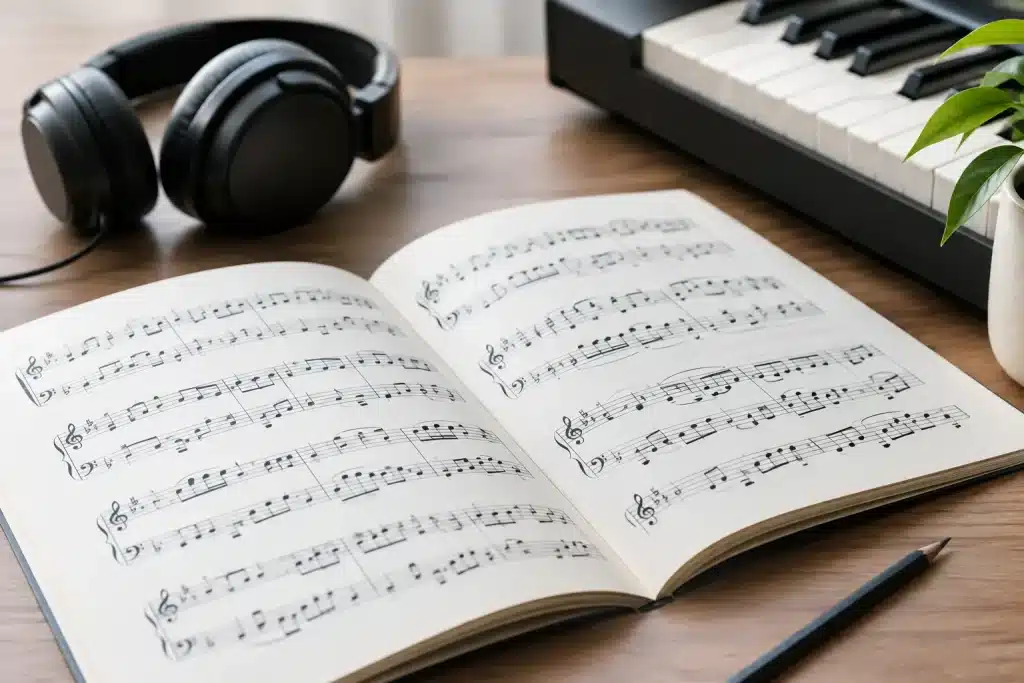
A new piece of music can look more complicated on the page than it sounds. Music notation symbols are practical directions that show the pitch of a note, the duration of a note relative to a whole note, when to repeat, and how the music should be played.
In staff notation, music is written on a staff that consists of five lines and the spaces between them; each position on the staff helps indicate the pitch. A clef is used to identify those pitches—for example, the treble clef places middle C below the staff, while a C clef can mark middle C on a particular line.
For pianists, singers, and guitarists, learning these markings turns sheet music from a page of code into a useful practice tool. Start with symbols that affect what you play most often: a vertical line separates measures, a fermata shows that a note or rest should be held, and a grace note is played briefly before the main note.
Repeat directions such as da capo, da capo al fine, and dal segno tell you where to return in the piece. You do not need to memorize every symbol before you begin; learn them as they appear in each new arrangement, including markings for cut time, percussion notation, and polyphonic music.
Why Music Notation Symbols Matter
Notes tell you pitch, but notation supplies the details that make those pitches sound like a song. The same melody can feel rushed or relaxed, quiet or powerful, detached or connected depending on the symbols around it. Ignoring those directions may still let you recognize the tune, but it can make a performance sound less complete.
This matters especially with popular-song arrangements. A piano score may show a syncopated rhythm in the right hand while the left hand keeps a steady pattern. A vocal arrangement may use a pickup note before the first full measure. A guitar part may combine standard notation, chord names, and tablature. Reading the markings accurately helps you spend less practice time guessing.
Digital sheet music also makes this easier to manage. When you can view a licensed, song-specific arrangement right away and print a working copy at home, you can mark tricky sections, circle repeats, and return to the score whenever you need a reminder.
The Music Notation Symbols You Will See First
Clefs, key signatures, and time signatures
At the beginning of a staff, the clef tells you how to read the lines and spaces. Piano music commonly uses a treble clef for the right hand and a bass clef for the left hand. Vocal melodies are usually written in treble clef. Guitar music may appear in treble clef, often an octave higher than it sounds, or in tablature.
The key signature comes next. Its sharps or flats apply throughout the piece unless a natural sign or another accidental changes a note. A key signature with no sharps or flats does not automatically mean C major – it could also indicate A minor. The song’s melody, chords, and final resting point help clarify the key.
The time signature looks like a fraction. The top number tells you how many beats are grouped in each measure, while the bottom number identifies the note value that receives one beat. In 4/4 time, for example, a quarter note gets one beat and there are four beats in a measure. In 6/8, the pulse is often felt in two larger groups, even though six eighth notes fill the measure.
Note values and rests
A note’s shape tells you its duration. Whole notes last longer than half notes, which last longer than quarter notes, eighth notes, and sixteenth notes. Filled note heads, stems, and flags are not decoration – they are a timing system.
Rests work the same way, except they tell you when not to play or sing. That silence is part of the rhythm. Beginners often count notes carefully but treat rests as empty space. Instead, count through them. A rest can create the space that makes a vocal phrase breathe or a piano accompaniment groove.
A dot after a note adds half of that note’s original value. A dotted quarter note, for instance, lasts for one and a half beats in 4/4. A tie, shown as a curved line between two notes of the same pitch, combines their values into one sustained sound. Do not re-attack the second note unless another marking tells you to.
Accidentals
Sharps, flats, and naturals are accidentals. A sharp raises a pitch by a half step, a flat lowers it by a half step, and a natural cancels a sharp or flat. Within a measure, an accidental generally applies to that same note name and octave until the bar line.
This is one place where looking ahead pays off. If you see an accidental early in a measure, remember it before playing the next matching note. On piano, that may mean choosing a black key. On guitar, it may mean shifting one fret. For singers, it means listening for a slightly raised or lowered pitch rather than relying on the key signature alone.
Rhythm and Navigation Marks
Bar lines divide music into measures. A double bar line can signal a major section change or the end of a piece. Repeat signs – dots placed beside a bar line – tell you to return to an earlier point and play that section again. If there is only an ending repeat sign, go back to the beginning or to the nearest starting repeat sign.
First and second endings prevent you from playing the same ending twice. Play the first ending on the first pass, take the repeat, then skip it and continue to the second ending. These can feel awkward at first, so it helps to trace the route with your finger before you play.
A segno sign, which resembles an S with dots, and a coda sign, which looks like a circle with a cross, provide another set of directions. You may see instructions such as “D.S. al Coda,” meaning return to the segno and later jump to the coda. “D.C.” means go back to the beginning. These markings are common in arrangements that save page space by avoiding the need to print a repeated chorus in full.
Expression Symbols That Shape the Song
In musical notation, music symbols communicate dynamics and help performers understand music. Common music symbols include p for soft, mp for moderately soft, mf for moderately loud, and f for loud; pp means very soft, while ff means very loud. Their meanings are relative rather than fixed, so an mf marking in an intimate verse may differ from mf in a full, energetic chorus. Learning music symbols and their meanings is an important part of music theory.
Crescendo and decrescendo markings instruct you to gradually get louder or softer. They may appear as words or as widening and narrowing hairpin shapes. Follow the direction across the full span instead of making one sudden change at the end.
Articulation symbols affect how a note begins and ends. A dot above or below a note usually indicates staccato, meaning the note should be played short and separated. A horizontal line indicates tenuto, asking you to hold the note for its full duration or give it gentle emphasis. An accent mark calls for a stronger attack. A slur connects two or more notes of different pitches into one smooth phrase, while a tie connects two notes of the same pitch to create one longer note.
For vocalists, slurs often show which notes belong to one lyrical phrase. For pianists, they can guide hand and pedal choices. For guitar players, a similar effect may require careful picking, hammer-ons, pull-offs, or sustained fretting. Although the technique depends on the instrument, the musical goal remains the same.
Instrument-Specific Music Notation Symbols to Know
Piano arrangements may include pedal markings, a musical symbol in written music that tells you how to shape the sound. “Ped.” tells you to use the sustain pedal, while an asterisk or release mark indicates when to lift it. Use your ears, especially when the harmony changes: holding the pedal too long can blur the pitch of the notes, even when the marking seems to cover a long passage.
Vocal scores pair musical notes with lyrics. A hyphen divides syllables across successive notes, while an underline or extended line shows that one syllable continues across a group of notes. Commas and breath marks suggest natural places to breathe. These symbols and their meanings are guides, not permission to interrupt a word or an important musical thought.
Guitar arrangements often place chord symbols above the musical staff, such as Am, G, or D/F#. These indicate harmony and can be useful even when reading tablature. Tablature uses six lines to represent strings and numbers for frets, while markings such as H for hammer-on, P for pull-off, and / or for slides show how to play the note. Because music notation symbols can vary by style of music, check the legend when one is provided.
A Better Way to Practice a Marked-Up Score
Before playing from top to bottom, scan the page for the key signature, time signature, tempo indication, repeats, and any unusual symbols. Then identify the spots where the rhythm changes or where your route through the music is not obvious. This takes less than a minute and prevents the familiar mid-song stop caused by an overlooked repeat.
Next, practice the notes and rhythm slowly enough to count accurately. Add dynamics, articulation, and pedal or phrasing once the basic pattern is stable. Separating those layers is not cheating. It is how many musicians make unfamiliar music manageable.
When you purchase an individual digital arrangement, print a copy if writing helps you learn. Add reminders such as “repeat,” “lift pedal,” or “watch accidental” only where you truly need them. Too many markings can become visual noise. The goal is a score that supports your next practice session, not a page covered in warnings.
Music notation is a set of useful instructions, not a test of how much theory you can recite. Each symbol you recognize gives you one less reason to pause and one more chance to focus on the song you came to play.
Frequently Asked Questions About Music Notation Symbols
What are music notation symbols?
Music notation symbols are written marks that show how music should be performed. They can indicate pitch, rhythm, tempo, dynamics, articulation, and other instructions for musicians.
What are the most common symbols in sheet music?
Common music notation symbols include the treble and bass clefs, note and rest symbols, time and key signatures, bar lines, accidentals, and dynamic markings such as p for piano (soft) and f for forte (loud).
What do the treble clef and bass clef mean?
A clef identifies the pitches represented by the lines and spaces on a staff. The treble clef is commonly used for higher-pitched instruments and voices, while the bass clef is generally used for lower-pitched instruments and voices.
How do note symbols show duration?
The shape of a note indicates its duration relative to the beat. For example, a whole note typically lasts four quarter-note beats in common time, a half note lasts two, and a quarter note lasts one. The exact beat value can depend on the time signature and tempo.
What is the difference between a note and a rest?
A note tells a musician to produce a sound for a particular duration. A rest indicates silence for a specified duration. Notes and rests use corresponding symbols to represent rhythmic values.
What do sharps, flats, and naturals mean in music notation?
These accidental symbols change a note’s pitch. A sharp raises a note by a semitone, a flat lowers it by a semitone, and a natural cancels a previous sharp or flat, subject to the notation’s measure and key-signature rules.
What do time signatures and key signatures tell musicians?
A time signature indicates how beats are grouped in each measure and which note value receives the beat. A key signature lists sharps or flats that apply throughout a piece or section, helping define its tonal framework.
How are tempo and dynamics shown in sheet music?
Tempo markings describe how fast to play, often using terms such as Allegro or a metronome marking. Dynamic symbols indicate volume, from very soft markings like pp to loud markings like ff.
What do articulation marks and ties mean?
Articulation marks explain how notes should be played, such as short and detached with a staccato dot or smooth and connected with a slur. A tie joins two notes of the same pitch so their durations are combined into one sustained sound.