
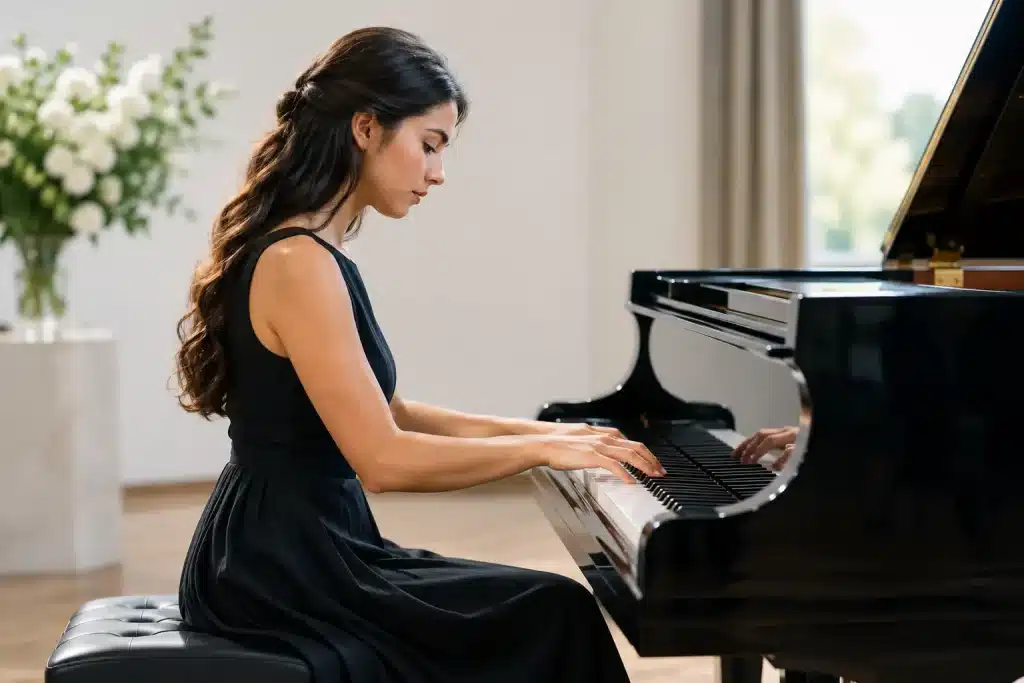
A recital piece has to do more than fill three minutes. It needs to feel comfortable under your hands, give you a clear musical story to tell, and leave enough attention free to recover if nerves show up. The best songs for piano recitals are not always the hardest ones. They are the pieces you can play with steady rhythm, shaped dynamics, and real confidence.
For many pianists, a recognizable song is a smart recital choice. Family, friends, and fellow students connect quickly when they hear a familiar melody, while the performer gets a meaningful reason to polish every phrase. The key is finding an arrangement that matches your current skills instead of choosing a song solely because the original recording sounds impressive.
How to Choose the Best Songs for Piano Recitals
Start with the occasion. A formal studio recital may call for a well-known classical work or a restrained pop ballad, while a school talent show can handle a bigger, more rhythmic arrangement. Think about your audience, but do not let their preferences override your ability level. A clean, musical intermediate performance will almost always land better than an advanced piece played with tension and missed notes.
Choose music with a melody you can bring forward clearly. On piano, the listener needs to hear the tune above accompaniment patterns, chords, or arpeggios. Also consider the ending. Songs with a definite final chord tend to feel more secure onstage than songs that fade out in the original recording.
Finally, check the arrangement details before you commit. Some piano versions preserve every vocal run, instrumental layer, and key change from the recording. Others simplify the texture while keeping the song recognizable. Neither is automatically better. The right choice is the one you can learn thoroughly before recital day.
12 Best Songs for Piano Recitals
1. “Clair de Lune” by Claude Debussy
“Clair de Lune” remains a favorite for pianists who want atmosphere and color. Its flowing phrases reward careful pedaling and patient listening rather than flashy speed. It is best for late-intermediate to advanced players, since control of balance and tone matters throughout. If you choose it, resist the urge to rush through the softer passages. The sense of space is part of the performance.
2. “Für Elise” by Ludwig van Beethoven
The opening of “Für Elise” is instantly recognizable, which makes it a dependable choice for student recitals. Beginning and early-intermediate pianists can perform an accessible version focused on the famous opening section, while more experienced players can take on the complete work. Its main challenge is not note-reading alone. Keep the repeated motif light and even so it sounds playful instead of mechanical.
3. “River Flows in You” by Yiruma
This modern piano favorite creates a full sound without requiring dense virtuoso technique. The repeating broken-chord accompaniment gives the performer a reliable pattern, while the melody provides room for expression. It suits intermediate players who are working on voicing and pedal changes. Because the pattern repeats, practice the transitions between sections carefully. Those are the moments most likely to disappear under pressure.
4. “Let It Be” by The Beatles
A strong choice for a mixed-age audience, “Let It Be” works well as a solo piano piece because its melody and chord progression are so clear. A simpler arrangement can fit an early-intermediate player, while a fuller version gives intermediate musicians opportunities to add fills, bass movement, and dynamic growth. Keep the pulse steady. This song has a calm, reassuring feel that can be lost if the tempo wanders.
5. “A Thousand Years” by Christina Perri
“A Thousand Years” is a natural fit for recitals, weddings, and community performances. Its repeating harmonic pattern makes it approachable, but the melody needs careful shaping to avoid sounding flat. Intermediate players can make a big impact by gradually building from the quiet opening toward the chorus. It is also a practical option for singers and pianists performing together, provided the piano arrangement leaves room for the vocal line.
6. “Hallelujah” by Leonard Cohen
“Hallelujah” can be simple, moving, and highly adaptable. Its familiar chord progression makes it accessible for developing pianists, especially in arrangements that place the melody in the right hand with supportive chord patterns below. The trade-off is that familiarity raises expectations. Do not treat it as background music. Make deliberate choices about phrasing, dynamics, and how long you hold the final notes.
7. “Imagine” by John Lennon
“Imagine” is an excellent recital song for a pianist who wants something recognizable but not overstuffed. The accompaniment is generally spacious, which gives beginners and intermediate players time to prepare chord changes. That space also exposes uneven rhythm, so practice with a metronome before adding rubato. Once the beat feels secure, a little flexibility can make the performance sound personal and natural.
8. “Someone Like You” by Adele
For a more dramatic pop selection, “Someone Like You” gives the pianist a memorable melody and a satisfying emotional arc. The left-hand accompaniment often repeats enough to become comfortable, while the right hand has to carry the song’s intensity without becoming heavy. It is best for intermediate players who can maintain a steady pattern while shaping a lyrical line. Plan your crescendos in advance rather than making every chorus loud.
9. “Can’t Help Falling in Love” by Elvis Presley
This is a graceful option for players who prefer a slower, elegant performance. Its melody sits naturally on piano, and arrangements can range from simple chordal versions to richer solo settings. The piece is especially effective when played with gentle, controlled timing. Take care not to drag the pauses between phrases. A calm tempo should still move forward.
10. “The Entertainer” by Scott Joplin
“The Entertainer” brings personality to a recital program. Its ragtime rhythm is cheerful, recognizable, and a refreshing contrast after several ballads. It is often a better fit for intermediate and advanced pianists because syncopation requires coordination and a dependable beat. Practice hands separately until the rhythm feels easy, then keep the left hand steady enough for the right hand’s accents to sparkle.
11. “My Heart Will Go On” by James Horner and Will Jennings
A well-chosen piano arrangement of “My Heart Will Go On” can deliver a cinematic recital moment. The melody is broad and familiar, and the song offers plenty of room for dynamic contrast. Choose this piece if you can play long melodic phrases without losing the beat underneath. It helps to mark where each phrase is heading, especially before the larger chorus sections, so the performance grows with purpose.
12. “Comptine d’un autre été: L’après-midi” by Yann Tiersen
This piece is ideal for pianists who enjoy repeating patterns and understated emotion. Its steady left-hand motion can feel comfortable after consistent practice, while the right hand asks for relaxed, even phrasing. It is generally suited to intermediate players. The biggest risk is playing every repetition exactly the same way. Small changes in volume and tone help the music breathe without interrupting its hypnotic character.
Build a Recital Performance, Not Just a Practice Piece
Once you have selected a song, practice performing it from start to finish several times a week. Stopping to fix every mistake is useful during detail work, but it does not prepare you for the feeling of continuing after a slip. Create a simple routine: walk to the bench, adjust your seat, take a breath, begin, finish, and pause before standing. Familiarity with that sequence can make a real stage feel less unfamiliar.
Memorization is optional unless your teacher or event requires it. Reading from printed sheet music is completely reasonable, especially for a first recital or a new arrangement. If you use music, make page turns part of your plan. Print a clear copy, secure the pages, and decide whether a page turn can be avoided by making a repeat or a small layout adjustment before performance day.
Record yourself early enough to make changes. A recording reveals rushed tempo, uneven melody balance, and pedals that blur more clearly than a practice session often does. Play once for a friend or family member before the event, too. Even a tiny audience changes your focus in useful ways.
A recital is a chance to share a song, not prove that you chose the most difficult one available. Pick an arrangement you enjoy returning to, give it enough time to settle into your hands, and let the music sound like yours. With licensed digital sheet music you can view and print at home, FreshSheetMusic.com makes it easier to spend less time searching and more time preparing for that moment at the piano.
Best Songs for Piano Recitals: Frequently Asked Questions
How do I choose the best songs for piano recitals?
Choose recital repertoire that suits the player’s level, interests, and confidence. A balanced whole recital might include a baroque piece by Bach, a romantic waltz or nocturne, and a lively rag or tarantella. Piano teachers can help select music that is challenging but not too difficult to play.
What are good recital pieces for a late elementary or early intermediate student?
Late elementary and early intermediate students often do well with easy piano pieces featuring clear melody notes, manageable broken chords, and opportunities to practice legato. Short works by composers such as Bober, Morin, or Mier can be great for students; a teacher duet is another fun way to build confidence on stage.
Which classical composers are popular choices for piano recitals?
Favorite composers for recital programs include Bach, Chopin, Schumann, Brahms, and Gershwin. Their music offers a wide range of styles, from baroque counterpoint to the romantic idiom and jazz-influenced rhythms. Consider the student’s level and the specific piece rather than choosing by composer alone.
Is a Chopin prelude or nocturne suitable for an intermediate student?
Some Chopin works may suit an intermediate student, but many require advanced technique and musical maturity. Selected pieces from Chopin’s 24 preludes can be more approachable than a large-scale work, although difficulty varies. A piano teacher can assess whether the fingering, phrasing, and expressive demands are a good match.
What makes a piano piece a good recital crowd-pleaser?
A crowd-pleaser often has a memorable melody, a distinctive mood, or an energetic finish. A dreamy nocturne, a gorgeous piece in E minor or G major, or a rhythmic rag can all make an excellent piece. The best choice is one the performer can play securely and communicate expressively.
Should students memorize their recital music?
Memorizing can help performers focus on expression, but it is not the only way to prepare. Students should learn the structure, harmonies, and transitions, and understand details such as an inversion, a repeated pattern, or an LH accompaniment. Piano lessons and regular practice in the piano studio can help make performance preparation more reliable.
How can piano teachers create a balanced recital program?
Piano teachers can vary tempo, mood, and musical period across the recital repertoire. Pair a lyrical waltz or valse with a brisk etude, sonata 1st movement, or pentatonic-inspired piece, and consider a duet for variety. Strong piano pedagogy balances technical growth with beautifully composed music that students enjoy learning.
What should students practice when a piece feels difficult to play?
Break challenging passages into small sections, slow them down, and work on rhythm, fingering, and evenness before increasing the tempo. Pay special attention to legato melody notes, LH patterns, and transitions between sections. Piano methods that encourage focused repetition and thoughtful listening can help students prepare new pieces without rushing.
Can improvisation be included in a piano recital?
Yes. A short improvisation can add a personal touch, especially when built around a simple pentatonic scale, a chord progression, or a familiar melody. Students might create a dreamy introduction or a brief cadenza, then connect it to a written piece. A carefully planned improvisation can feel spontaneous while still giving the performer a clear musical framework.