
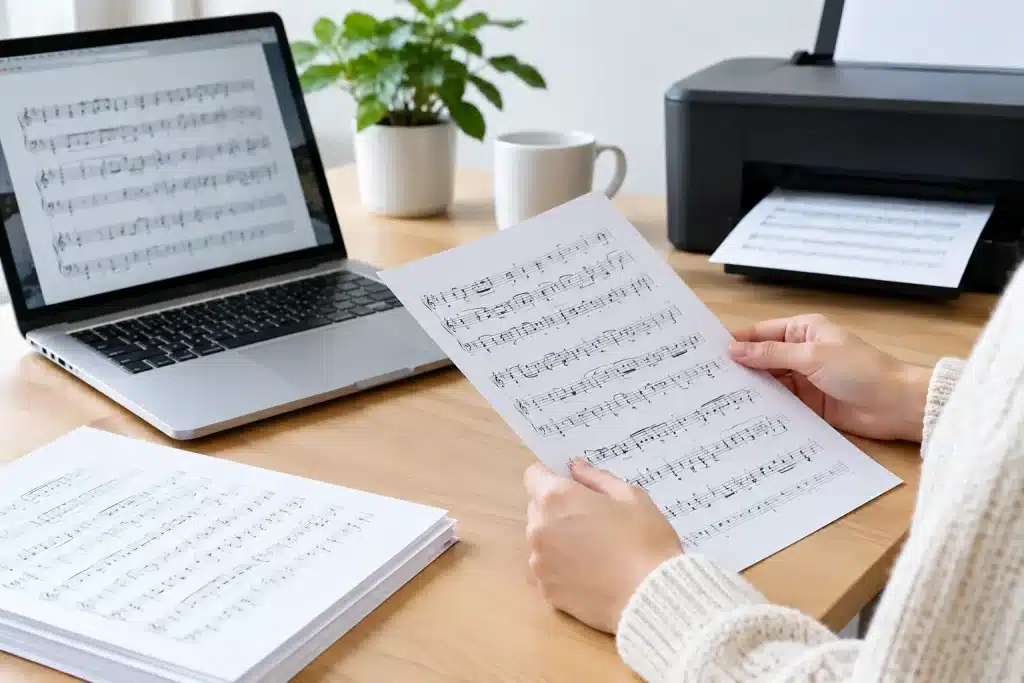
A song can be easy to find online and still not be yours to print, share, or perform from. That is why understanding what makes sheet music legal matters for every pianist, singer, guitarist, teacher, and home musician. Legal sheet music gives you a playable arrangement while respecting the writers, publishers, and arrangers behind the music you love.
For most players, this is not about navigating complicated legal language. It is about choosing a trustworthy source, knowing what your purchase allows, and avoiding the common assumption that a PDF is free to use simply because it appeared in a search result.
What makes sheet music legal?
Legal sheet music is music that is sold, distributed, or shared with permission from the copyright owner or under a valid legal exception. For a popular song, that permission typically comes through a license arranged with the publisher that controls the composition.
A song has more than one creative layer. The underlying composition includes the melody, lyrics, and often the harmonic structure written by the songwriter. A sheet music arrangement may also have its own protected elements, such as a simplified piano part, a guitar tab, a vocal layout, fingering, or an original transcription. Recording an artist performing a song is another separate right entirely.
When you buy a licensed digital arrangement, you are usually purchasing personal access to that specific notation. You can view it online and print it within the stated terms, but you are not buying ownership of the song’s copyright. Think of it as buying authorized use of an arrangement, not buying the right to republish it.
A license is the key difference
The clearest sign that sheet music is legal is that the seller has authorization to offer it. Licensing allows a retailer to make a specific song arrangement available to customers while compensating the people who own the rights.
This matters because even a carefully written score can be unauthorized. Someone may transcribe a chart by ear, type out lyrics with chords, or scan pages from a book, then upload the result. The work involved does not automatically give that person permission to distribute the song. If the original composition is still protected, sharing that transcription generally requires permission.
Licensed notation also tends to identify the song, writers, publisher, arranger, and copyright notice. Those details are not just formalities. They help show that the music has a documented source and that the arrangement was prepared for legitimate use.
For musicians, licensing has a practical upside: the score is more likely to be complete, readable, and built for the instrument listed. A legal piano arrangement should not feel like a blurry photo of a page with missing measures. It should help you sit down, print the music, and start learning.
Buying a PDF does not mean unlimited rights
Digital sheet music is convenient because you can access it immediately, view it at home, and print when you are ready to practice. But the rights included with a purchase are usually personal and limited.
Personal use commonly means you may use the arrangement for your own practice, learning, teaching preparation, or performance, subject to the seller’s terms. You may be allowed to print copies for yourself, especially if you need one at the piano and another in a practice binder. The permitted number of prints or devices can vary by provider and product, so the purchase terms are worth checking before you buy.
What personal use usually does not mean is sending the file to your band, uploading it to a shared drive, posting screenshots on social media, or selling your printed copies. Giving a friend a copy may feel harmless, but it can still be unauthorized distribution.
A useful rule is simple: if another person needs the arrangement, they should obtain their own licensed copy. That keeps access clear and helps support the writers and publishers whose work makes the song possible.
Public-domain music follows different rules
Not every piece of sheet music requires a current license. Works in the public domain can generally be copied, printed, arranged, and shared without permission because their copyright has expired or they were never eligible for copyright protection.
Still, public domain does not always mean every version you find is free to use. The original composition may be public domain, while a modern arrangement is protected. For example, the melody to an old classical work may be free to use, but a recently created beginner piano version with new fingerings, simplified rhythms, added dynamics, and original formatting can have its own copyright.
This distinction is especially useful for teachers and performers. You may be free to work from the original public-domain composition, but you should not assume that a contemporary edition can be copied without permission. Check the publication date, copyright notice, and whether the edition includes new creative material.
Why free downloads can be risky
“Free” and “legal” are not synonyms. Some free sheet music is legitimately offered by the copyright owner, publisher, arranger, or a site with permission. Other files are scans from books, copied digital purchases, or unofficial transcriptions posted without approval.
A few warning signs can help you make a quick decision. Be cautious when a file has cropped-out publisher information, a blurry scan, mismatched page sizes, visible markings from another owner, or no source information at all. Be equally cautious with a site offering every current hit as a free download with no explanation of licensing.
Quality is another consideration. An unauthorized chart may have wrong chords, incomplete repeats, missing lyrics, or awkward page turns. Saving a few dollars is rarely worthwhile if you spend your practice time correcting notation or learning the wrong version of a song.
Legal sheet music and live performance are not the same question
Owning legal sheet music does not automatically cover every kind of public performance. This is where the answer depends on the setting.
Playing a song at home is different from performing it at a ticketed venue, a restaurant, a school event, a livestream, or a video upload. Public-performance rights are often handled by the venue, event organizer, broadcaster, or platform rather than by the individual musician. A venue may have the necessary licenses for its programming, but that does not automatically cover recording the performance and posting it online.
For most individual players, the immediate concern is obtaining legitimate notation for practice and preparation. If you are organizing a concert, teaching studio, church service, or online performance, it is wise to understand who is responsible for the relevant performance permissions. The answer can change based on location, audience, and how the music is shared.
How to choose legal sheet music with confidence
Start with a retailer that clearly sells licensed, song-specific arrangements and explains how digital access and printing work. Look for accurate song credits, readable previews when available, and instrument-specific formats such as piano, voice, guitar chords, lyrics, or tabs.
Then choose the arrangement that fits your actual goal. A beginner learning a favorite chorus may need an easier piano version. A singer preparing for an audition may need a vocal-focused score in the right key. A guitarist may need chords and tab rather than a full piano-vocal arrangement. Buying one authorized arrangement that you can actually use is often more practical than purchasing a large collection that includes only a few songs you want.
Fresh Sheet Music is built around that kind of direct access: choose an individual licensed arrangement, purchase it, view it online, and print it for your personal music-making. Pairing the score with a tutorial, lesson, or cover can also make practice more focused, especially when you are learning the rhythm, voicing, or structure of a familiar song.
A better habit for everyday musicians
Legal sheet music is not just a copyright checkbox. It is a way to make your practice more reliable. You know where the arrangement came from, what you may do with it, and that the people who created the music are being recognized for their work.
When a song is worth learning, it is worth getting a version you can trust. Choose the arrangement that matches your instrument and skill level, keep your purchase for personal use, and let the page in front of you support the next hour at the piano, guitar, or microphone.
What does copyright law say about what makes sheet music legal?
Sheet music is generally protected by copyright when it contains an original musical composition, such as music or lyrics created by a composer. Copyright gives the copyright holder—often the composer, music publishers, or both—exclusive rights to reproduce, distribute, and create derivative works. The rules vary by country, so this is general information rather than legal advice.
Is sheet music in the public domain legal to print?
Public domain music can generally be printed, copied, and performed without obtaining permission for the underlying musical work. However, a modern arrangement, edited edition, or newly created original sheet may have its own copyright. Check the copyright information for the specific version you want to use.
Is it legal to photocopy copyrighted sheet music?
Photocopying copyrighted sheet music without permission may constitute copyright infringement, even if you only make one copy or use it for personal practice. Exceptions may exist under local law, but they are limited and depend on the circumstances. When in doubt, get permission or obtain a lawful copy.
Can a music teacher copy sheet music for students?
A music teacher generally cannot assume that copying pages of sheet music for a class is lawful. Educational use does not automatically permit copying music or distributing copies. You’re a music teacher? Check the applicable copyright law, the publisher’s license, and any permissions available through your school or organisation.
Is piano sheet music downloaded online legal to use?
Piano sheet music and other print music found online are legal to download only when the source is authorized or the work is in the public domain. A free download is not necessarily lawful: sites such as MuseScore may host user-created arrangements, while IMSLP primarily provides public domain and appropriately licensed materials. Check the license and whose sheet music it is before printing or sharing it.
How can I tell whether music is copyrighted?
Most original musical compositions are protected by copyright as soon as they are created and recorded or written down; a copyright notice is not always required. Look for the composer, publisher, publication date, edition details, and licensing information. Copyright duration varies by jurisdiction, so an older piece of music may still be protected, and a newer arrangement may have a separate copyright.
Can I arrange copyrighted music or make copies for a band?
Creating a derivative work, such as an arrangement of a copyrighted song, may require permission from the copyright holder. The same can apply when you make copies for a band, orchestra, or choir. A mechanical license may cover certain recordings or uses of a composition, but it does not necessarily authorize copying or distributing sheet music.
What can happen if I copy sheet music without permission?
Unauthorized copying or distribution can lead to a request to remove the material, a demand for payment, or legal action, depending on the facts and applicable law. It may also affect the livelihood of composers and publishers. To use music legally, obtain a licensed hard copy or download, confirm that the work is lawfully available, or get permission from the copyright holder.
Frequently asked questions about copyright and legal sheet music
Before you print, copy, or share music, identify the musical work and the particular edition, then check its license or copyright information. If you cannot confirm that the music is public domain or that your intended use is authorized, do not reproduce it without permission. For a specific infringement case or uncertainty about your rights, consult a qualified legal professional.