
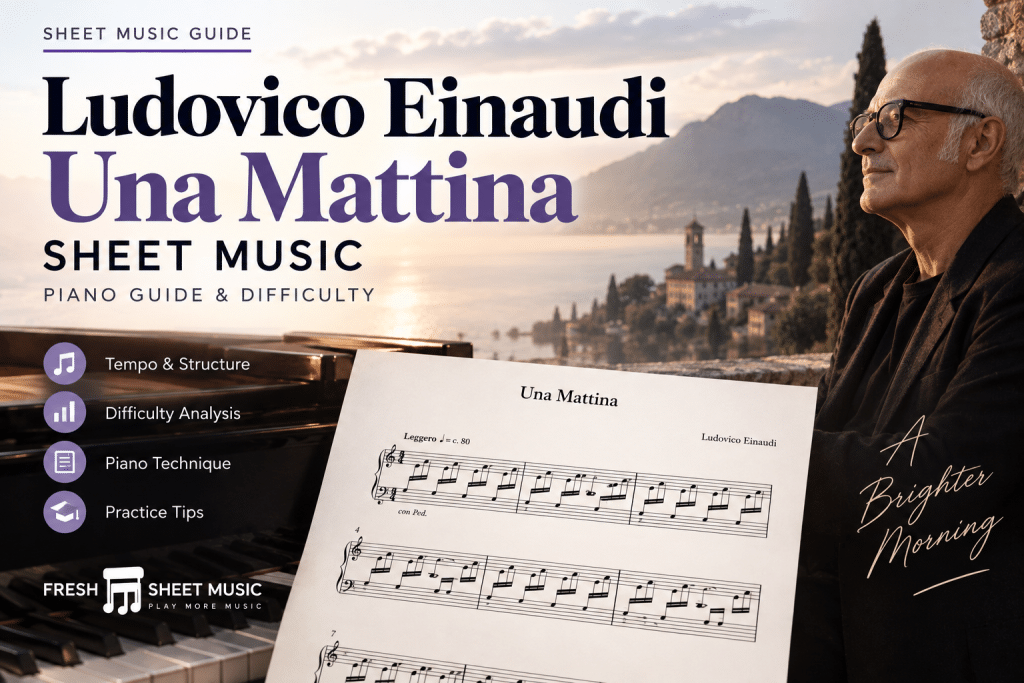
Looking for Ludovico Einaudi “Una Mattina” sheet music?
This officially licensed Educational Piano edition is a three-page score built around flowing repeated-note patterns, controlled pedal, subtle dynamic changes and the light, even touch that defines much of Einaudi’s piano writing.
|
♫
|
Reviewed by
FreshSheetMusic Editorial Team
This guide was prepared by examining the officially published sheet music, including its notation, rhythm, dynamics, pedal markings, phrasing and practical playing requirements.
|
Below, we examine the tempo, technical demands, repeating patterns, pedal use and practice strategy for this Educational Piano edition of “Una Mattina”.
View Ludovico Einaudi “Una Mattina” Sheet Music →
Ludovico Einaudi “Una Mattina” Sheet Music at a Glance
| Piece | Una Mattina |
| Composer | Ludovico Einaudi |
| Arrangement | Educational Piano |
| Pages | 3 |
| Time signature | 4/4 |
| Tempo marking | Leggero, ♩ ≈ 80 |
| Key signature | No sharps or flats |
| Main technical focus | Even sixteenth notes, hand coordination, pedal and phrasing |
| Difficulty | Early-intermediate to intermediate |
| Format | Licensed digital sheet music |
The score may look visually repetitive at first, but that repetition is precisely where the musical challenge lies. “Una Mattina” depends on an even pulse, consistent articulation and controlled shaping of repeated figures. Small rhythmic or dynamic inconsistencies become very noticeable because the texture is so transparent.
About Ludovico Einaudi’s “Una Mattina”
“Una Mattina” is the title track of Ludovico Einaudi’s 2004 album Una mattina. Einaudi’s official discography lists it as the opening track of the album. :contentReference[oaicite:2]{index=2}
Musically, the piece is built from compact melodic cells and continuously repeating accompaniment patterns rather than large virtuosic gestures. The effect comes from gradual change: harmony, register, dynamics and phrasing evolve while the basic rhythmic motion remains recognizable.
That makes “Una Mattina” a useful study in control. The goal is not simply to play many notes in succession, but to make repeated patterns sound calm, balanced and intentional.
Listen to “Una Mattina” Before You Play It
Listening before practicing is especially useful with Einaudi’s music because the notation can appear simpler than the finished performance sounds. Pay attention to the steadiness of the pulse, the way phrases rise and fall, and how the pedal connects the texture without blurring it.
The recording above is available through Ludovico Einaudi’s official artist channel and identifies the composition as part of the 2004 Una Mattina release. :contentReference[oaicite:3]{index=3}
What Tempo Is “Una Mattina” Played At?
The score is marked Leggero, ♩ ≈ 80. “Leggero” means light or lightly, which is an important performance instruction rather than simply a tempo indication.
The repeated sixteenth-note patterns should therefore remain controlled and fluid rather than heavy. A player who presses too deeply into every note can make the texture sound labored even when the metronome marking is correct.
What Key Is “Una Mattina” Written In?
This edition is printed with no sharps or flats in the key signature. The FreshSheetMusic product record itself leaves the “Original published key” field unavailable, so we would not force a key label into the product metadata without publisher confirmation. :contentReference[oaicite:4]{index=4}
For practical playing purposes, this means the pianist does not begin with a fixed key-signature accidental pattern to remember. Instead, attention can remain on the recurring note shapes, intervals and changing harmonic sonorities shown directly in the notation.
How Difficult Is “Una Mattina” to Play on Piano?
We would place this three-page Educational Piano edition around the early-intermediate to intermediate level.
The notation is not difficult because of large leaps or extreme speed. The real challenge is consistency. A convincing performance requires:
- steady sixteenth-note subdivision;
- good coordination between both hands;
- smooth transitions between repeating patterns;
- controlled pedal changes;
- dynamic shaping despite a repetitive texture;
- the ability to remain relaxed over long repeated passages.
A beginner may be able to learn the notes slowly, but producing the flowing and even character of the piece generally requires more developed control.
What Is the Piano Writing Like?
1. Repeating Sixteenth-Note Patterns Drive the Piece
The opening immediately establishes a repeating broken-note texture. Similar figures return throughout the score, creating the continuous motion associated with the piece.
Because the notes repeat in recognizable shapes, the pianist should practice them as gestures or patterns rather than reading every pitch as an isolated event.
2. The Texture Depends on Evenness
There are many consecutive sixteenth notes, but the piece should not sound hurried. Uneven accents inside each group can make the rhythm unstable.
Practice slowly enough that every subdivision feels equal, then gradually increase the tempo without changing the physical motion.
3. Pedal Is Part of the Sound
The score begins with con Ped., indicating the use of pedal. The aim is to connect the resonance while keeping the repeated figures clear.
Too little pedal can make the piece sound dry; too much can blur changes in harmony. Listen for the point where one sonority changes into the next and coordinate pedal changes with those harmonic shifts.
4. The Middle Section Changes the Texture
On the second page, the writing briefly becomes more separated between melodic material and accompaniment before returning to the familiar repeated-note pattern.
The score also uses first and second endings, so players should make sure they understand the repeat structure before attempting full run-throughs.
5. Dynamics Matter Despite the Repetition
The score includes markings such as mp, p and later pp. These changes prevent the repeated material from sounding static.
Think of the dynamics as shaping a long musical arc rather than treating each measure as an identical loop.
6. The Ending Gradually Releases the Energy
Near the end, the score marks dim. and then rit., before settling into the final sustained sonority.
The slowing should feel gradual rather than abrupt. Allow the repeated motion to relax naturally while keeping the final notes controlled.
Preview the Educational Piano Arrangement →
How to Learn “Una Mattina” on Piano
- Learn the repeating patterns away from full tempo.
Start slowly and identify which note shapes return. This reduces the amount of material you have to consciously read. - Practice each hand separately.
Make sure the sixteenth-note groups remain completely even before combining the hands. - Combine short sections.
Work in two- or four-measure groups rather than attempting an entire page at once. - Add pedal after the notes are stable.
This prevents the pedal from hiding uneven playing. - Observe the repeat endings.
Practice the first and second endings separately so that the formal structure becomes automatic. - Add dynamics gradually.
Once rhythm and coordination are secure, shape the differences between mp, p and pp. - Practice the final dim. and rit.
Avoid suddenly slowing down. Let the tempo and volume decrease together.
Is “Una Mattina” Good for Beginner Pianists?
It can be a good progression piece for an advancing beginner, but it is not ideal as a first piano piece.
The repeated patterns are visually approachable, yet playing them evenly with both hands while controlling pedal and dynamics requires coordination that a complete beginner may not yet have.
For an early-intermediate pianist, however, “Una Mattina” can be particularly useful for developing rhythmic consistency, relaxation, pedal control and musical phrasing.
Where Can I Get Official Ludovico Einaudi “Una Mattina” Sheet Music?
FreshSheetMusic offers an officially licensed Educational Piano edition of Ludovico Einaudi’s “Una Mattina”. This specific edition contains three pages and includes an online notation preview before purchase. :contentReference[oaicite:5]{index=5}
FreshSheetMusic also maintains a larger Ludovico Einaudi sheet music collection containing hundreds of arrangements for different instruments and difficulty levels. :contentReference[oaicite:6]{index=6}
Frequently Asked Questions
What tempo is “Una Mattina” played at?
This score is marked Leggero, approximately 80 beats per minute for the quarter note.
How difficult is “Una Mattina” on piano?
We would rate this Educational Piano edition around early-intermediate to intermediate. The main challenge is maintaining even repeated-note patterns while coordinating both hands, pedal and dynamics.
How many pages is the “Una Mattina” sheet music?
This specific Educational Piano edition contains three pages.
Does “Una Mattina” use pedal?
Yes. The opening of this edition is marked con Ped., indicating pedal use. Good pedal control is important for connecting the texture without making it muddy.
What does “Leggero” mean in “Una Mattina”?
Leggero means light or lightly. In practice, it suggests a relaxed touch and clear, flowing articulation rather than heavy playing.
Can beginners learn “Una Mattina”?
An advancing beginner may be able to learn it slowly, but the repeated sixteenth notes, two-hand coordination and pedal control make it better suited to players approaching the early-intermediate level.
Where can I get licensed “Una Mattina” sheet music?
The licensed Educational Piano edition is available from FreshSheetMusic with a digital notation preview before purchase.
Ready to Play “Una Mattina”?
Preview the officially licensed Educational Piano edition and explore the three-page score for Ludovico Einaudi’s “Una Mattina”.