
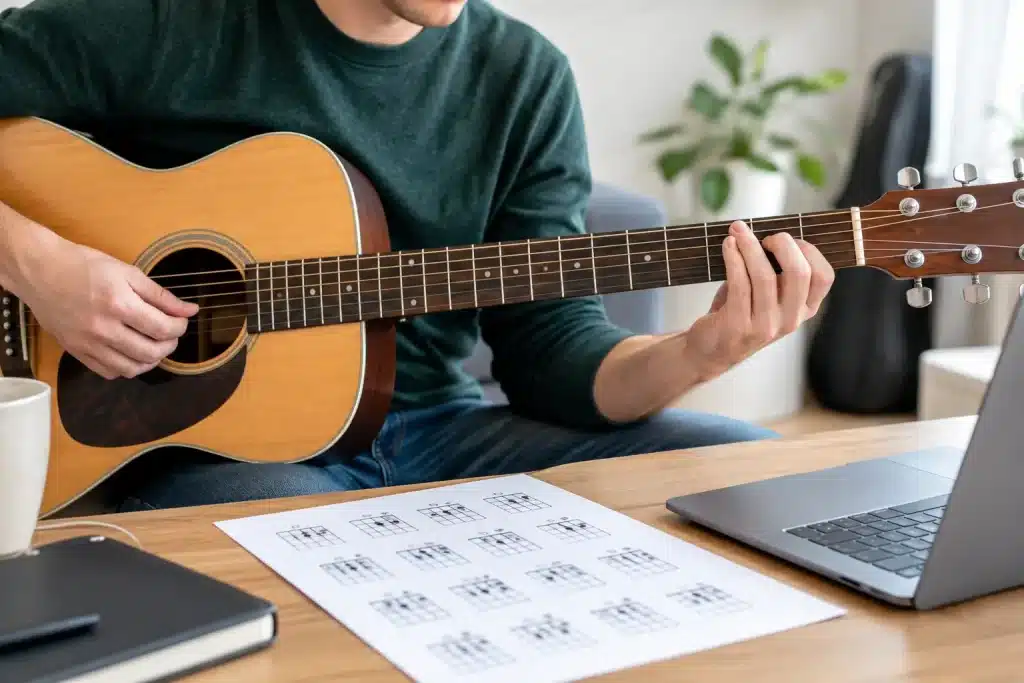
A chord chart can turn a song you know from the radio into something you can play tonight. Once you know how to use chord charts, you do not need to read every note on the page to accompany yourself, support a singer, or join a casual jam. You need to recognize the song’s roadmap, hold a steady pulse, and make clean chord changes.
For pianists, guitarists, singers, and developing accompanists, chord charts are often the fastest route from listening to playing. They are also flexible. A well-made chart gives you the harmony and structure while leaving room to choose an arrangement that fits your skill level and instrument.
What a chord chart tells you
A chord chart is a simplified map of a song. Instead of writing out every melody note, rhythm, and accompaniment pattern, it shows the chords that support each section. You may see chord names above lyrics, inside measures, or arranged in a grid.
A typical chart identifies sections such as verse, chorus, intro, bridge, and ending. Chords such as C, Am, F, and G tell you what harmony to play. Lyrics, when included, show where those changes happen in relation to the vocal line.
This is different from a fully notated piano score. Sheet music may specify exactly which notes to play, how long to hold them, and what dynamics to use. A chord chart gives you more freedom. That freedom is useful, but it also means you must make a few musical decisions yourself.
For example, a chart may show this progression:
`| C | G | Am | F |`
Each chord usually lasts one full measure unless the chart indicates otherwise. Your job is to keep counting, change chords at the right moment, and choose a rhythm or accompaniment pattern that suits the song.
Start by finding the song’s pulse
Before playing any chord, look for the time signature. Most popular songs are in 4/4, meaning you count four beats per measure: 1, 2, 3, 4. Some songs use 3/4, with a waltz-like count of 1, 2, 3, while others may use 6/8 or another feel.
A chord chart does not always spell out every beat. If one chord appears in a measure of 4/4, count four beats on that chord. If two chords appear in the same measure, they often receive two beats each. A chart may write them as `C G` or use symbols such as `C / G /` to show the subdivision.
Do not assume every chart follows the same formatting convention. Check the legend or notation notes if they are provided, and listen closely to a recording when possible. The ear is especially helpful for confirming whether a change lands on beat 1, halfway through the measure, or just before a new lyric phrase.
A useful first practice step is to clap or tap the beat while saying the chord names aloud. If you can keep the count going without playing, your hands will have an easier job when you sit down at the piano or pick up the guitar.
How to use chord charts section by section
Treat the chart like a route with signposts. Read the section labels first, then scan for repeated patterns. Popular songs often reuse the same progression in multiple verses or return to a familiar chorus. Recognizing that repetition reduces the amount you need to process in real time.
Read ahead, not just at the chord you are playing
New players often stare at the current chord until it is time to change. That creates late transitions. Instead, play the chord under your hands while looking one measure ahead. You are preparing your fingers for the next move before the change arrives.
On piano, this may mean finding the next chord shape early and selecting an inversion with minimal movement. On guitar, it may mean getting your fretting hand ready during the final beats of the current measure. Start slowly enough that you can keep your eyes moving forward.
Use the lyrics as timing cues
When chord names appear above lyrics, the chord normally changes at the syllable directly beneath it. This is one reason chord-and-lyric sheets work well for singers and singer-instrumentalists: they connect harmony to the words you already know.
Still, lyrics can be spaced unevenly on a page. Count the beat rather than relying only on visual spacing. If a line feels unclear, listen to the original song and mark the change lightly on your printed copy for your own practice reference.
Notice repeats, endings, and special directions
Charts may include repeat signs, first and second endings, a D.S. or D.C. instruction, a coda, or a note such as “repeat chorus.” These details prevent the classic mistake of ending a song while everyone else is heading back into the verse.
Take ten seconds before you play to trace the order of the sections: intro, verse, chorus, verse, chorus, bridge, final chorus, ending. You do not have to memorize the entire form immediately, but knowing the route keeps you from being surprised by a transition.
Choose chord voicings that fit your instrument
The same chord symbol can be played many ways. That is one of the biggest advantages of chord charts, but it can also overwhelm beginners. Start with the clearest, easiest version of each chord.
For piano, use simple root-position triads at first. If the left hand plays the root note and the right hand plays the chord, you can create a full sound with a straightforward pattern. As your changes become smoother, experiment with inversions. Keeping common notes between chords makes progressions sound connected and reduces hand jumps.
For guitar, use familiar open chords when they fit the key. If a song has difficult barre chords, a capo may let you use easier chord shapes while still matching the original key. That is a practical choice, especially when you are accompanying yourself or a singer.
For either instrument, you do not need to play every possible note. In a group setting, simpler voicings often sound better because they leave space for bass, vocals, and other instruments. If you are playing solo, add fuller textures only when they do not interrupt the rhythm.
Build a rhythm before adding detail
Chord charts tell you the harmony, not always the exact groove. Your rhythmic choice should support the style of the song.
A beginner pianist might play root notes in the left hand on beat 1 and chord tones in the right hand on beats 2, 3, and 4. For a ballad, you might use broken chords or a gentle repeating pattern. On guitar, start with steady downstrokes before trying a more detailed strumming pattern.
The trade-off is simple: a more elaborate pattern can sound impressive, but only if it stays in time. A basic rhythm played steadily is more musical than a complex groove that falls apart at every chord change. Record yourself or practice with a metronome to see whether the beat remains consistent.
Practice a chord chart in small passes
Do not expect to sight-read a new chart perfectly from top to bottom. Break the learning process into manageable passes.
First, identify the key and circle any chords you do not recognize. Then practice only the chord changes, without rhythm, until your hands can move between them. Next, play through each section with a simple pulse. Finally, add lyrics, melody, fills, or more stylistic accompaniment.
If a passage keeps causing trouble, isolate two measures rather than restarting the whole song. Repeat them slowly five or six times, then connect them to the measure before and after. This is more efficient than repeatedly practicing the parts you already know.
Digital, licensed arrangements are particularly useful here because you can view the chart right away, print a working copy for your music stand, and make practice notes without waiting for a book to arrive. When choosing an arrangement, make sure it matches your instrument and current level. A chord-and-lyric chart, piano arrangement, or guitar tab each serves a different purpose.
When a chord chart is not enough
Chord charts are excellent for accompaniment, songwriting, casual performance, and learning a song’s structure. They may not be enough if you need to reproduce a specific piano part, a recognizable instrumental hook, or an exact vocal rhythm. In those cases, a fully notated arrangement can show details that a chart intentionally leaves open.
You can also combine both formats. Use the chord chart to understand the harmony and form, then use notation to learn the signature parts that make the song recognizable. This approach gives you structure without sacrificing the details that listeners expect.
The best chord chart players are not the ones who add the most notes. They are the ones who keep the song moving, listen to the people around them, and make every change feel dependable. Start with the next song you want to play, keep the rhythm simple, and let each confident pass make the chart easier to trust.
Frequently Questions about How to Use Guitar Chord Charts and Notation
What is a guitar chord chart?
A guitar chord chart is a visual guide showing where to place your fingers on the strings and frets to play a chord. It often uses a grid, dots for finger positions, and symbols for open or muted strings. Chord charts are a handy road map for learning songs, especially if you do not yet read traditional music notation.
How do you read chord charts?
To read chord charts, imagine looking straight at the guitar’s fretboard. The vertical lines represent the strings, with the thickest string usually shown on the left, and the horizontal lines represent the frets. A dot marks where to press a string; numbers inside dots can indicate which finger to use. An “O” means to play a string open, while an “X” means not to play it.
How do you use a chord chart to play a chord?
Match each dot to the corresponding string and fret, then place your fingers just behind the fret. Strum only the strings indicated by the chart, keeping other strings muted if needed. Check that each note rings clearly. If a chord feels difficult, practice placing your fingers slowly before strumming.
Do you need to read music to use guitar chord charts?
No. Chord charts are designed to help musicians play chords without reading standard notation or knowing every detail of music theory. They show finger positions rather than the notes within a written staff. Learning to read chord charts can be a simple place to start before exploring traditional notation.
How are guitar chord charts used with a chord sheet?
A chord sheet places chord names above the lyrics to show when to change chords. For example, a chart might show C major, G, and Am above the words in a verse. Use the matching guitar chord charts to learn each shape, then follow the chord sheet and change chords as the song progresses.
How do you know the rhythm and number of beats for each chord?
A chord chart usually shows which chord to play, but not necessarily its rhythm or duration. Follow the song’s recording, a rhythmic notation guide, or instructions on the chord sheet to determine the number of beats. In common time, a chord may last four beats, one beat, or another duration depending on the arrangement and tempo.
What are slash chords and the Nashville number system?
A slash chord, such as C/E, names a chord followed by a bass note to play underneath it. The Nashville number system represents chords by their position in a song’s key instead of using letter names. In the key of C major, for instance, C is the I chord and G is the V chord. Both approaches can help a band transpose songs and communicate chord changes during rehearsal.
Can you use chord charts to improvise or play along with a band?
Yes. Chord charts help you follow a chord progression and play along with a singer or other musicians. Once you know the chords, you can experiment with strumming patterns, voicings, or melodic notes from the key’s scale. In jazz and other genres, a chart may provide a framework for improvising while the rhythm section maintains the tempo and bassline.
Are chord charts different for acoustic guitar and other instruments?
Guitar chord charts show finger positions across six strings and several frets, while charts for other instruments use different layouts or notation. Some guitar diagrams show only the first few frets; others mark a position higher on the neck with a number beside the grid. Always check the instrument, tuning, and chart key before playing.