
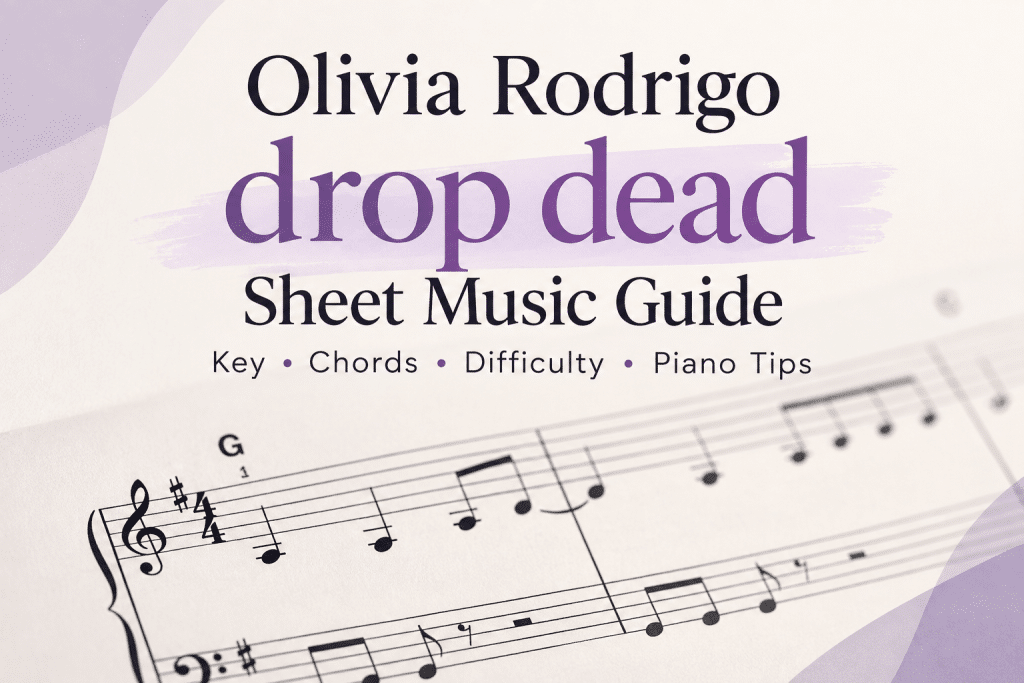
Sheet Music Guide
Looking for Olivia Rodrigo “drop dead” sheet music?
The officially licensed Really Easy Piano arrangement
is a four-page digital score designed to make the song approachable while retaining its recognizable melody, harmony and rhythmic character.
|
♫
|
Reviewed by
FreshSheetMusic Editorial Team
This guide was prepared by examining the officially published sheet music, including its notation, harmony, rhythm, arrangement and practical playing requirements.
|
Below, we explore the song’s meaning and emotional character alongside its written key, main chords, difficulty, accompaniment, optional rap section and the parts worth practicing before you start playing.
Olivia Rodrigo “drop dead” Sheet Music at a Glance
| Song | drop dead |
|---|---|
| Artist | Olivia Rodrigo |
| Arrangement | Really Easy Piano |
| Genre | Pop |
| Pages | 4 |
| Time signature | 4/4 |
| Written key | G major |
| Main chords | G, C, D and D7 |
| Difficulty | Beginner to early-intermediate |
| Format | Licensed digital sheet music |
The published arrangement is written with one sharp in the key signature and centers mainly on G, C and D-family harmony. One particularly important note appears directly on the score: the original recording is a semitone higher than the written arrangement.
About Olivia Rodrigo’s “drop dead”
“drop dead” appears on Olivia Rodrigo’s third album, you seem pretty sad for a girl so in love. The song is credited to Olivia Rodrigo, Daniel Nigro and Amy Allen.
From a pianist’s perspective, the song works particularly well in a simplified keyboard arrangement because much of its musical identity can be preserved through the vocal melody, primary harmony and a repeating bass-driven accompaniment.
Rather than reproducing every layer of the studio recording, this Really Easy Piano version focuses on the elements a pianist needs to make the song immediately recognizable.
What Is Olivia Rodrigo’s “drop dead” About? The Meaning Behind the Song
Olivia Rodrigo’s “drop dead” explores the complicated emotions that can arise when romantic attraction, vulnerability and frustration collide. The song’s provocative title suggests an emotional extreme, reflecting how strong feelings can turn an ordinary relationship conflict into something much more dramatic. Rather than treating the title as a literal statement, it can be understood as part of the song’s heightened emotional language.
One interpretation is that the song expresses the tension between wanting someone and feeling overwhelmed by that connection. Its attitude and rhythmic energy help communicate emotions that are not necessarily straightforward or comfortable. This interpretation fits Rodrigo’s broader songwriting approach, in which conflicting feelings often coexist rather than resolve neatly.
The contrast between the song’s emotional intensity and its accessible pop structure is part of what makes it interesting to perform. A catchy melody and a steady rhythmic foundation can carry feelings that are far more complicated than the music initially suggests.
What does this mean for pianists?
The emotional contrast offers a useful guide to interpretation. Keep the recurring left-hand eighth-note pattern steady while allowing the right-hand melody to sound more expressive and conversational. This helps preserve the tension between the song’s rhythmic momentum and its vocal character, even in a simplified piano arrangement.
For listeners interested in the meaning behind “drop dead,” the central idea is less about a single literal message and more about the emotional contradictions that can accompany romantic attachment. The interpretation above is an editorial reading of the song, rather than a confirmed explanation from Rodrigo herself.
Listen to “drop dead” Before You Play It
Listening to the original performance before practicing is useful because it gives you a reference for pulse, vocal phrasing and the contrast between the sung sections and the more rhythm-driven passage later in the song.
A useful practice method is to learn the notation independently first and only then return to the recording to work on timing, phrasing and overall musical feel.
What Key Is Olivia Rodrigo’s “drop dead” Sheet Music In?
This Really Easy Piano arrangement is written in G major. Its key signature contains one sharp: F-sharp.
However, the score includes an important publisher’s note stating that the original recording is a semitone higher. In practical terms, the published easy-piano arrangement has been shifted down by one half-step from the recording.
This matters if you try to play the printed score directly along with Olivia Rodrigo’s recording. Your playing will sound slightly lower even when you are reading the music correctly.
For practice, learn the score in its written key first. Once you are comfortable with the arrangement, you can explore transposition if you specifically want to match the recording.
What Chords Are Used in “drop dead”?
The arrangement uses a deliberately compact harmonic vocabulary. The most important chords are:
- G major
- C major
- D major
- D7
For a developing pianist, this is one of the arrangement’s advantages. Much of the music can be understood as movement between the primary chords of G major rather than a long sequence of unfamiliar or extended harmonies.
The D7 chord is especially useful to recognize by ear because its dominant function creates tension that naturally wants to resolve back toward G. Understanding that relationship can make the piece easier to remember than simply memorizing individual notes measure by measure.
How Difficult Is “drop dead” to Play on Piano?
We would classify this arrangement as beginner to early-intermediate.
It is published as a Really Easy Piano arrangement and simplifies several elements that could make a full transcription of a contemporary pop song significantly more demanding.
The main reasons this version is approachable are:
- a consistent 4/4 meter;
- a small group of recurring chords;
- a repetitive left-hand accompaniment;
- a clearly presented right-hand melody;
- limited harmonic complexity;
- repeated musical ideas throughout the arrangement.
A complete beginner may still need time to coordinate both hands, particularly when maintaining the left-hand rhythm underneath the melody. A pianist who already understands basic treble and bass clef reading and simple major chords should have a realistic path to learning the arrangement.
What Is the Piano Arrangement Like?
1. The left-hand pattern drives the rhythm
One of the most distinctive features of the arrangement is its recurring left-hand eighth-note bass pattern. The publisher specifically highlights this figure in the score because it helps move the rhythm forward.
This makes the left hand more important than its relatively simple notation might suggest. If the bass rhythm becomes uneven, the whole performance can lose momentum.
Practice the left hand separately until the pattern feels automatic before combining it with the melody.
2. The right hand carries the recognizable vocal melody
The right hand is primarily responsible for presenting the sung melody in a playable piano register. Because the texture is relatively uncluttered, musical phrasing becomes more important than simply playing the correct pitches.
Once the notes are secure, try to shape the melody as if you were singing it. Avoid giving every note exactly the same weight.
3. The harmony remains intentionally simple
Much of the arrangement revolves around G, C and D-family chords. This repeated harmonic framework is one reason the score is suitable for less experienced players.
Instead of treating every measure as completely new information, learn to recognize the chord changes visually. That reduces the amount of note-by-note processing required and can make the arrangement considerably easier to memorize.
4. The rap section is optional
Later in the arrangement, the notation changes to accommodate the more speech-like, rhythm-driven section of the song.
The score explicitly marks this section as optional and provides a D.S. al Fine instruction for players who want to omit it.
This is useful for beginners because you can first learn a shorter version of the piece, become comfortable with the main structure, and then add the optional section later.
How to Learn “drop dead” on Piano
If you are learning the song from this arrangement, the following practice order should make the process more efficient:
- Learn the left hand first. Practice the recurring bass figure until you can maintain an even pulse without hesitation.
- Identify G, C, D and D7. Recognizing the underlying harmony will make later measures quicker to read.
- Practice the right-hand melody separately. Concentrate on accurate rhythm, smooth movement and natural phrasing.
- Combine short sections. Work in groups of a few measures rather than repeatedly restarting the entire piece.
- Leave the optional section until later. You can initially omit the rhythmically different rap section and add it once the main arrangement is secure.
- Compare your performance with the recording. Use the original track to refine rhythm and phrasing, while remembering that the printed arrangement is written a semitone lower.
Is “drop dead” Good for Beginner Pianists?
Yes, particularly for players who have progressed beyond their very first piano lessons.
The Really Easy Piano arrangement reduces the song to its most recognizable musical ingredients while retaining enough rhythmic character to make it sound like the original song rather than a generic beginner exercise.
A player who can already read basic treble and bass clef notation, maintain a steady 4/4 pulse and recognize simple major chords should be well positioned to work through it.
Where Can I Get Official Olivia Rodrigo “drop dead” Sheet Music?
FreshSheetMusic offers the officially licensed digital Really Easy Piano arrangement of Olivia Rodrigo’s “drop dead.” The score contains four pages of music and is available online as licensed digital sheet music.
You can view the available score preview before purchasing to check the notation, arrangement style and difficulty for yourself.
Frequently Asked Questions
What key is Olivia Rodrigo’s “drop dead” sheet music in?
The Really Easy Piano arrangement is written in G major with one sharp. The score notes that the original recording is a semitone higher.
What chords are used in “drop dead”?
The simplified piano arrangement relies mainly on G, C, D and D7 chords.
What is Olivia Rodrigo’s “drop dead” about?
The song can be interpreted as exploring the emotional contradictions of romantic attraction, particularly the tension between vulnerability, frustration and intense feelings. This is an interpretation rather than a confirmed explanation from the artist.
What does the title “drop dead” mean?
In the context of the song’s emotional language, the title can be read as a dramatic expression of overwhelming feelings rather than a literal statement.
Is “drop dead” difficult to play on piano?
The published version is arranged for Really Easy Piano. We classify it as beginner to early-intermediate for a player who already understands basic notation and two-hand coordination.
How many pages is the “drop dead” piano sheet music?
This licensed Really Easy Piano edition contains four pages of music.
Can beginners learn “drop dead”?
Yes. Its recurring harmony, steady 4/4 meter and simplified accompaniment make the arrangement accessible to developing pianists.
Does the sheet music use the same key as Olivia Rodrigo’s recording?
No. The published score specifically states that the original recording is a semitone higher than this Really Easy Piano arrangement.
Where can I get licensed “drop dead” sheet music?
The officially licensed Really Easy Piano digital score is available from FreshSheetMusic.
Ready to Play “drop dead”?
If this arrangement matches your playing level, view the score preview and get the officially licensed digital sheet music from FreshSheetMusic.