
Looking for All I Want for Christmas Is You sheet music by Mariah Carey? Few modern Christmas songs are as instantly recognizable as this festive pop classic. With its sparkling piano introduction, swinging rhythm, colorful harmonies and memorable vocal melody, it has become a favorite for holiday performances.
Whether you’re preparing a Christmas recital, accompanying a singer or simply learning a seasonal favorite, the right arrangement makes a significant difference.
The seven-page Mariah Carey sheet music PDF available from FreshSheetMusic is arranged for piano, vocal and guitar, with the vocal melody, lyrics, guitar chord diagrams and fully notated piano accompaniment.
In this guide, we’ll explore the story and meaning of the song, its key and chords, the differences between its opening and main sections, piano-playing techniques, difficulty, and practical tips for learning the complete arrangement.
|
♫
|
Reviewed by FreshSheetMusic Editorial Team
Score-Based Piano and Music Analysis
This guide was prepared using the supplied seven-page Piano, Vocal & Guitar score (SKU 92535). We checked the printed songwriting credits, key signature, chord symbols, tempo changes, rhythmic notation, accompaniment patterns, repeat directions and ending options. Difficulty ratings and practice recommendations are editorial assessments.
|
Get Mariah Carey Christmas Sheet Music PDF →
All I Want for Christmas Is You Sheet Music at a Glance
| Song | All I Want for Christmas Is You |
| Artist | Mariah Carey |
| Songwriters | Mariah Carey and Walter Afanasieff |
| Original release | 1994, from the album Merry Christmas |
| Arrangement | Piano, Vocal & Guitar (Right-Hand Melody) |
| Arrangement code | PVGRHM |
| PDF length | 7 pages |
| Written key | G major |
| Time signature | 4/4 |
| Opening tempo | Moderately, approximately 82 BPM; rubato section approximately 66 BPM |
| Main tempo | Moderately fast, approximately 140 BPM, with swing |
| Difficulty | Intermediate, editorial estimate |
| Score features | Vocal melody, lyrics, piano grand staff, guitar chord diagrams, repeats, coda and optional ending |
| Product SKU | 92535 |
The Story Behind Mariah Carey’s Christmas Classic
Mariah Carey and Walter Afanasieff wrote and produced “All I Want for Christmas Is You” for Carey’s 1994 holiday album Merry Christmas.
At the time, releasing a Christmas album relatively early in a pop career was not an obvious choice. Carey later recalled initially questioning the idea, but the project became one of the defining achievements of her recording career.
The song combines contemporary pop and R&B vocals with an older Christmas-recording aesthetic. Its brisk swing feel, familiar seasonal imagery and richly layered backing vocals help it sound both nostalgic and immediately recognizable.
Unlike many holiday standards that originated decades earlier, “All I Want for Christmas Is You” became a modern addition to the Christmas repertoire.
How Did the Song Become So Popular?
The song’s popularity grew across multiple Christmas seasons rather than relying only on its initial release. It eventually reached No. 1 on the Billboard Hot 100 in December 2019, approximately 25 years after its debut.
Its seasonal return to playlists, radio and holiday performances has helped establish it as a recurring Christmas favorite.
The song’s longevity is also connected to its musical design: a strong melodic hook, a memorable rhythmic groove and a lyrical idea that is easy for listeners to understand.
Historical sources: Sony Music and Library of Congress.
What Is the Meaning of All I Want for Christmas Is You?
At its heart, the song is about valuing love and companionship above Christmas presents or material gifts.
Rather than focusing on decorations, toys or traditional holiday wishes, the narrator expresses one overriding desire: to spend Christmas with someone special.
This simple romantic message is one reason the song works beyond the usual holiday setting. Its emotional theme is universal, while the lyrics place that feeling within the excitement of Christmas.
A Love Song Wrapped in Christmas Traditions
The lyrics mention recognizable seasonal elements such as presents, the Christmas tree, Santa Claus and winter celebrations. Yet each of these images serves as a contrast to the narrator’s personal wish.
The result is both a Christmas song and a romantic pop song, which helps explain its popularity at holiday parties, concerts and seasonal events.
How the Music Reinforces the Message
The opening is comparatively intimate, with a slower, flexible tempo and a piano-led introduction. Once the main rhythmic section begins, the music becomes much more energetic.
That change mirrors the song’s emotional progression from a personal wish to an exuberant celebration.
Watch Mariah Carey – All I Want for Christmas Is You (Official Video)
Before learning the piano arrangement, listen to the official recording and pay particular attention to the transition from the rubato introduction to the faster swing groove.
Official music video from Mariah Carey’s verified YouTube artist channel. Watch directly on YouTube.
2019 Make My Wish Come True Edition
Carey also released an updated official music video in December 2019, celebrating the song with elaborate Christmas visuals and choreography.
2019 official music video. Watch on YouTube.
Both versions can help performers understand the song’s festive character, although the supplied sheet music is a practical Piano, Vocal & Guitar arrangement rather than a note-for-note transcription of every instrument in the studio recording.
What Key Is All I Want for Christmas Is You In?
The seven-page FreshSheetMusic arrangement is written in G major, with one sharp in the key signature: F-sharp.
G major is familiar to many pianists and guitarists because its basic diatonic chords are relatively approachable. However, the song goes well beyond simple three-chord Christmas music.
The printed arrangement uses chromatic harmonies, dominant seventh chords, minor-sixth colors and slash chords that contribute to its classic holiday-pop sound.
Chords Found in the Seven-Page Score
| Chord | Musical function or playing tip |
|---|---|
| G | Tonic chord; establishes the home key. |
| Em | Relative minor; adds contrast while sharing notes with G major. |
| C | Subdominant harmony; provides an important harmonic shift. |
| D / D7 | Dominant harmonies that lead naturally toward G. |
| G/B | G major with B in the bass; first inversion. |
| G/D | G major with D in the bass; second inversion. |
| Cm6/E♭ | Chromatic minor-subdominant color with E-flat bass. |
| B7 / B7♯5 | Secondary dominant and altered dominant colors leading toward E minor. |
| E7 | Secondary dominant, often leading toward A minor harmony. |
| Am7 / Am9 | Minor seventh and ninth colors that enrich the progression. |
| Am7♭5/D | Half-diminished harmony over D, creating strong dominant-related tension. |
These chord symbols are taken from the actual PDF. Their appearance in this table does not mean they should all be played in the displayed order.
A Simplified Starting Progression
For an initial harmonic warm-up, beginners can practice a simplified four-chord cycle:
This is a useful practice exercise based on the opening harmonic vocabulary, not a replacement for the complete written progression.
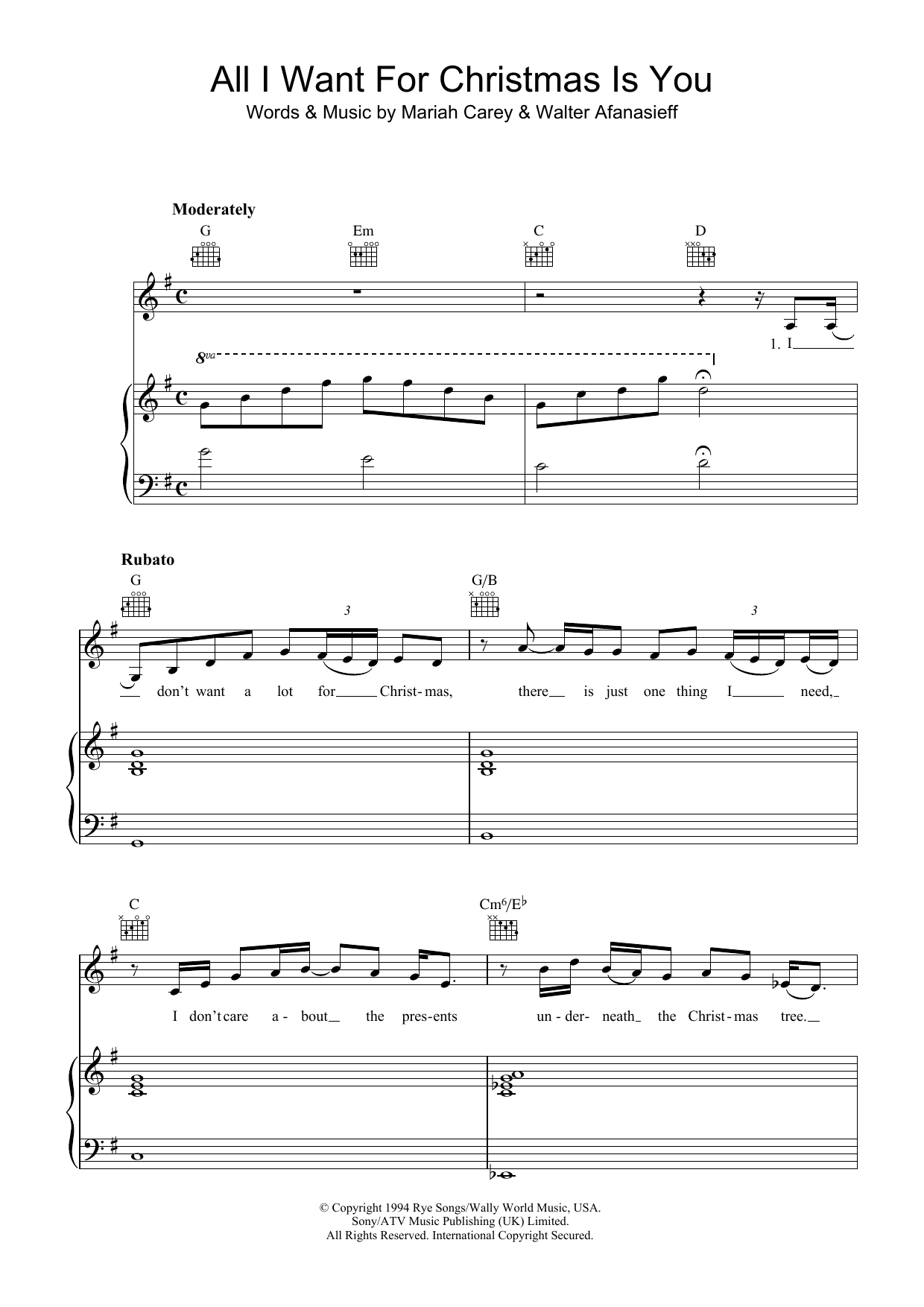
To reproduce the distinctive sound of the arrangement, pianists will eventually need the additional slash chords, chromatic harmonies and voice-leading details shown in the score.
Tempo and Rhythm: From Rubato to Christmas Swing
One of the most important aspects of playing “All I Want for Christmas Is You” is recognizing that the introduction and main section do not have the same rhythmic character.
The Opening: Moderate and Rubato
The first page begins with a moderately paced piano introduction marked approximately 82 BPM, followed by a slower rubato passage at approximately 66 BPM.
Rubato means the performer can shape the timing expressively rather than maintaining a completely rigid pulse.
For the opening, concentrate on phrasing, harmonic balance and a natural connection between the piano and vocal melody.
The Main Section: Moderately Fast With Swing
On page two, the score introduces a new tempo marking: Moderately fast, approximately 140 BPM, together with a swing indication.
The piano accompaniment becomes more rhythmic, using repeated chord patterns and triplet subdivisions.
This is the point where the arrangement takes on its characteristic upbeat holiday-pop feel.
How to Practice the Swing Feel
Rather than playing every pair of eighth notes with equal duration, develop a relaxed long-short feel where the notation and style call for swing.
Begin slowly and use the triplet subdivisions printed in the piano part to establish the groove. Avoid exaggerating the rhythm into an overly heavy shuffle.
Once the accompaniment is comfortable, increase the tempo gradually toward the score’s indicated main-section speed.
Inside the Seven-Page Piano, Vocal & Guitar Arrangement
Page 1: Piano Introduction and Opening Vocal Lines
The score opens with a right-hand piano figure supported by sustained bass notes. The written introduction leads into a rubato vocal section with chord symbols including G, G/B, C and Cm6/E♭.
The pianist should prioritize smooth phrasing and avoid rushing the expressive vocal introduction.
Page 2: Harmonic Color and the Main Tempo Change
The introduction continues through harmonies such as G/D, B7♯5, Em, E7, Am7 and Am7♭5/D.
The main rhythmic section then begins with the moderately fast swing marking. The accompaniment introduces repeated triplet-based chord figures.
This page deserves separate practice because it contains the arrangement’s most significant change in feel.
Page 3: The Main Verse Groove
The accompaniment settles into a more regular pulse. The piano bass supports the rhythm while the right hand follows the song’s harmonic movement.
The vocal staff includes alternate lyric lines for repeated sections, so performers should distinguish the written repeats from a simple linear page-by-page reading.
Page 4: Chromatic Harmony and the Refrain
The arrangement continues to use the distinctive Cm6/E♭ color before returning toward G major and the refrain.
Pay attention to the bass motion and chord inversions. Smooth transitions are more important than striking every chord with excessive force.
Page 5: Refrain, Coda Direction and Alternate Endings
This page includes a To Coda direction and first- and second-ending brackets. The piano writing alternates between sustained harmony and rhythmic accompaniment.
Mark the navigation symbols clearly before attempting a complete run-through.
Page 6: Bridge and Return Instructions
The bridge develops the festive atmosphere with lyrics about Christmas lights, children and sleigh bells.
The accompaniment supports the vocal phrases with steady bass movement and changing right-hand harmony. The page concludes with a D.S. al Coda instruction.
Page 7: Coda, Repeat and Fade, and Optional Ending
The final page contains the coda and the closing refrain. It provides both a Repeat and Fade instruction and an Optional Ending with a written final G-major resolution.
For a live Christmas recital, the optional ending may be more practical than attempting to imitate a studio fade-out.
Is All I Want for Christmas Is You Difficult to Play on Piano?
For this specific seven-page Piano, Vocal & Guitar edition, we recommend an intermediate-level pianist, although the difficulty depends on whether the player is accompanying a vocalist or adapting the arrangement for solo performance.
| Musical skill | Challenge |
|---|---|
| Basic chords | G, Em, C and D are relatively approachable. |
| Extended harmony | Seventh, ninth, altered and slash chords require preparation. |
| Introduction | Rubato timing and expressive phrasing. |
| Main accompaniment | Consistent swing and triplet-based figures. |
| Tempo | Transition into the faster 140 BPM section. |
| Score navigation | Repeats, first and second endings, D.S. al Coda. |
| Solo adaptation | Combining vocal melody with accompaniment if no singer is present. |
A beginner can start by learning the basic chord vocabulary and melody separately. However, playing the complete arrangement at the written tempo is a more substantial task.
How to Learn All I Want for Christmas Is You on Piano
The most efficient approach is to divide the score into smaller technical and musical tasks rather than attempting all seven pages immediately.
- Learn the G-major scale. Practice one or two octaves, remembering F-sharp. This helps establish the key’s basic note patterns.
- Review the core chords. Play G, Em, C and D in comfortable inversions before introducing the more colorful harmonies.
- Practice the opening separately. Focus on smooth melodic motion and expressive rubato timing.
- Study the chromatic chords. Work slowly through Cm6/E♭, B7♯5, E7 and Am7♭5/D, listening to how each harmony connects to the next.
- Build the swing accompaniment. Isolate the triplet-based figures on page two and develop a consistent rhythmic feel.
- Practice hands separately. Secure the bass movement and right-hand voicings before combining them.
- Increase tempo gradually. Begin below performance speed, then progress toward approximately 140 BPM when the accompaniment is secure.
- Mark every repeat. Identify the first and second endings, Segno, To Coda and D.S. al Coda instructions.
- Rehearse the optional ending. Prepare a clear final cadence if you plan to perform the song live.
- Record a complete performance. Listen for rhythmic consistency, harmonic balance and a convincing transition between the introduction and main section.
A Seven-Day Christmas Piano Practice Plan
For intermediate pianists who can practice approximately 20–30 minutes per day, the following plan provides a structured starting point.
| Day | Practice focus |
|---|---|
| 1 | G-major scale, basic chords and score overview. |
| 2 | Rubato introduction and expressive phrasing. |
| 3 | Main swing accompaniment, hands separately. |
| 4 | Verse accompaniment and chromatic chord transitions. |
| 5 | Refrain, bridge and rhythmic accuracy. |
| 6 | Repeat navigation, coda and optional ending. |
| 7 | Complete run-through, recording and targeted corrections. |
This is a practice framework, not a guarantee of mastering the entire score in one week. Less experienced players may need several weeks to develop the accompaniment at performance tempo.
Tips for Performing the Song at Christmas
For Piano and Voice
If you’re accompanying a singer, establish the introduction together and agree on the transition into the main tempo. Keep the piano underneath the vocal line rather than competing with it.
For Solo Piano
Because this is a Piano, Vocal & Guitar arrangement, the vocal melody is printed separately from the piano accompaniment. A solo pianist may need to redistribute notes or simplify the accompaniment to bring out the melody clearly.
For Guitarists
The score includes guitar chord diagrams, making it possible to follow the song’s harmonic structure. Some of the altered and extended chords may require additional practice or carefully chosen alternative voicings.
For Christmas Recitals
Consider using the optional written ending on page seven. A clear final G-major chord is often more effective on stage than trying to recreate the original recording’s fade-out.
Where Can I Download All I Want for Christmas Is You Sheet Music?
You can find the licensed digital All I Want for Christmas Is You Piano, Vocal & Guitar sheet music at FreshSheetMusic.com.
The seven-page edition includes the vocal melody, lyrics, piano accompaniment and guitar chord diagrams. It is suitable for musicians who want a more complete arrangement than a basic chord chart.
The product listing identifies the arrangement as PVGRHM, with SKU 92535, and provides a score preview so you can examine the notation before ordering.
Check the product’s current purchase, download, printing and transposition options before completing your order, as interactive features can depend on the edition and viewer.
Frequently Asked Questions About All I Want for Christmas Is You Sheet Music
What key is All I Want for Christmas Is You in?
The seven-page FreshSheetMusic Piano, Vocal & Guitar arrangement is written in G major, with one sharp in the key signature.
What are the main piano chords?
The score includes G, Em, C, D, G/B, G/D, Cm6/E♭, B7, B7♯5, E7, Am7, Am9, Am7♭5/D and D7. The complete arrangement uses these harmonies in different sections.
Is the song easy to play on piano?
The basic chord vocabulary is accessible, but the complete seven-page arrangement is better suited to intermediate pianists because of its swing rhythm, extended chords, tempo changes and repeat structure.
Who wrote All I Want for Christmas Is You?
Mariah Carey and Walter Afanasieff wrote the song, originally released in 1994.
What album is the song from?
It was released on Mariah Carey’s 1994 Christmas album Merry Christmas.
What is the time signature?
The arrangement is written in 4/4 time, with a swing feel in the faster main section.
What tempo should I use?
The score begins moderately at approximately 82 BPM, moves into a rubato section around 66 BPM and then introduces a moderately fast swing section at approximately 140 BPM.
Does the sheet music include guitar chords?
Yes. The Piano, Vocal & Guitar edition includes chord symbols and guitar chord diagrams alongside the vocal and piano notation.
How many pages are in the sheet music PDF?
The edition available from FreshSheetMusic contains seven pages.
Where can I get the sheet music PDF?
The licensed seven-page Piano, Vocal & Guitar edition is listed at FreshSheetMusic.com.
Play Mariah Carey’s Christmas Classic This Holiday Season
Learn the festive piano accompaniment, colorful G-major harmonies and upbeat swing rhythm of “All I Want for Christmas Is You.” Explore the licensed seven-page Piano, Vocal & Guitar arrangement and start preparing your Christmas performance.