
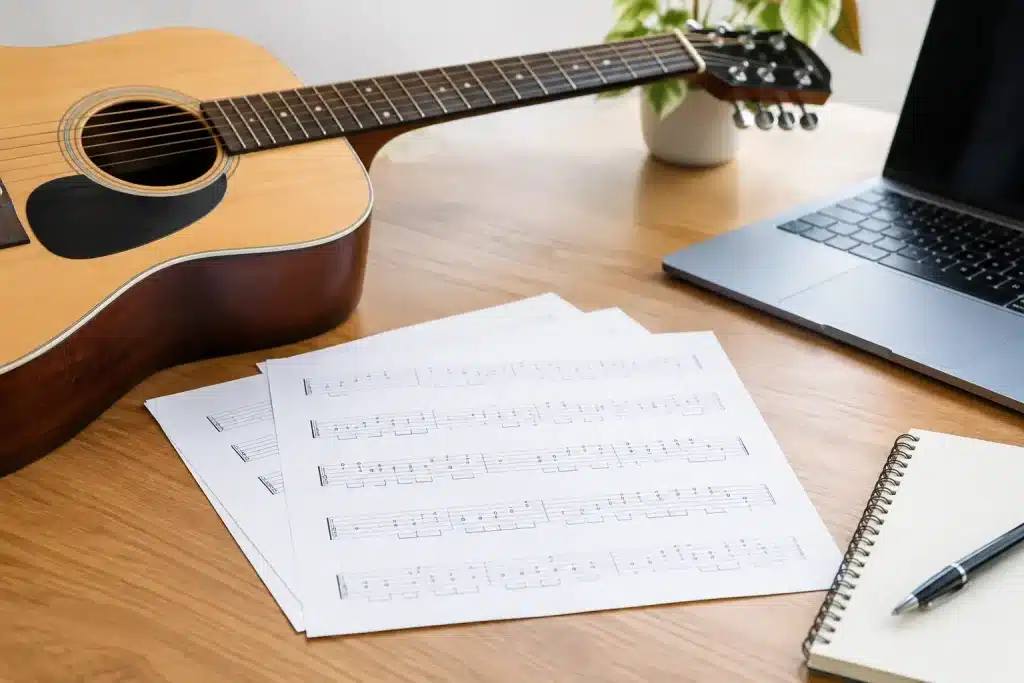
A song can sound simple until you sit down with your guitar and try to find the exact riff, chord voicing, or turnaround by ear. Printable guitar tabs for songs give you a practical starting point: a playable map of what your hands need to do, ready when you are ready to practice.
For many guitarists, the best arrangement is not the most complicated one. It is the one that matches the version of the song they want to play, fits their current ability, and can be printed clearly for a lesson, rehearsal, or relaxed session at home. Digital, song-specific notation makes that process much easier than searching through a large book for one title.
Why Printable Guitar Tabs for Songs Help You Practice Better
Guitar tab shows the strings and frets directly, which makes it especially useful for learning recognizable riffs, lead lines, fills, and chord shapes. Instead of translating standard notation into fretboard locations in real time, you can see where to place your fingers and begin working on the sound right away.
That does not mean tab is only for beginners. Intermediate and advanced players often use it to check a recorded part, learn a specific lick, or compare alternative positions for the same notes. A well-prepared arrangement can also include chord names, lyrics, rhythmic notation, technique markings, and standard notation, depending on the song and the format offered.
Printing matters because a physical page changes how you practice. Your music stays visible beside the guitar instead of disappearing behind another app, notification, or screen lock. You can mark difficult measures, circle repeats, write in a capo reminder, and make notes about picking direction or fingerings as you learn.
Start With the Arrangement, Not Just the Song Title
Two listings for the same song may serve very different players. One may be a full guitar transcription with detailed riffs and rhythm figures. Another may focus on chords and lyrics for singing while strumming. Neither is automatically better. The right choice depends on what you need to play.
If you are preparing for a casual sing-along, a chord-based arrangement may be the most useful and affordable option. If you want to recreate a memorable intro or solo, look for guitar tab that includes the instrumental details. Players working on reading skills may prefer an arrangement that pairs tablature with standard notation.
Before purchasing, check the instrument designation and arrangement description. Ask a few simple questions: Is this written for guitar? Does it include tab, chords, lyrics, or notation? Is it close to the level and style of the performance you have in mind? A song can be playable in several keys, tunings, and capo positions, so the original recording is not always the most comfortable place to start.
An easier arrangement is not a shortcut in the negative sense. It can help you learn the song’s form, harmonic movement, and feel before taking on harder details. On the other hand, simplifying a signature riff too far can make the part less satisfying. Choose the version that supports your actual goal.
Choose Licensed Music You Can Use With Confidence
Popular songs are copyrighted works, even when chord charts and tabs seem easy to find online. Unofficial copies can be incomplete, inaccurate, difficult to read, or shared without permission. They may also leave out the notation details that make a part sound right.
Licensed digital arrangements offer a clearer route. You buy access to a specific composition, view it online, and print it for personal use according to the terms provided. That supports the writers and rights holders behind the music while giving you a dependable resource for everyday playing.
FreshSheetMusic.com is built around this song-by-song approach. Rather than buying a whole collection for one tune, musicians can choose an applicable licensed arrangement and access it immediately after purchase. That is helpful when a lesson, rehearsal, audition, or family gathering is coming up sooner than a shipping box could arrive.
Print a Page That Works at the Music Stand
A readable printout starts with the source file, but a few practical choices make a real difference. Preview the music first so you know how many pages you need and where page turns will happen. If your printer gives you scaling options, avoid shrinking the notation so much that fret numbers and chord symbols become hard to read.
Standard letter-size paper is usually the easiest choice for home printing. Use portrait or landscape orientation only if the arrangement is designed for it. For a multi-page song, print on one side when possible. Turning a page is usually easier than flipping paper over while holding a pick and keeping time.
Keep the printout clean at first, then add your own useful marks after a practice run. Write the tempo at the top, flag a repeat you tend to miss, or note the capo fret in large letters. If a song has an awkward page turn, you may be able to tape pages together for rehearsal or place them side by side on a wider stand.
Avoid relying on a blurry screenshot or a compressed image. Clear spacing, accurate symbols, and legible fret numbers reduce mistakes before they become habits. When the page is easy to scan, you can spend more attention on timing, tone, and musical phrasing.
Turn Tab Into a Repeatable Practice Plan
Reading the whole page from top to bottom is rarely the fastest way to learn a new song. Start by listening closely to the section you want to play. Notice the pulse, where the guitar enters, and whether the part is strummed, picked, muted, sustained, or layered with other instruments.
Then work in small sections. Learn the chord shapes or fret positions without worrying about speed. Play the rhythm slowly until the movements feel steady, then connect two measures at a time. If a phrase falls apart, reduce the tempo rather than repeating the mistake at full speed.
Tab tells you where notes are played, but the recording tells you how they feel. Pay attention to articulation such as slides, bends, hammer-ons, pull-offs, palm muting, and rests. A correct fret number played with the wrong timing or touch can still sound unlike the song.
For rhythm guitar, practice the chord changes separately from the strumming pattern. For lead parts, isolate the tricky transitions rather than replaying the entire solo. When a section becomes reliable, play it with the recording or a backing track. This is where the printed page becomes a reference instead of a crutch.
Use Your Printout Beyond Solo Practice
A printable arrangement earns its place in your music folder when it helps in more than one setting. Bring it to a lesson so your instructor can point out efficient fingering or alternate voicings. Keep a marked copy for band rehearsal, especially if the song has clear cues, stops, key changes, or endings that need agreement.
It is also useful for singers who play guitar. Lyrics and chord symbols can help you coordinate vocal phrasing with chord changes, while tab can preserve a distinctive intro or instrumental hook. If you teach, a printed song arrangement can give a student a concrete short-term goal instead of another abstract exercise.
Just remember that printable music works best as a living practice tool. Update your markings as your understanding improves. You may begin by counting every beat, then later highlight only the places that still need attention.
The goal is not to collect more tabs than you can play. Choose one song you genuinely want to hear yourself perform, print an arrangement that fits your level, and give it a focused place on the stand. A few intentional practice sessions can turn a familiar recording into music that feels like your own.
Frequently Asked Questions About Printable Guitar Tabs for Songs
What is a guitar tab?
A guitar tab, or tablature, is a simple form of music notation that shows which strings and frets to play. Unlike standard sheet music, a guitar tab is designed around the guitar, making it a useful resource for beginners and experienced players alike.
Where can I find printable guitar tabs for songs?
Explore a collection of printable tabs for popular songs, including rock favorites and easy guitar arrangements. Check that the tab is clear, complete, and suitable for your skill level before you print or download it.
Can I download guitar tabs as a PDF?
Many guitar tab resources are available as a PDF download. A PDF format preserves the layout on different devices, so you can print the sheet or view it digitally while you practice.
Are free guitar tabs available?
Yes. You can find free guitar tabs and free sheet music online. Availability and permitted use vary, so review each resource’s terms before you download, print, or share a song arrangement.
How do I read a guitar tab?
A standard guitar tab uses six horizontal lines to represent the strings. Numbers indicate the frets to play, while symbols may show techniques such as slides, bends, or hammer-ons. Some tabs also include chord diagrams, rhythm guidance, or standard notation.
Are printable guitar tabs good for beginners?
Printable tabs can help a beginner learn a favorite song at a comfortable pace. Start with an easy arrangement, check any chord diagrams, and practice a short section slowly before trying to play along with the music.
What is the difference between a guitar tab and sheet music?
Sheet music uses standard notation to show pitch and rhythm, while a guitar tab focuses on string and fret positions. Some resources combine both formats, helping a student connect tablature with traditional music notation.
Can I make my own tab sheet?
Yes. Use a blank guitar tab template or blank tab sheets to write down an arrangement, chord changes, or a musical idea. A printable template is useful for students, teachers, and composers who want a simple practice record.
How can I choose the best printable guitar tab?
Look for a quality tab with readable notation, accurate chords, and a clear arrangement. Choose a version that matches your playing level and instrument, then print it or keep it open on a digital device to start playing.