
Looking for Jingle Bells sheet music by Michael Bublé, arranged by Mac Huff? This energetic Christmas choral arrangement transforms a familiar holiday classic into a fast-swing showcase filled with close vocal harmonies, syncopated rhythms and playful exchanges between singers.
Inspired by Michael Bublé’s recording featuring The Puppini Sisters, this edition is designed for SATB choir and piano with optional instrumental accompaniment. It is especially suited to Christmas concerts, school and community choirs, and ensembles looking for a festive swing arrangement.
The licensed Jingle Bells SATB sheet music available from FreshSheetMusic features four-part choral notation, piano accompaniment, jazz-influenced harmonies and performance directions.
This guide examines the history behind the arrangement, its musical characteristics, choir difficulty, rehearsal strategies and practical performance considerations.
Reviewed by FreshSheetMusic Editorial Team
This guide is based on the supplied SATB and piano score for Jingle Bells, adapted for publication by Mac Huff. The editorial review considered the printed credits, vocal scoring, tempo, key signature, chord symbols, rhythmic writing, dynamics, rehearsal marks and closing sections. Difficulty estimates and rehearsal recommendations are editorial judgments.
Get Jingle Bells SATB Sheet Music PDF →
Jingle Bells SATB Sheet Music at a Glance
| Song | Jingle Bells |
| Recording artist | Michael Bublé featuring The Puppini Sisters |
| Original composer | James Pierpont |
| Arrangement credits | David Foster, Patty Andrews and Victor Schoen |
| Publication adaptation | Mac Huff |
| Scoring | SATB choir and piano |
| Optional parts | Instrumental combo parts available separately |
| Key signature | One flat |
| Time signature | 4/4 |
| Tempo | Fast swing, approximately 123 BPM |
| Duration | Approximately 2:35 |
| Music pages | 14 numbered pages, 2–15 |
| Difficulty | Intermediate to advanced choir (editorial estimate) |
| Product SKU | 96996 |
The Story Behind Michael Bublé’s Jingle Bells
“Jingle Bells” is one of the world’s most recognizable Christmas songs. Written by James Pierpont in the nineteenth century, the melody has been adapted into countless styles, from traditional holiday singing to jazz, big-band swing and contemporary pop.
Michael Bublé recorded his interpretation with The Puppini Sisters for his 2011 album Christmas. Rather than presenting the tune as a straightforward singalong, the recording emphasizes rhythmic energy, vintage vocal-group harmonies and playful interaction between performers.
The Puppini Sisters’ close-harmony style complements Bublé’s jazz-influenced vocal approach. Together, they evoke the lively sound of earlier swing-era vocal groups.
How Does Mac Huff Fit Into the Arrangement?
The published choral score credits James Pierpont as the original composer. It identifies David Foster, Patty Andrews and Victor Schoen in the arrangement credits and states that Mac Huff adapted the music for publication.
These credits describe different musical roles. Mac Huff’s contribution is the published choir adaptation, which makes the recording’s vocal style accessible to SATB ensembles through written parts and rehearsal-ready notation.
The resulting score retains the spirited swing character while providing singers and accompanists with a coordinated concert arrangement.
Sources: Hal Leonard choral edition and Michael Bublé’s official studio feature.
What Is the Meaning of Jingle Bells?
Unlike many Christmas carols with explicitly religious themes, “Jingle Bells” describes the excitement of a winter sleigh ride.
Its appeal lies in movement, celebration, humor and the shared enjoyment of a festive experience. The familiar refrain emphasizes the cheerful sound of sleigh bells and the pleasure of traveling through snowy surroundings.
Michael Bublé’s version amplifies that playful character through musical dialogue, rhythmic surprises and energetic vocal harmonies.
For choirs, the most important interpretive goal is not simply singing the correct pitches. Performers should communicate the excitement and theatrical personality of the arrangement.
Watch Michael Bublé – Jingle Bells Featuring The Puppini Sisters
Before rehearsing the SATB score, listen to the official recording. Focus on the relationship between the lead vocal and the close-harmony responses, the swinging rhythmic feel and the contrast between solo and ensemble passages.
Official Michael Bublé video, published December 5, 2017. Watch on YouTube.
The studio recording is a useful stylistic reference, but the printed SATB edition should remain the primary source for exact pitches, rhythms, dynamics and ensemble entrances.
Musical Analysis: Swing Rhythm, Harmony and SATB Texture
1. Fast Swing Rhythm
The score begins with the marking Fast swing, approximately 123 beats per minute. It also includes a swing interpretation indication for eighth notes.
Although the time signature is 4/4, the rhythmic character is different from straight eighth-note pop music. Singers and pianists need a shared sense of swung subdivisions and a relaxed but forward-moving pulse.
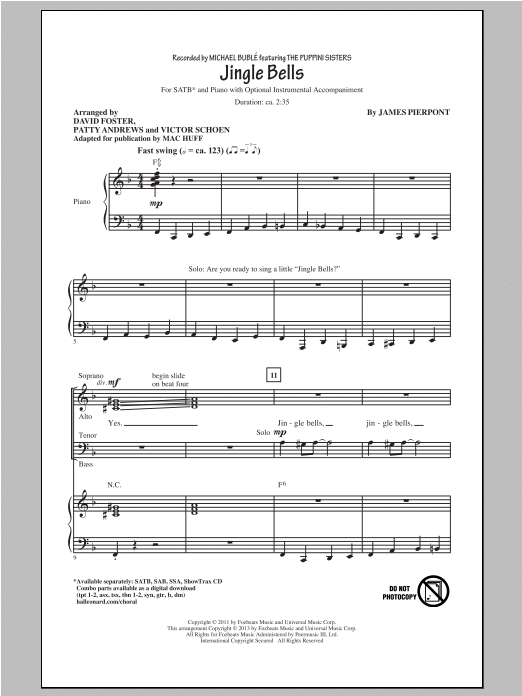
The arrangement includes syncopated attacks, rests and short rhythmic figures. These details are essential to its jazz-influenced character.
2. Jazz-Influenced Chord Vocabulary
The score uses harmonies associated with swing and jazz accompaniment, including major-sixth chords, minor sevenths, dominant sevenths, slash chords and diminished sonorities.
| Harmony | Musical significance |
|---|---|
| F6 | Adds a characteristic major-sixth color to the home harmony. |
| B♭6 | Creates a warm subdominant-area sound. |
| C7 | Dominant seventh harmony that provides forward tension. |
| Gm7 | Minor-seventh harmony frequently associated with predominant motion. |
| Gm7/C | Creates a suspended dominant-related sonority over C. |
| Diminished chords | Provide chromatic movement and transitions between harmonies. |
These are selected examples from the score rather than a complete, continuous chord progression. The piano part contains additional harmonic detail that should be read directly from the notation.
3. Four-Part Vocal Harmony
The SATB arrangement uses soprano, alto, tenor and bass voices, but not every section is written as four independent lines throughout.
At different points, the music alternates between solo-led phrases, unison writing, divided voice parts and fuller choral textures. This variety creates contrast and allows the familiar melody to remain clear.
Choir directors should pay particular attention to close-spaced chord tones, accurate intonation and balanced dynamics. In swing music, a beautifully tuned chord can lose its impact if the singers do not enter together.
4. Call-and-Response Writing
One of the arrangement’s most entertaining characteristics is its use of conversational musical exchanges.
The score begins with a spoken-style solo cue, followed by a choral response. Later sections use short rhythmic vocal figures, echoes and overlapping lines to build excitement.
These moments work best when singers understand which part is carrying the main idea and which parts are responding or providing background texture.
5. Piano Accompaniment
The piano introduction establishes the swing pulse through repeated bass movement and compact right-hand harmony.
Throughout the arrangement, the accompaniment provides rhythmic stability and harmonic support, while the voices supply much of the theatrical character.
The pianist should avoid making every beat equally heavy. Light articulation, clear bass movement and rhythmic coordination with the choir are more effective than excessive volume.
Inside the SATB Score: Key Rehearsal Sections
Opening: Piano Groove and Vocal Introduction
The opening establishes the fast swing character. The piano introduces the rhythmic foundation before the singers enter with a playful spoken-style exchange.
A tenor solo begins the recognizable melody near measure 11. Choir directors should rehearse the introduction and solo entrance together to ensure that the swing feel remains continuous.
Measures 27–43: Verse Development and Ensemble Entrance
The score develops the familiar winter-sleigh narrative with solo singing and piano support. Around measure 43, the texture becomes fuller as upper voices enter more prominently.
These passages require careful attention to changes in vocal scoring and dynamic levels.
Measures 59–91: Layered Refrains and Rhythmic Contrasts
The arrangement introduces additional vocal layers and rhythmic exchanges. Different voice groups contribute short phrases while the piano maintains harmonic continuity.
At approximately measure 91, the score calls for a gradual crescendo, creating momentum into the following passage.
Measures 99–123: Dynamic Build and Choral Coordination
The music continues to alternate between solo-led and fuller choral writing. Changes in dynamics and articulation help create a larger concert sound.
The section beginning around measure 123 includes playful rhythmic syllables. Rehearse these passages slowly before restoring the full swing tempo.
Measures 131–139: Playful Vocal Figures
The score features scat-like syllables and conversational vocal gestures. These details are essential to the arrangement’s personality, but they require precise diction and synchronized entrances.
Practice the rhythms on a neutral syllable first, then add the printed text.
Measures 147–End: Final Refrain and Written Ending
The closing section brings the ensemble together for a lively final refrain. The score includes strong dynamic markings, sustained harmonies and a clearly notated ending.
Unlike recordings that rely on a fade-out, this concert arrangement provides a definite final cadence suitable for live performance.
How Difficult Is Jingle Bells Arranged by Mac Huff?
We estimate this arrangement at an intermediate-to-advanced choral level. The familiar melody is accessible, but the full score requires stronger ensemble skills than a standard unison Christmas carol.
| Skill | Challenge |
|---|---|
| Rhythm | Swing subdivisions, syncopation and coordinated attacks. |
| Harmony | Close voicings and chromatic jazz-influenced chords. |
| Vocal independence | Maintaining separate SATB lines and overlapping responses. |
| Diction | Fast text, rhythmic syllables and precise consonants. |
| Dynamics | Contrasting solo passages, ensemble entries and crescendos. |
| Piano | Consistent swing accompaniment and jazz-style chord changes. |
Experienced high-school choirs, community ensembles and established adult choirs are likely to find the arrangement especially rewarding. Less experienced groups may require additional sectional rehearsals.
How to Rehearse Jingle Bells With an SATB Choir
- Establish the swing pulse. Have singers clap the beat and practice swung eighth-note patterns before learning the full arrangement.
- Introduce the piano groove. Rehearse the introduction until the accompaniment establishes a stable rhythmic foundation.
- Learn each voice part independently. Work through soprano, alto, tenor and bass lines in sections before combining them.
- Secure the solo entrances. Practice the opening exchange and subsequent solo phrases with the accompanist.
- Tune the close harmonies. Sustain difficult chords, listen to the inner voices and correct intonation before adding rhythmic movement.
- Rehearse call-and-response passages. Identify which voices lead and which respond, ensuring that entries remain crisp.
- Practice scat-style syllables slowly. Separate rhythm from diction, then combine both at gradually increasing tempos.
- Add dynamic contrasts. Preserve the difference between lighter passages and full-ensemble climaxes.
- Rehearse the ending separately. Coordinate the final vocal releases and piano cadence.
- Run the complete piece. Record a rehearsal and evaluate balance, swing feel, diction and ensemble timing.
Performance Tips for Christmas Concerts
Make the Opening Conversational
The introductory exchange works best when performed naturally and with personality. The performers should sound as though they are inviting the audience into a celebration.
Keep the Swing Feel Light
A fast swing arrangement should sound energetic rather than heavy. Encourage singers to maintain forward motion without accenting every beat equally.
Balance the Choir and Piano
The piano provides important rhythmic and harmonic support, but it should not obscure the vocal lines. Adjust balance according to the room and ensemble size.
Consider Optional Instrumental Parts
Hal Leonard lists separately available combo parts for trumpets, saxophones, trombone, synthesizer, guitar, bass and drums. These can create a fuller swing-band sound when suitable musicians and rehearsal time are available.
Finish With Confidence
Rehearse the final cadence until the choir, pianist and conductor agree on the last attack and release. A coordinated ending gives the piece a strong concert finish.
Where to Download Michael Bublé Jingle Bells SATB Sheet Music
The licensed Jingle Bells sheet music arranged by Mac Huff is available through FreshSheetMusic under product SKU 96996.
The edition is intended for SATB choir with piano accompaniment. It contains the written vocal parts, lyrics, piano notation and performance markings needed to prepare the arrangement.
Before purchasing, review the product’s current download and printing terms. Choral editions may require multiple licensed copies for ensemble use, and optional instrumental parts may be sold separately.
Frequently Asked Questions About Jingle Bells SATB Sheet Music
Who arranged Michael Bublé’s Jingle Bells for SATB choir?
The published choral adaptation is by Mac Huff. The score also credits David Foster, Patty Andrews and Victor Schoen for the arrangement, with James Pierpont as the original composer.
Is this a piano solo or choir arrangement?
It is an SATB choir arrangement with piano accompaniment, not a standalone piano solo.
What does SATB mean?
SATB stands for soprano, alto, tenor and bass, the four principal voice parts used in mixed-voice choral writing.
What tempo is Jingle Bells arranged by Mac Huff?
The score begins with a fast swing marking at approximately 123 beats per minute.
What key is the arrangement in?
The score begins with one flat in the key signature and uses F-centered harmony with jazz-influenced chromatic chords.
How difficult is the arrangement?
Our editorial estimate is intermediate to advanced because of the swing rhythms, close harmonies, syncopation and coordinated SATB writing.
Does the score include piano accompaniment?
Yes. The edition includes a fully notated piano part alongside the choral score.
Are instrumental parts available?
Yes. The publisher lists optional combo parts separately, including brass, saxophones and rhythm-section instruments.
How long is the performance?
The printed score gives an approximate performance duration of two minutes and thirty-five seconds.
Where can I buy the SATB sheet music PDF?
The licensed Michael Bublé Jingle Bells SATB arrangement, adapted by Mac Huff, is listed at FreshSheetMusic.com under SKU 96996.
Bring Swing to Your Next Christmas Concert
Give your choir a festive challenge with Michael Bublé’s jazz-influenced Jingle Bells arrangement, adapted for SATB voices by Mac Huff. Explore the complete choir and piano score and start preparing a memorable holiday performance.