
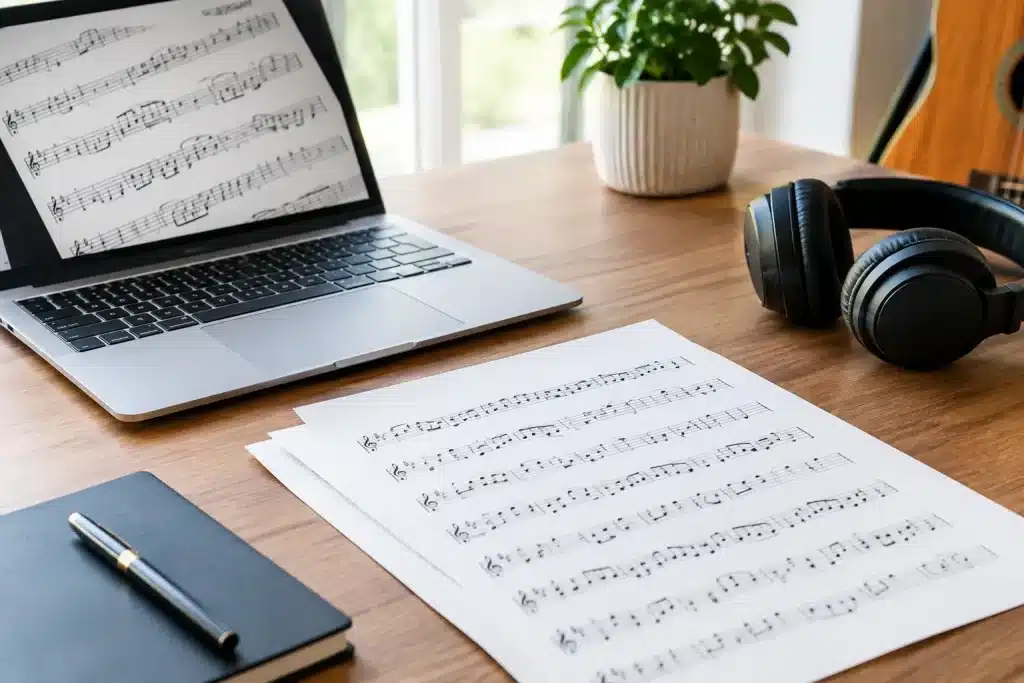
A last-minute recital request, a new song you cannot get out of your head, or a student asking for a current hit can all lead to the same question: where to buy legal sheet music without waiting for a book to arrive. The best answer is usually a licensed digital sheet music retailer that offers the specific song and arrangement you need, ready to view online and print at home.
That sounds simple, but not every file labeled “sheet music” is authorized, complete, or written for your instrument. Choosing a legal source protects the songwriters and publishers behind the music. Just as importantly for a player, it gives you a readable arrangement with clear notation, dependable formatting, and purchase terms you can understand.
Where to Buy Legal Sheet Music Online
Legal sheet music is sold by retailers that have permission to distribute arrangements from copyright owners or their publishing representatives. When you buy from a licensed source, you are paying for a legitimate edition of a song, not a scan from a book, an incomplete transcription, or a file shared without permission.
For most musicians, digital delivery is the practical choice. You can search by song title, artist, instrument, or style, choose an arrangement, complete the purchase, and start playing in minutes. There is no trip to a store and no need to buy a large anthology when one song is all you need.
FreshSheetMusic.com is built around that use case: individual licensed popular-song arrangements available for online viewing and at-home printing. That format works especially well when your practice schedule is busy, a performance is coming up, or you want to work on one recognizable song at a time.
A legal retailer should make the basics easy to find. Look for clear information about the instrument or format, such as piano solo, easy piano, vocal line with piano accompaniment, guitar chords, or guitar tab. The listing should also explain what you are purchasing and how you can access or print it. If a site is vague about licensing, offers a huge catalog of copyrighted songs for free, or relies on user-uploaded scans, it is worth looking elsewhere.
Start With the Arrangement, Not Just the Song
Finding the right title is only half the job. One song can have several arrangements, and the best choice depends on how you plan to use it.
A pianist playing for personal enjoyment may want a full piano solo that captures the melody, harmony, and key instrumental moments. A singer preparing for an audition may need a vocal arrangement with piano accompaniment in a comfortable key. A guitarist might be looking for chord symbols and lyrics for a casual performance, while another player needs tab that shows a specific picking pattern or lead part.
Before you buy, read the arrangement details. Check the listed instrument, difficulty level, key, page count, and whether lyrics or chord symbols are included. If a preview is available, use it to see whether the layout feels comfortable and whether the opening passage matches the version you know.
This is where paying for a song-specific arrangement can be more useful than buying a general songbook. A collection may include a song you like, but it might be in a simplified format, an unfamiliar key, or an arrangement that does not match your goal. Buying one licensed piece lets you choose more deliberately.
Match the music to your current skill level
The original recording is not always the most playable version. A dense piano arrangement can be satisfying for an advanced player but discouraging for someone still developing hand independence. An easy piano version may leave out rhythmic details or harmonic color, but it can get a beginner playing the melody quickly.
Neither option is automatically better. Choose the version that will keep you practicing. If you are learning a song for a performance next week, a clean, manageable arrangement is often the smarter purchase. If it is a long-term project, a more detailed score may be worth the extra work.
For vocalists, key matters just as much as difficulty. A song that sounds great in the original artist’s range may sit too high or too low for your voice. If more than one key is available, compare before buying. If not, consider whether you can transpose it or work with an accompanist who can.
How to Tell Whether Sheet Music Is Legitimate
Copyright can feel abstract until you need music fast. Fortunately, you do not need to become a publishing expert to make a responsible choice. Start by considering where the file comes from and what the seller tells you about it.
A legitimate listing is typically attached to a real retailer and a specific, identified arrangement. It provides organized product information rather than simply offering a downloadable file. The purchase process should be straightforward, and access should be tied to your account, order, or stated personal-use permissions.
Be cautious with “free PDF” results for well-known songs. Some may be public-domain works, educational excerpts, or arrangements shared with permission. Many others are unauthorized copies. A scan with handwritten markings, a cropped publisher credit, blurry pages, or missing sections is a strong warning sign. So is a file that claims to offer popular songs at no cost with no explanation of rights.
Legal access does not mean you can make unlimited copies or distribute the file to a choir, class, band, or friends. Digital sheet music purchases are generally intended for personal use under the retailer’s terms. If you need multiple copies for an ensemble, classroom, church group, or studio, check the appropriate licensing and copy permissions before printing for everyone.
That distinction matters. Buying one copy for your own practice is different from supplying music to a group. Respecting the stated terms helps keep the music available for musicians while supporting the writers, arrangers, and publishers who make it possible.
Why Digital Sheet Music Fits Everyday Practice
The strongest reason to buy legal sheet music digitally is not just speed. It is control. You can select the exact song, format, and difficulty you need rather than settling for whatever happens to be in a book on your shelf.
Printing at home also makes practice more flexible. Keep a copy on your music stand, mark fingerings or breaths on your personal printout, and return to the online version when you need it. For a singer or guitarist, having lyrics, chords, and notation in one organized arrangement can make rehearsal easier. For piano players, a properly formatted score is far easier to follow than a chord chart that leaves the important details to guesswork.
Digital music does have a few practical considerations. Your printer settings affect how the pages look, and dense notation may be easier to read on paper than on a small screen. Print a test page when possible, use a comfortable page scale, and organize your pages before a rehearsal. If you are performing, plan page turns in advance or use an approved digital setup that you have practiced with.
The benefit is that you can move from inspiration to focused practice quickly. Hear a song in the car, decide it belongs in your repertoire, and begin learning it the same day with an arrangement designed for your instrument.
Make Each Purchase Count
A good sheet music purchase should do more than give you notes on a page. It should give you a workable next step in your musical routine. Set a realistic goal before you print: learn the chorus hands separately, clean up the rhythm in one verse, memorize the chord progression, or prepare a polished version for a lesson.
If the arrangement feels challenging, do not judge it after one read-through. Listen closely to the original, identify repeated sections, and work in small phrases. Video lessons, performance covers, and slow practice can help turn unfamiliar notation into music that feels natural under your hands or in your voice.
Legal sheet music is a small purchase with a direct result: a song you can actually play, sing, practice, and share in a performance. Choose an arrangement that fits your instrument and ability, print it with care, and let the next page on your stand become part of your repertoire.
Frequently Asked Questions About Where to Buy Legal Sheet Music
Is sheet music on Amazon legal?
Many sheet music books and editions sold on Amazon are legitimate, including products published by Hal Leonard and other established companies. Before you buy sheet music, review the publisher, seller, edition, and product details. Avoid listings that appear to offer unauthorized scans or copies.
Where can I find legal classical sheet music?
For classical sheet music, browse publisher catalogs, specialist music stores, and authorized digital platforms. Henle editions are known for urtext scores, while Schirmer’s Library and the Library of Musical Classics include a range of classic repertoire. IMSLP can also provide public-domain scores, but check the copyright rules that apply in your country and confirm that a particular edition is free to use legally.
What should I consider when choosing sheet music for piano?
Choose piano music that matches the player’s level, from beginner to intermediate. A beginner piano method, Piano Adventures book, Faber piano book, or Hanon exercise collection may suit piano students building technique. Check the arrangement, page layout, and whether the book includes a songbook, practice guidance, or a keyboard accompaniment.
Can I buy legal sheet music for instruments other than piano?
Yes. Authorized sellers carry printed music and digital editions for instruments such as clarinet, as well as tablature for guitar and parts for orchestra. Check that the score matches the instrument, key, and playing level, and look for a licensed edition from a reputable publisher.
Where can I buy sheet music for children or special occasions?
Music stores and publisher catalogs often offer a book for kids, songs for kids, Christmas piano collections, Broadway favorites, and soundtrack songbooks. For a practical music gift, consider a sheet music songbook or a songbook with chords, making sure the arrangements suit the recipient’s instrument and experience.
What supplies should I buy with sheet music?
A sheet music folder helps keep printed music organized, while a sheet music stand makes it easier to read during practice. Composers and students who want to write a composition can also use a blank sheet music notebook, music manuscript notebook, or wide staff manuscript paper.
Can I find a huge selection of legal sheet music online?
Online platforms and publisher catalogs make it easy to browse a huge selection of piano, choral, classical, and contemporary music. Whether you are looking for a beginner method, an orchestra score, or a popular song, verify the seller’s licensing information and choose authorized printed music or digital sheet music for your region.