
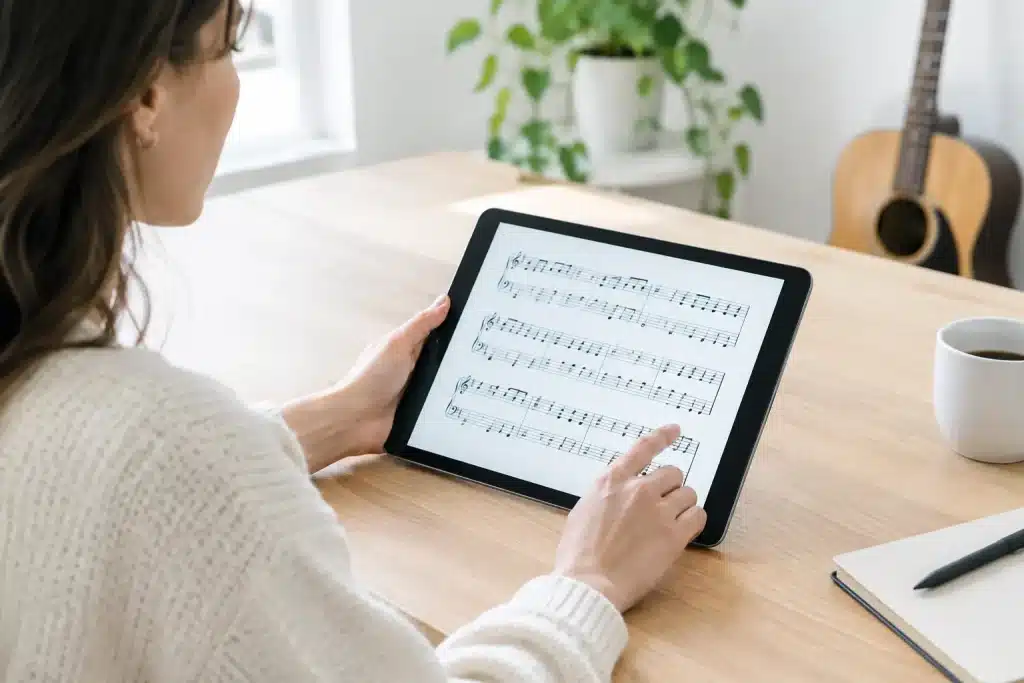
A song gets stuck in your head on Tuesday, and by Tuesday night you want to play it. That is the simple advantage of digital sheet music: you can find a licensed arrangement for the specific song you want, purchase it, view it online, and print it from home without waiting for a book to arrive.
For pianists working through a new pop ballad, singers preparing a favorite tune, or guitarists looking for chords and tabs, that speed changes the practice routine. Instead of building your plans around a store trip or a collection that includes only one song you need, you can focus on the music in front of you.
What Digital Sheet Music Actually Gives You
Digital sheet music is music notation delivered electronically rather than printed and shipped as a physical product. Depending on the arrangement, it may include a full piano score, vocal melody and lyrics, guitar chords, tabs, chord diagrams, or a combination of these elements.
The best format depends on what you are trying to do. A pianist may want a complete arrangement with both hands written out. A vocalist may need melody, lyrics, and chord symbols for rehearsal with an accompanist. A guitarist may prefer a lead sheet or tab that puts the song’s harmonic shape and signature riffs within reach.
The benefit is not just that the file is digital. It is that the music is song-specific. If you are learning one current hit for a recital, a wedding, a lesson, or your own enjoyment, buying a full songbook can feel wasteful. An individual arrangement lets you pay for the piece you will actually practice.
Licensed notation matters here, too. Popular songs are copyrighted works, and a legitimate arrangement respects the writers, publishers, and artists behind the music. Purchasing licensed sheet music gives you a clear, reliable way to use the song for personal practice and printing within the rights provided with your purchase.
Why Digital Sheet Music Fits Real Practice
Most musicians do not have unlimited practice time. You may have 20 minutes before work, an hour after dinner, or a short window before a lesson. When inspiration strikes, waiting several days for printed music can interrupt that momentum.
With digital access, you can purchase a composition when you are ready to start. View it on a laptop, tablet, or desktop screen, then print a copy for the piano bench, music stand, or lesson folder. Some players prefer screen viewing because it keeps their library compact. Others learn better with paper because they can circle accidentals, mark fingerings, and write reminders above difficult measures. Digital delivery supports both habits.
It also makes last-minute preparation less stressful. Maybe your teacher assigns a song, a friend asks you to sing at an event, or you decide to add a recognizable piece to your repertoire. You still need time to learn the music, of course. Digital sheet music cannot replace focused practice. But it removes the unnecessary delay between choosing a song and getting started.
Choose the Arrangement Before You Buy
A familiar song can appear in several arrangements, and they are not interchangeable. Reading the product details before purchasing helps you select music that matches both your instrument and your current ability.
Start with the instrumentation. Look for labels such as piano solo, piano/vocal/guitar, easy piano, voice with piano accompaniment, guitar tab, or lead sheet. A piano/vocal/guitar arrangement can be especially useful for singers who want lyrics and melody alongside chord symbols, while a piano solo usually gives the pianist a more self-contained performance version.
Then consider level and texture. Beginner-friendly arrangements often simplify rhythms, reduce large reaches, use more approachable keys, or remove some inner details from the original recording. That is not a lesser version of the song. It can be the right bridge between recognizing a tune and playing it confidently.
Intermediate and advanced arrangements may preserve more of the recording’s rhythms, fills, harmonic color, and expressive detail. They can be rewarding, but they may require stronger reading skills, wider hand spans, more independent coordination, or greater rhythmic accuracy. Choose the version that gives you a productive challenge rather than one that leaves you stuck at the first page.
Finally, inspect what is included. Lyrics may be essential for a singer but unnecessary for a piano-only performance. Chord symbols can help a guitarist improvise an accompaniment, while tab can show specific fretboard choices that chord names alone do not explain. Small details determine whether an arrangement becomes useful music or an unused download.
A Simple Way to Use Digital Music at Home
Once you have the music, give it a place in your routine. Print a clean copy if you work best on paper, or set up your device at a comfortable viewing height. Make sure the screen is stable and readable before you begin. A tablet sliding around on the piano stand is a distraction you do not need.
Read through the page before playing. Check the key signature, time signature, tempo marking, repeated sections, and any tempo changes. If the song has a tricky rhythm or a syncopated vocal entrance, listen to the original recording or a trusted cover first. Your ears can clarify what the notation is asking you to do.
For piano players, separate hands early when a passage feels crowded. Practice the left-hand pattern until it becomes steady, then add the right hand in small sections. For singers, speak the lyrics in rhythm before trying to sing the full melody. Guitarists can isolate chord changes, then bring in strumming or picking patterns after the transitions feel natural.
Marking your copy is part of learning, not a sign that you are doing it wrong. Add fingerings, breath marks, page-turn reminders, chord cues, or notes about difficult intervals. When you return to the piece the next day, those markings save time and help you see exactly what still needs work.
Printing and Viewing: Use the Format That Helps You Learn
Printing at home is one of the most practical reasons to buy digital notation. A printed page is easy to annotate, easy to place on a music stand, and easier to share with your own future self after a few weeks away from the piece. Use a clear print setting, and avoid shrinking the page so much that notes and lyrics become difficult to read.
That said, printing is not always necessary. If you have a reliable tablet or computer setup, online viewing keeps your music library portable and reduces paper clutter. This can be helpful when you are traveling, taking lessons in different locations, or practicing in a small space.
There is a trade-off. Paper makes handwritten notes effortless, while screens can make organization and storage easier. Many musicians use both: a digital library for access and a printed copy for songs currently in active rotation. Use the option that keeps your attention on the music rather than on managing materials.
Remember that a purchase comes with personal access and printing rights according to its listing. It is a good habit to treat digital notation as you would any other copyrighted music: use it responsibly, keep your purchase information organized, and avoid distributing copies beyond the permitted use.
Build a Library You Will Actually Play
It is tempting to collect more songs than you can learn. A better approach is to keep a small, useful rotation: one song that feels comfortable, one song that develops a skill, and one song that simply makes you want to sit down and play.
That rotation can change with your goals. A beginner pianist might choose a simple melody, a chord-based pop arrangement, and an easy version of a favorite song. An experienced player may balance a polished performance piece with a new challenge and a song to sight-read for fun. Singers and guitarists can use the same idea by pairing repertoire work with songs that strengthen range, rhythm, chord vocabulary, or lyric delivery.
FreshSheetMusic.com is designed around that practical choice: find a licensed arrangement for the individual song you want, access it right away, and put it to work in your own practice. Video tutorials, lessons, and cover versions can also give you a useful reference when the written page needs a little extra context.
The next song you learn does not need to wait for a shipment or a full book of music. Pick an arrangement that fits your instrument and your level, make space for a focused practice session, and let the first few measures turn a favorite recording into something you can make yourself.