
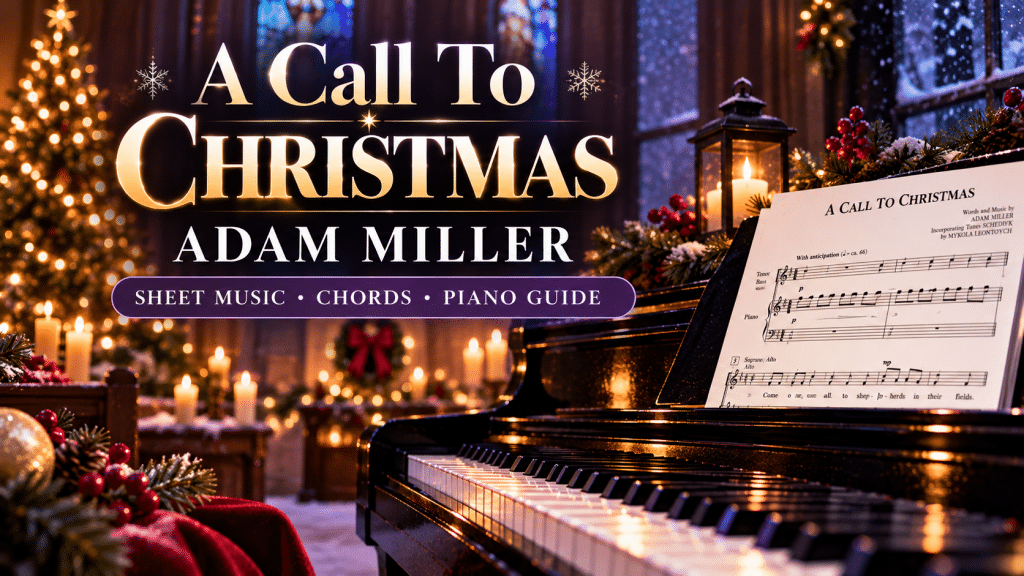
Looking for A Call to Christmas sheet music by Adam Miller? This festive SATB choral composition combines a rhythmic piano accompaniment, expressive four-part vocal writing and musical material from Mykola Leontovych’s Shchedryk, widely associated with the Christmas classic “Carol of the Bells.”
The downloadable edition contains 14 pages of fully notated music for soprano, alto, tenor, bass and piano. It is designed for choir directors, church musicians, accompanists and ensembles preparing a Christmas concert or seasonal worship service.
Below, we’ll explore the composition’s background, musical meaning, tempo, key, 12/8 rhythm, score structure, difficulty, performance techniques and rehearsal tips. You’ll also find a way to locate a matching SATB performance video.
|
♫
|
Editorial Score Review
FreshSheetMusic Editorial Team
Our review is based on the supplied 14-page digital score. We examined its title-page credits, SATB voicing, piano accompaniment, printed tempo, meter, vocal entrances, dynamics and closing instructions. Difficulty assessments and practice suggestions are editorial recommendations.
|
View A Call to Christmas Sheet Music →
A Call to Christmas Sheet Music at a Glance
| Song title | A Call to Christmas |
| Composer and lyricist | Adam Miller |
| Incorporated music | Material from Shchedryk by Mykola Leontovych |
| Arrangement | SATB choir with piano accompaniment |
| PDF length | 14 pages |
| Performance duration | Approximately 4 minutes |
| Time signature | 12/8 |
| Opening tempo | With anticipation, dotted-quarter note approximately 66 BPM |
| Key signature | One sharp; E minor tonal center |
| Difficulty estimate | Intermediate |
| Publisher | Shawnee Press / Hal Leonard |
| Digital product release | April 21, 2025, as listed by FreshSheetMusic |
| SKU | 1741934 |
The Story Behind Adam Miller’s A Call to Christmas
A Call to Christmas is a contemporary sacred Christmas anthem by Adam Miller that incorporates musical material from Shchedryk, the Ukrainian composition by Mykola Leontovych.
That connection is particularly meaningful because Shchedryk is the musical foundation of the familiar Christmas song “Carol of the Bells.” Its distinctive recurring melodic idea has become closely associated with festive choral music.
Miller’s composition develops its own Christmas message while drawing on that recognizable musical tradition. The result is an energetic anthem that blends the excitement of the Nativity proclamation with a more reflective conclusion.
The score is published in the Brookfield Christmas Choral series by Shawnee Press, part of Hal Leonard’s publishing catalog. The publisher identifies Christmas, Christmas Eve and concert performance as suitable uses.
Is A Call to Christmas the Same as Carol of the Bells?
No. Although the two works share a musical connection, they are not the same composition.
“Carol of the Bells” is an English-language Christmas song based on Leontovych’s Shchedryk. “A Call to Christmas” is a separate choral composition by Adam Miller that explicitly incorporates material from the earlier Ukrainian work.
For choir directors, this creates an opportunity to connect a new Christmas anthem with a familiar musical tradition without presenting the two pieces as interchangeable.
What Is A Call to Christmas About?
The song presents Christmas as an invitation to celebrate the birth of Christ. Its lyrics draw on the Nativity narrative, including the angels’ announcement, the shepherds and the holy Child.
As the composition progresses, the emphasis expands from recounting the Christmas story to calling listeners to respond with celebration and worship.
The musical structure supports this movement. Repeated accompaniment figures establish anticipation, the choral texture grows fuller and the dynamic intensity rises toward the climax.
The final section then becomes quieter, providing a moment of reflection after the more celebratory material.
Watch A Call to Christmas – Adam Miller SATB Choir
A matching YouTube video is indexed under the title “A CALL TO CHRISTMAS (SATB Choir) – by Adam Miller.” The publisher also provides a score-preview option.
Use the following link to locate the performance. Listen for the repeated piano motif, the staggered SATB entrances, the dynamic build and the final soft passage.
Adam Miller · Choir and piano · Performance preview
For the publisher’s score and audio preview, visit Hal Leonard’s A Call to Christmas listing.
Musical Analysis: Key, Tempo and Time Signature
What Key Is A Call to Christmas In?
The score uses a one-sharp key signature and centers on E minor. This tonal character works particularly well with the repeated, insistent musical figures associated with the incorporated Shchedryk material.
Because the score contains complete notation rather than chord symbols throughout, the harmony is primarily communicated through the piano and vocal staves.
Musicians should therefore use the written notes to identify specific harmonies instead of assuming a single repeated chord progression for the entire piece.
Understanding the 12/8 Time Signature
One of the most important features of this composition is its 12/8 meter.
In compound quadruple meter, each measure contains four main beats, and each beat divides naturally into three eighth notes.
For the pianist, this creates the foundation for the repeating accompaniment pattern. For singers, understanding the four larger beats helps maintain accurate entrances and sustained phrases.
What Is the Tempo?
The opening is marked With anticipation, with a dotted-quarter-note tempo of approximately 66.
This does not mean the piece should feel slow or heavy. The moving accompaniment produces rhythmic energy, while the underlying beat remains measured and controlled.
Conductors should establish a stable pulse before increasing intensity through dynamics and phrasing.
The Piano Accompaniment: Why It Matters
The piano is not merely providing occasional chord support. It plays a prominent musical role throughout the composition.
At the beginning, a repeating figure establishes the atmosphere before the choir becomes fully involved. As the work develops, the accompaniment supports the vocal harmony and reinforces transitions between sections.
The pianist must maintain the compound-meter subdivision without allowing the repeated notes to become mechanical or overpowering.
Three Essential Piano Practice Techniques
- Establish a consistent pulse. Practice the opening figure slowly with a metronome set to the dotted-quarter beat.
- Control the accompaniment dynamics. Keep the repeated figures light when the choir is singing softer passages, then increase intensity where the score directs.
- Rehearse with the choir early. Staggered entrances and sustained vocal lines require close coordination between pianist and conductor.
For the final section, the accompanist should prepare the transition from the larger climactic sound into the restrained ending.
Inside the 14-Page A Call to Christmas Score
Pages 1–3: Opening and Introduction of the Christmas Message
The score begins with a repeating piano pattern and an entrance by the lower voices. Soprano and alto voices are introduced later, expanding the texture.
The opening sections require careful counting because not every vocal part enters at the same time.
Pages 4–6: Development and Rising Intensity
The music introduces additional phrases and repeated melodic ideas. Dynamic markings encourage a gradual increase in energy while the accompaniment continues to maintain forward motion.
Choirs should rehearse the crescendos and sustained notes with consistent vowel shapes and planned breathing.
Pages 7–9: Expanding SATB Texture
The four vocal parts become more actively involved. The music alternates between shared statements and overlapping material, creating a broader choral sound.
This section is especially important for balance between soprano, alto, tenor and bass.
Pages 10–13: Climax and Full Choral Sound
The later sections feature more substantial choral harmony and a stronger accompaniment. The ensemble moves toward a celebratory climax.
Directors should focus on unified consonants, clear text and avoiding excessive volume that obscures the inner voices.
Page 14: Quiet, Whispered Conclusion
The ending provides a contrast to the preceding intensity. The score marks a whispered final call, accompanied by softer piano dynamics and a gradual reduction in musical activity.
Rather than simply fading away, the choir should treat this as a precisely coordinated closing gesture.
How Difficult Is A Call to Christmas?
Based on the supplied score, an intermediate difficulty level is a reasonable editorial estimate for both the choir and accompanist.
| Musical element | Main challenge |
|---|---|
| SATB harmony | Maintaining independent vocal lines |
| 12/8 meter | Consistent compound subdivision |
| Piano writing | Repeated figures, coordination and dynamic control |
| Choral entrances | Accurate counting and ensemble awareness |
| Climactic sections | Balance, diction and controlled intensity |
| Final passage | Unified whispered delivery |
Experienced church, school and community choirs should find the work achievable with organized rehearsal. Beginning ensembles may need extra preparation for the independent parts and accompaniment coordination.
How to Rehearse A Call to Christmas: Step-by-Step
- Introduce the rhythmic foundation. Have singers clap or speak the 12/8 subdivision before reading their parts.
- Practice each SATB part separately. Confirm pitches, rhythms and entrances for every section.
- Combine voice parts gradually. Begin with two-part combinations, then build toward the complete choir.
- Work with the pianist. Coordinate the opening pattern, rests and staggered vocal entrances.
- Shape the dynamics. Mark where the choir should grow, relax or change tone color.
- Develop clear diction. Agree on consonant placement so the Christmas message remains intelligible.
- Isolate the climax. Rehearse the fuller choral passages without forcing the sound.
- Prepare the ending. Practice the transition into whispering and coordinate the final release.
Where Does A Call to Christmas Fit in a Christmas Program?
With a duration of approximately four minutes, the piece is well suited to several seasonal performance settings.
Christmas Eve Worship
The Nativity message and call to worship make this an appropriate selection for a Christmas Eve service. Its energetic character can help establish a celebratory atmosphere.
Church Christmas Concert
The composition can serve as an opening anthem or a featured choral selection. Its connection to Shchedryk provides a recognizable musical reference for listeners.
School and Community Choir Programs
Ensembles with a balanced SATB section and a confident accompanist can use the work to introduce compound meter, staggered entrances and dynamic contrast.
Before selecting it, conductors should assess the written vocal ranges, ensemble experience and available rehearsal time.
Where to Download A Call to Christmas Sheet Music
FreshSheetMusic offers Adam Miller’s A Call to Christmas sheet music as a digital PDF under product SKU 1741934.
The edition contains 14 pages for SATB choir and piano, including all vocal parts, accompaniment, musical directions and the complete conclusion.
This makes it useful for choir directors, accompanists and ensembles planning a Christmas performance.
Remember to check the licensing and printing conditions for your choir and purchase the number of authorized copies required for your singers.
Frequently Asked Questions About A Call to Christmas
Who composed A Call to Christmas?
Adam Miller wrote the words and music, incorporating material from Mykola Leontovych’s Shchedryk.
Is A Call to Christmas connected to Carol of the Bells?
Yes. It incorporates material from Shchedryk, the Ukrainian composition whose melody became associated with Carol of the Bells.
What is the arrangement for?
It is written for SATB mixed choir with fully notated piano accompaniment.
What key is A Call to Christmas in?
The score has a one-sharp key signature and an E minor tonal center.
What is the time signature?
The composition begins in 12/8, with four main compound beats per measure.
What is the tempo?
The opening is marked With anticipation, with a dotted-quarter tempo of approximately 66.
How long is the piece?
The printed score indicates a performance duration of approximately four minutes.
Is A Call to Christmas difficult?
It is best approached as intermediate choral repertoire because of the SATB writing, compound meter, repeated piano patterns and ensemble coordination.
How many pages are in the PDF?
The downloadable score contains 14 pages.
Where can I purchase A Call to Christmas sheet music?
The SATB choir and piano edition is available from FreshSheetMusic.
Bring A Call to Christmas to Your Choir
Explore Adam Miller’s festive SATB anthem with its energetic piano writing, Christmas proclamation and connection to Leontovych’s Shchedryk. Prepare your next seasonal performance with the complete digital score.