
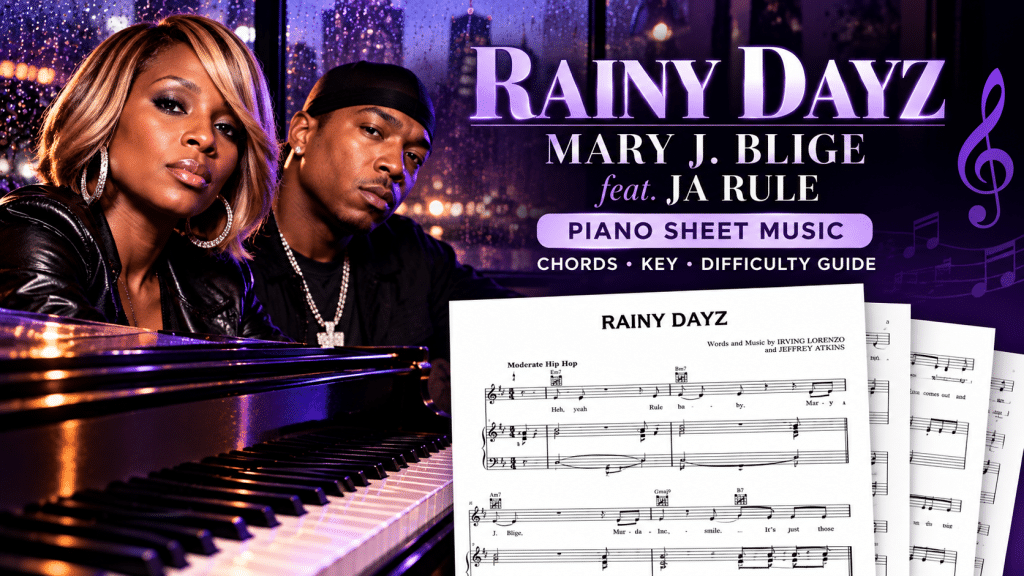
Looking for Mary J. Blige “Rainy Dayz” sheet music featuring Ja Rule? This 11-page piano-vocal-guitar arrangement captures the soulful melody and steady hip-hop groove of the 2002 R&B hit. It includes a fully notated piano accompaniment, vocal melody, lyrics and guitar chord diagrams.
Whether you’re accompanying a vocalist, learning early-2000s R&B piano or studying the song’s expressive harmony, this guide covers the key, chords, piano difficulty, song meaning, arrangement structure and practical playing techniques.
|
♫
|
Editorial Score Review
FreshSheetMusic Editorial Team
Analysis based on the supplied 11-page score, including its printed transposition note, chord symbols, vocal parts, piano accompaniment, coda instructions and optional ending. Difficulty ratings are editorial estimates.
|
View “Rainy Dayz” Sheet Music PDF →
Mary J. Blige “Rainy Dayz” Sheet Music at a Glance
| Song | Rainy Dayz |
| Artists | Mary J. Blige featuring Ja Rule |
| Songwriters | Irving Lorenzo and Jeffrey Atkins |
| Producer | Irv Gotti |
| Release year | 2002 |
| Album | No More Drama (2002 reissue) |
| Genre | R&B / Hip-Hop / Soul |
| Arrangement | Piano, vocal and guitar chord diagrams |
| Pages | 11 |
| Original key | E-flat minor |
| Key of this edition | E minor (transposed up one semitone) |
| Key signature | One sharp (F-sharp) |
| Time signature | 4/4 |
| Tempo marking | Moderate Hip Hop |
| Main chords | Em7, Bm7, Am7, G, Gmaj9, B7 |
| Estimated difficulty | Intermediate |
| Notable features | Male/female vocal parts, rap rhythms, D.S. al Coda, repeat and fade, optional ending |
| Product SKU | 19980 |
The Story Behind Mary J. Blige and Ja Rule’s “Rainy Dayz”
Released as a single in 2002, “Rainy Dayz” brought together two influential voices in contemporary R&B and hip-hop: Mary J. Blige and Ja Rule.
The song appeared on the expanded 2002 edition of Blige’s fifth studio album, No More Drama. The album’s broader themes of emotional struggle, personal growth and resilience make “Rainy Dayz” a natural fit.
The recording was produced by Irv Gotti, whose work with Ja Rule and Murder Inc. helped define the sound of mainstream hip-hop and R&B during the early 2000s. The songwriting credits identify Irving Lorenzo (Irv Gotti) and Jeffrey Atkins (Ja Rule).
The duet combines Blige’s emotionally expressive singing with Ja Rule’s gritty, conversational delivery. This contrast is central to the track’s appeal: the sung sections offer reassurance, while the rap passages acknowledge how difficult life can become.
Commercially, the song reached No. 12 on the US Billboard Hot 100 and No. 17 on the UK Singles Chart, becoming another notable collaboration from that period.
Why the Collaboration Works
Mary J. Blige’s vocal style combines gospel-influenced expression, soul phrasing and the rhythmic sensibility of hip-hop. Ja Rule’s contribution adds a contrasting texture and a more direct spoken perspective.
Instead of presenting these styles separately, “Rainy Dayz” allows them to respond to one another. The result is a song that moves between emotional vulnerability and determination without abandoning its underlying groove.
What Is “Rainy Dayz” About? Song Meaning Explained
“Rainy Dayz” uses rain as a metaphor for emotional pain, hardship and uncertainty, while sunlight represents hope and the possibility of better days.
The song acknowledges that difficult experiences cannot always be avoided. Relationships, disappointment, personal struggles and the pressure of everyday life can create periods that feel overwhelming.
However, the central message is not simply about sadness. It is also about resilience, compassion and supporting one another through difficult moments.
Blige’s melodic refrain expresses the desire for relief and reassurance. Ja Rule’s verses introduce more personal and spiritual reflections, reinforcing the idea that hope can persist even when circumstances remain difficult.
What Do Rain and Sunshine Symbolize?
Rain represents the challenges that temporarily obscure happiness. Sunshine symbolizes recovery, emotional clarity and renewed optimism.
The contrast is deliberately simple and relatable. Nearly everyone has experienced periods of discouragement followed by moments of relief.
Why Does the Song Feel Both Sad and Uplifting?
The minor-key harmony gives the music a reflective quality, but the steady rhythm and repeated reassuring phrases keep it moving forward.
For a pianist, that emotional balance is important. The accompaniment should maintain a reliable pulse while allowing the vocal melody to sound expressive and human.
Listen to Mary J. Blige Featuring Ja Rule – “Rainy Dayz”
Before practicing the arrangement, listen to the recording and concentrate on the interplay between the steady accompaniment, Mary J. Blige’s expressive melody and Ja Rule’s rhythmic delivery.
The following recording is available through Mary J. Blige’s official artist channel.
Official-artist audio upload. This is not presented as the song’s official music video.
What Key Is “Rainy Dayz” Sheet Music In?
The original song is in E-flat minor, but the supplied 11-page arrangement is written in E minor.
This is not an assumption based on the chord symbols: the publisher’s note on page 1 explicitly identifies the original key and explains that the edition has been transposed upward by one half-step.
The written score therefore has one sharp in its key signature, F-sharp, and centers its harmony around E minor.
Why Is This Edition Transposed?
A transposition changes the pitch level of the entire arrangement while preserving the relationships between the notes and chords.
Moving from E-flat minor to E minor reduces the number of flats in the key signature. That can make the score more approachable for pianists who are comfortable reading familiar keys.
However, if you’re accompanying the original recording or a vocalist who prefers the original key, the difference matters. Playing the E-minor score against an E-flat-minor recording without transposing one of them will produce a pitch mismatch.
What Is the Main Chord Progression?
The arrangement repeatedly cycles through the following harmonic pattern:
Some early passages use Gmaj9 instead of G, adding a richer color. The recurring B7 chord creates a strong pull back toward E minor.
For practicing, treat the G-to-B7 movement as two separate harmonic events, even where they occur close together within the same phrase.
“Rainy Dayz” Piano Chords Explained
The supplied score uses a compact set of minor seventh, major and dominant seventh chords. Learning these shapes first will make the written accompaniment much easier to understand.
| Chord | Notes | Role |
|---|---|---|
| Em7 | E–G–B–D | Main minor tonal center |
| Bm7 | B–D–F#–A | Smooth minor-seventh movement |
| Am7 | A–C–E–G | Warm, reflective subdominant harmony |
| G | G–B–D | Relative-major color |
| Gmaj9 | G–B–D–F#–A | Extended, soulful major harmony |
| B7 | B–D#–F#–A | Dominant chord leading toward E minor |
Why Are Minor Seventh Chords Important?
Minor seventh chords create a softer, more layered sound than simple minor triads. They are common in soul, jazz-influenced R&B and contemporary pop accompaniment.
Em7, Bm7 and Am7 share several notes with neighboring chords, which makes smooth voice leading possible. Rather than lifting your entire hand for every change, look for common tones that can remain in place.
What Does Gmaj9 Add?
Gmaj9 extends a basic G-major chord by adding its major seventh and ninth. The result is a richer harmonic color that suits the reflective mood of the song.
For a simplified accompaniment, a beginner can initially play G major, then introduce the F-sharp and A notes when comfortable.
Why Does B7 Contain D-sharp?
Although the key signature of E minor contains F-sharp, the B7 chord introduces D-sharp. This is the raised seventh degree of E harmonic minor.
That D-sharp creates a strong leading-tone pull toward E, helping the progression return convincingly to its tonal center.
How Difficult Is “Rainy Dayz” to Play on Piano?
Based on the supplied notation, we assess this edition as intermediate. The chord vocabulary is approachable, but the complete arrangement requires rhythmic confidence and coordination.
The score includes:
- A complete two-hand piano accompaniment on a grand staff.
- Repeated syncopated figures and offbeat accents.
- A mixture of sustained chords and moving eighth-note passages.
- Minor seventh, major ninth and dominant seventh harmonies.
- Separate male and female vocal entries.
- Rhythmically notated rap passages, including triplet figures.
- A D.S. al Coda instruction and extended coda.
- A repeat-and-fade passage and an optional final chord.
A player with basic chord knowledge can create a simplified version. Performing the complete written accompaniment, particularly while following a vocalist, is a more substantial task.
Inside the 11-Page “Rainy Dayz” Piano Arrangement
1. Page 1: A Restrained Introduction
The score opens with the marking Moderate Hip Hop and a soft dynamic indication in the piano part.
The opening progression introduces Em7 and Bm7 before moving toward Am7, Gmaj9 and B7. The accompaniment is comparatively spacious, leaving room for the spoken introductory vocal material.
Resist the temptation to play too heavily. A controlled, understated beginning gives the song space to develop.
2. Pages 2–3: Establishing the Main Groove
The repeated chord cycle supports the main sung material. The piano writing alternates between held harmonies, short rhythmic accents and more active passages.
The vocal melody contains repeated notes and closely spaced rhythmic figures. For an accompanist, the challenge is to maintain a consistent pulse without competing with the singer.
3. Pages 4–5: Contrasting Vocal Exchanges
The score identifies male and female vocal material, helping performers distinguish between the different parts of the duet.
Some phrases overlap or respond closely to one another. This creates a conversational texture rather than a conventional solo vocal line.
Page 5 also introduces a more speech-like passage, represented with rhythmic noteheads. When rehearsing with a vocalist, count these passages carefully without forcing every syllable into an unnaturally sung tone.
4. Page 6: Rap Rhythm and Triplets
Page 6 contains prominent rhythmically notated vocal passages, including triplet groupings. These figures require a different approach from the smoother sung melody.
Count the subdivisions slowly and listen to the recording to understand how the vocal delivery sits against the underlying beat.
The pianist’s role is to preserve the groove, not to imitate every detail of the rap performance in the accompaniment.
5. Page 7: D.S. al Coda
The score includes a D.S. al Coda instruction. This directs the performer back to the segno sign, then onward to the coda at the appropriate marked point.
Mark the navigation route before performing the piece from beginning to end. Misreading a repeat instruction can be more disruptive in performance than an occasional wrong note.
6. Pages 7–10: Extended Coda and Vocal Development
The coda is not simply a short closing measure. It contains several pages of additional vocal material and accompaniment, returning to the familiar harmonic framework.
The repeated progression gives the music continuity while the vocal phrases provide variation and emotional development.
For efficient practice, identify which accompaniment patterns repeat. Mastering one pattern can make several later passages easier to learn.
7. Page 11: Repeat and Fade or Optional Ending
The final page provides a Repeat and Fade instruction and a separately labeled Optional Ending.
This is useful for different performance situations. A gradual fade may suit a recording-style interpretation, while the optional ending provides a more definite conclusion for live performance.
The optional final harmony is Em7, reinforcing the tonal center of the transposed edition.
How to Learn “Rainy Dayz” on Piano: 8 Practical Steps
- Identify the correct key. Remember that this edition is in E minor, not the recording’s original E-flat minor.
- Learn the chord vocabulary. Practice Em7, Bm7, Am7, G, Gmaj9 and B7 as separate shapes.
- Build the bass foundation. Play the root movement slowly with your left hand until the progression feels natural.
- Practice the right-hand voicings. Keep shared notes between chords where possible and avoid unnecessary hand movement.
- Work on the groove. Count in 4/4, subdivide the beat and isolate syncopated accompaniment figures.
- Separate sung and rap passages. Study the different rhythmic approaches, especially the triplet figures on page 6.
- Map the score navigation. Locate the segno, To Coda, D.S. al Coda and final repeat instructions.
- Choose your ending. Decide whether to use the repeat-and-fade passage or the optional final chord.
Can Beginners Play “Rainy Dayz”?
Beginners with some chord-reading experience can learn a simplified accompaniment, especially because the song relies on a recurring progression.
Start with one bass note per chord in the left hand and a simple triad or seventh chord in the right hand. For example, begin with Em instead of Em7 and G instead of Gmaj9, then add the extra chord tones as your confidence improves.
The complete 11-page arrangement is more appropriate for intermediate players because it requires reading two piano staves, handling syncopation and following a fairly involved repeat structure.
If your goal is to accompany a singer rather than reproduce every note of the published piano part, a simplified chord-based version can be a useful starting point.
Where Can I Get Mary J. Blige “Rainy Dayz” Sheet Music?
FreshSheetMusic offers the 11-page “Rainy Dayz” digital sheet music edition, product SKU 19980.
The score includes the vocal melody and lyrics, a fully written two-hand piano accompaniment and guitar chord diagrams. It also contains the duet’s vocal indications, rhythmic details, coda structure and optional ending.
This edition is particularly useful for R&B pianists, vocal accompanists, music students and performers who want a more complete arrangement than a basic lyric-and-chord chart.
Before purchasing, note that the score is written in E minor, transposed one semitone above the original recording’s E-flat-minor key.
Frequently Asked Questions About “Rainy Dayz”
Who sings “Rainy Dayz”?
“Rainy Dayz” is performed by Mary J. Blige featuring rapper Ja Rule.
Who wrote “Rainy Dayz”?
The credited songwriters are Irving Lorenzo (Irv Gotti) and Jeffrey Atkins (Ja Rule).
When was “Rainy Dayz” released?
The song was released as a single in 2002 and appeared on the expanded edition of Mary J. Blige’s album No More Drama.
What is the meaning of “Rainy Dayz”?
The song uses rainy weather as a metaphor for hardship and emotional pain, while sunshine symbolizes hope, recovery and better days ahead.
What key is “Rainy Dayz” in?
The original song is in E-flat minor. The supplied FreshSheetMusic edition is transposed up one semitone to E minor.
What chords are used in “Rainy Dayz”?
The main printed chord symbols in this edition are Em7, Bm7, Am7, G, Gmaj9 and B7.
Is “Rainy Dayz” easy to play on piano?
The basic chord progression is approachable, but the complete piano-vocal-guitar arrangement is best suited to intermediate players because of its rhythmic detail and score navigation.
How many pages is the “Rainy Dayz” sheet music?
The supplied digital edition contains 11 pages.
Does the arrangement include Ja Rule’s rap parts?
Yes. The score includes male and female vocal indications and rhythmically notated passages corresponding to the duet, including rap-style delivery.
Where can I get “Rainy Dayz” piano sheet music?
You can find the 11-page piano-vocal-guitar edition at FreshSheetMusic.com.
Ready to Play Mary J. Blige and Ja Rule’s “Rainy Dayz”?
Explore the expressive minor-seventh harmonies, steady R&B accompaniment and memorable vocal lines of this early-2000s collaboration. The 11-page score provides the notation needed to study the complete arrangement.