
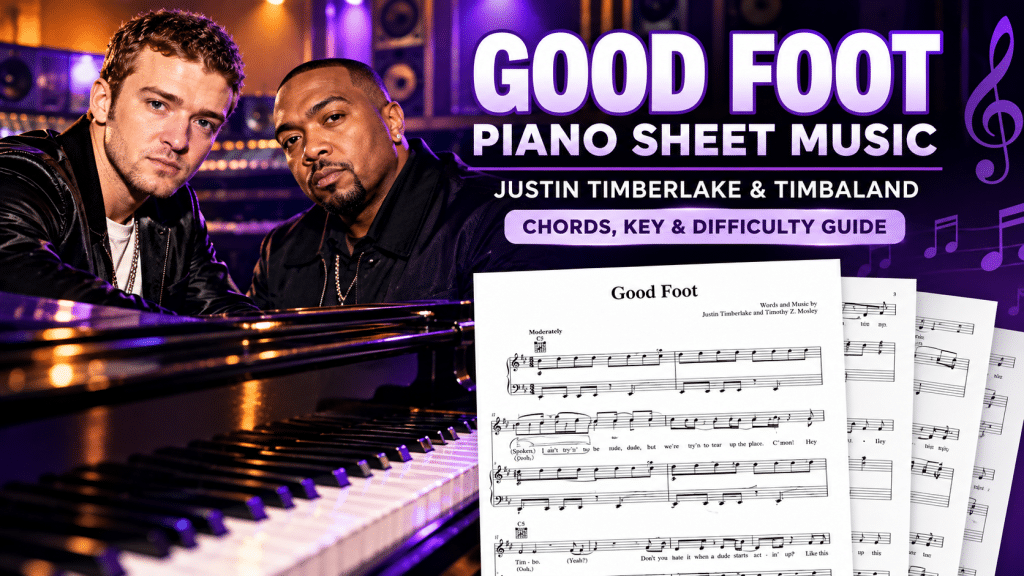
Looking for Good Foot sheet music by Justin Timberlake and Timbaland? This eight-page piano-vocal-guitar arrangement brings the infectious groove of the 2004 Shark Tale soundtrack to the keyboard, with a fully notated piano accompaniment, vocal melody, lyrics and guitar chord diagrams.
Whether you’re learning the song for a performance, accompanying a singer or exploring early-2000s R&B piano, this guide covers the chords, key, difficulty, rhythmic structure, song meaning and story behind the recording.
|
♫
|
Score Analysis
FreshSheetMusic Editorial Team
Reviewed from the published eight-page piano-vocal-guitar score, including its chord symbols, written piano accompaniment, vocal line, spoken passages, rhythmic patterns, repeat markings and two coda sections.
|
View “Good Foot” Sheet Music →
Justin Timberlake & Timbaland “Good Foot” Sheet Music at a Glance
| Song | Good Foot |
| Artists | Justin Timberlake and Timbaland |
| Songwriters | Justin Timberlake and Timothy Z. Mosley |
| Release | 2004 |
| Soundtrack | Shark Tale |
| Genre | R&B / Hip-Hop / Pop |
| Arrangement | Piano, vocal and guitar chord diagrams |
| Pages | 8 |
| Key signature | Three flats (C minor / E-flat major) |
| Tonal center | C minor |
| Main chords | C5, Cm, Db |
| Time signature | 4/4 |
| Tempo | Moderately (no numerical BPM indicated) |
| Difficulty estimate | Intermediate piano |
| Special features | Spoken passages, syncopation, D.S. al Coda I and II, repeat and fade |
| SKU | 51444 |
This is a more complete keyboard arrangement than a melody-and-chords lead sheet. The piano part is written on a grand staff, with an additional vocal staff above it. That makes it particularly useful for pianists accompanying a singer or studying the rhythmic techniques used in early-2000s R&B production.
The Story Behind Justin Timberlake and Timbaland’s “Good Foot”
“Good Foot” was released in 2004 as part of the soundtrack for DreamWorks Animation’s Shark Tale. The film featured an all-star voice cast and a contemporary soundtrack that blended pop, R&B and hip-hop.
The soundtrack brought together artists such as Christina Aguilera, Missy Elliott, Mary J. Blige and Sean Paul. “Good Foot” was performed by Justin Timberlake and Timbaland, two artists whose creative partnership would become one of the most influential collaborations in 2000s pop music.
The song was written by Justin Timberlake and Timothy Z. Mosley, better known as Timbaland, with Timbaland handling production.
At the time, Timberlake was establishing himself as a solo artist following the success of his 2002 debut album Justified. Timbaland had already built a reputation for his distinctive production style, characterized by unusual rhythmic textures, inventive percussion and memorable vocal arrangements.
“Good Foot” reflects that approach. Rather than relying on a complex harmonic progression, the song develops its identity through repetition, rhythmic accents, conversational vocals and a tightly controlled groove.
The track also provides an early example of the chemistry that would later become central to Timberlake’s 2006 album FutureSex/LoveSounds.
Music history connection: “Good Foot” represents an early-2000s collaboration between Justin Timberlake and Timbaland, combining contemporary R&B vocals with a rhythm-driven production style that helped define their later work together.
What Is “Good Foot” About? Song Meaning Explained
“Good Foot” is a playful, dance-oriented song about enjoying yourself, maintaining confidence and refusing to let unnecessary confrontation ruin a good time.
The lyrics present a social situation in which jealousy, competition and irritation threaten to interrupt the party atmosphere. Rather than responding with aggression, the performers use humor, swagger and playful exchanges to keep the energy moving.
The title itself suggests dancing, movement and participation. Getting on your “good foot” is an invitation to join the celebration and move with confidence.
Unlike an emotional ballad built around a developing narrative, “Good Foot” is primarily concerned with attitude and rhythm. The lyrics support the music’s lively, conversational character.
Why Is It Called “Good Foot”?
The expression “good foot” has long been associated with dancing and rhythmic movement in popular music. Here, it functions as an invitation to move, enjoy the moment and adopt a positive attitude.
The phrase also connects naturally with the song’s repeated rhythmic patterns, which emphasize movement more than melodic complexity.
How Does the Music Support the Meaning?
The steady beat, repeated bass figures, syncopated accents and short vocal exchanges reinforce the song’s playful confidence.
For pianists, this means the performance should feel rhythmic, controlled and energetic rather than overly expressive or sentimental.
Listen to Justin Timberlake and Timbaland’s “Good Foot”
Before learning the sheet music, listen to the recording and pay particular attention to the bass pulse, vocal phrasing and rhythmic accents. These elements are essential to capturing the song’s character on piano.
This is a publicly available audio upload, not a verified official music video.
Behind the Scenes: Making “Good Foot”
Studio footage of Justin Timberlake and Timbaland working on “Good Foot” provides additional insight into their creative process and the rhythmic approach behind the recording.
What Key Is Justin Timberlake and Timbaland’s “Good Foot” Sheet Music In?
The published arrangement uses a three-flat key signature, containing B-flat, E-flat and A-flat.
Three flats are shared by E-flat major and its relative minor, C minor. In this score, the recurring C-minor harmony and C-centered accompaniment make C minor the most useful practical tonal reference.
The main printed chord symbols are:
The harmony is deliberately compact. Instead of moving through many unrelated chords, the arrangement creates variety through rhythm, articulation and changes in harmonic color.
Why Does the Score Begin With C5?
The opening chord symbol is C5, also known as a power chord. Unlike a conventional major or minor triad, C5 contains no third, so it does not establish a major or minor quality by itself.
Its basic notes are C and G. This open sound works well in rhythm-driven music because it creates a strong tonal foundation without adding unnecessary harmonic complexity.
“Good Foot” Piano Chords Explained
The supplied score includes three principal chord symbols: C5, Cm and Db. These chords provide the harmonic foundation for the written piano accompaniment.
| Chord | Notes | Musical function |
|---|---|---|
| C5 | C–G | Open power-chord sound |
| Cm | C–Eb–G | Minor tonal center |
| Db | Db–F–Ab | Contrasting chromatic harmony |
The relationship between Cm and Db is especially distinctive. Db major is built a semitone above the C-minor root, creating a noticeable change in harmonic color.
A useful warm-up is to practice C5, Cm and Db as separate chord shapes before combining them with the rhythmic figures in the score.
Remember that the chord symbols are only a harmonic guide. The complete piano part contains additional rhythmic and textural information that should be learned from the written notation.
How Difficult Is “Good Foot” to Play on Piano?
Based on the eight-page score, we estimate the arrangement at an intermediate piano level. This is an editorial assessment rather than an official publisher grade.
The harmonic vocabulary is relatively simple, but the complete arrangement requires more than basic block chords.
Players will encounter:
- Repeated low-register bass patterns.
- Continuous eighth-note accompaniment figures.
- Syncopated vocal phrasing and rhythmic accents.
- Coordination between independent piano parts.
- Spoken passages with rhythmic notation.
- D.S. al Coda I and D.S. al Coda II instructions.
- A repeated final section with a fade-out ending.
A beginner may be able to play simplified chord patterns, but performing the complete written arrangement fluently requires stronger rhythmic control and familiarity with reading both piano staves.
Inside the “Good Foot” Piano Arrangement
1. A Strong Rhythmic Introduction
The arrangement begins with a C5 chord and a repeated rhythmic pattern that establishes the groove immediately. The left-hand part provides a low-register foundation while the right hand contributes additional movement.
Practice this opening separately. The timing must feel secure before the vocal material enters.
2. A Fully Written Piano Accompaniment
The score includes a grand-staff piano part beneath the vocal line. The accompaniment uses repeated notes, short rhythmic figures and coordinated movement between the hands.
This is useful for studying how rhythm-driven R&B piano can create energy without relying on complicated chord progressions.
3. Spoken and Rhythmically Notated Passages
Several passages contain spoken or rhythmically indicated vocal material rather than conventional sustained singing.
When accompanying a singer, maintain the pulse while allowing the spoken delivery to remain natural and conversational.
4. Syncopated Vocal Phrasing
The vocal writing frequently uses short notes, rests and offbeat accents. These details help create the song’s playful, rhythmic character.
Avoid placing every phrase heavily on the main beats. Follow the printed rhythms carefully to preserve the groove.
5. D.S. al Coda I
The score includes a D.S. al Coda I instruction, directing the performer back to the segno sign and then onward to the first coda section.
Mark this route in pencil if you are preparing the piece for a live performance.
6. D.S. al Coda II
A second D.S. al Coda instruction appears later in the arrangement, leading to a separately labeled Coda II.
Because the score contains two distinct coda sections, it is important not to confuse the first and second navigation routes.
7. Repeat and Fade Ending
The final page includes a repeat-and-fade instruction, reflecting the repetitive nature of the recorded arrangement.
For a live performance, pianists may choose to gradually reduce the volume of the repeated pattern or prepare a suitable final chord if a definite ending is required.
How to Learn “Good Foot” on Piano
- Learn the chord shapes. Practice C5, Cm and Db slowly before adding the written accompaniment.
- Establish the bass pulse. Play the left-hand pattern alone until it feels steady and relaxed.
- Practice the right-hand figures. Work through the repeated eighth-note patterns at a comfortable tempo.
- Combine hands in short sections. Begin with the introduction and gradually add more of the arrangement.
- Isolate the spoken passages. Count the rhythms carefully and maintain the underlying beat.
- Mark the repeat structure. Identify the segno signs, Coda I and Coda II before attempting a complete run-through.
- Increase tempo gradually. Maintain rhythmic precision rather than forcing speed.
- Play along with the recording. Listen for the groove and how the accompaniment supports the vocal performance.
Can Beginners Play “Good Foot”?
Beginners who already know basic chords can learn simplified sections of the accompaniment. The harmonic foundation is accessible because the score uses a relatively small collection of chords.
The complete published arrangement is more demanding. It contains independent piano parts, syncopated rhythms, spoken passages and multiple navigation markings.
For an easier version, begin with a single bass note in the left hand and a simple chord in the right hand. Once the changes feel natural, gradually introduce the written rhythmic patterns.
Where Can I Get Justin Timberlake and Timbaland “Good Foot” Sheet Music?
FreshSheetMusic offers a digital edition of “Good Foot” by Justin Timberlake and Timbaland, identified as SKU 51444.
The eight-page score includes vocal notation, lyrics, a complete two-hand piano accompaniment and guitar chord diagrams. It also preserves the spoken passages, rhythmic details and repeat structure needed to perform the arrangement.
This makes it a practical choice for piano players, vocal accompanists and musicians who want more detail than a basic chord chart.
Frequently Asked Questions
Who wrote “Good Foot”?
Justin Timberlake and Timothy Z. Mosley, professionally known as Timbaland, wrote the song.
What movie is “Good Foot” from?
The song appears on the soundtrack of the 2004 animated film Shark Tale.
What is “Good Foot” about?
It is a playful, dance-oriented song about enjoying yourself, maintaining confidence and avoiding unnecessary confrontation.
What key is the “Good Foot” sheet music in?
The supplied arrangement has three flats in its key signature, with C minor functioning as the main tonal center.
What chords are used in “Good Foot”?
The main printed chord symbols are C5, Cm and Db.
Is “Good Foot” easy to play on piano?
The basic chords are accessible, but the complete written piano arrangement is better suited to intermediate players because of its rhythmic coordination and repeat structure.
How many pages is the sheet music?
This edition contains eight pages of piano, vocal and guitar notation.
Does the score include lyrics?
Yes. The arrangement includes lyrics and notated vocal material, including rhythmically indicated spoken passages.
What does D.S. al Coda mean?
It means return to the segno sign, continue until the indicated coda instruction and then jump to the appropriate ending section. This score contains two separately labeled codas.
Where can I download “Good Foot” piano sheet music?
The eight-page digital arrangement is available from FreshSheetMusic.
Ready to Play Justin Timberlake and Timbaland’s “Good Foot”?
Learn the C-minor groove, master the syncopated piano accompaniment and discover the rhythmic details that make this Shark Tale soundtrack track so distinctive.