
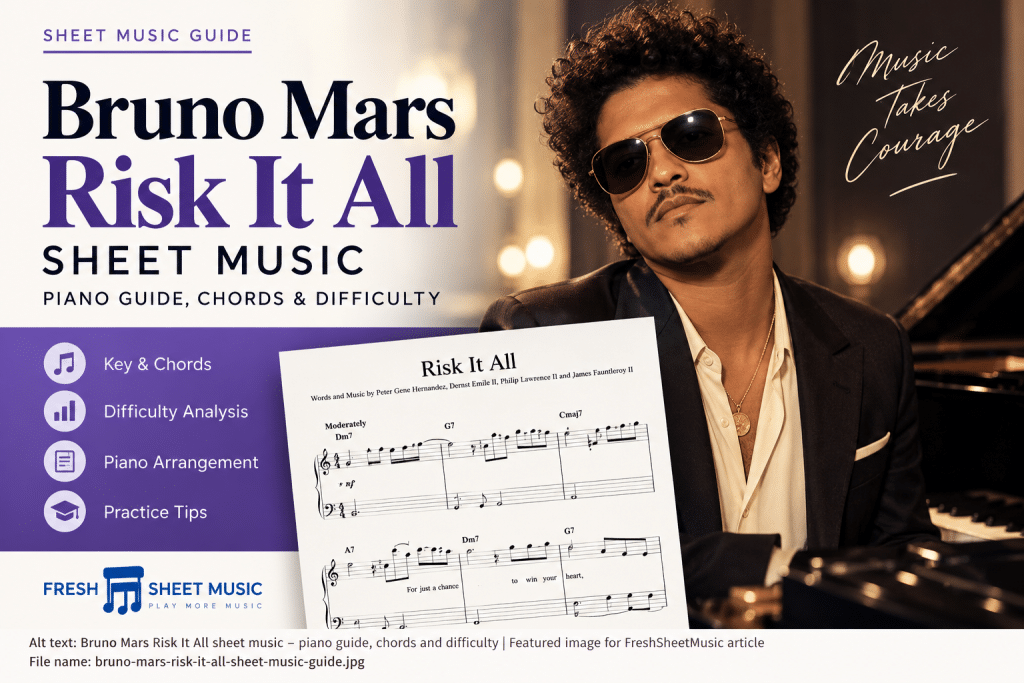
Looking for Bruno Mars “Risk It All” sheet music?
The officially licensed Really Easy Piano arrangement
is a three-page digital score that captures the song’s melody, rich seventh-chord harmony and expressive Latin-influenced character in an accessible piano setting.
|
♫
|
Reviewed by
FreshSheetMusic Editorial Team
This guide was prepared by examining the officially published sheet music, including its notation, harmony, rhythm, arrangement and practical playing requirements.
|
Below, we examine the key, chords, difficulty and notable musical features of the Really Easy Piano edition, along with practical suggestions for learning the arrangement.
View Bruno Mars “Risk It All” Sheet Music →
Bruno Mars “Risk It All” Sheet Music at a Glance
| Song | Risk It All |
| Artist | Bruno Mars |
| Arrangement | Really Easy Piano |
| Pages | 3 |
| Time signature | 4/4 |
| Written key | C major |
| Main chords | Dm7, G7, Cmaj7 and A7, with additional chromatic harmony |
| Tempo | Moderately |
| Difficulty | Beginner to early-intermediate |
| Format | Licensed digital sheet music |
Although the notation is presented without sharps or flats in the key signature, the harmony gives the arrangement a considerably richer sound than a basic three-chord piano piece. The recurring Dm7–G7–Cmaj7 progression strongly establishes C major, while A7 and several borrowed or chromatic chords add extra harmonic color.
About Bruno Mars’ “Risk It All”
“Risk It All” appears as the opening song on Bruno Mars’ 2026 album The Romantic. Its musical character draws heavily on the romantic bolero tradition, giving the song a slower, expressive feel with clear Latin influence.
The note included with the published piano score explains that the song developed from an initially more up-tempo idea into a romantic bolero. That character is reflected in the piano arrangement through expressive melodic phrasing, colorful seventh chords and a measured rhythmic feel rather than a heavily driving accompaniment.
For pianists, this makes “Risk It All” particularly interesting: the notes themselves are relatively approachable, but the music sounds best when the player pays attention to phrasing, timing and harmonic tension rather than simply playing the correct pitches.
Listen to “Risk It All” Before You Play It
Listening to the original recording before practicing is especially useful here because much of the character comes from phrasing and rhythmic placement. The published score specifically encourages an expressive approach and warns against rushing the semiquaver, or sixteenth-note, passages.
First learn the rhythm accurately from the notation. Then return to the recording and listen for where Bruno Mars allows melodic phrases to breathe. That comparison can help prevent the shorter note values from becoming rushed or mechanical.
What Key Is Bruno Mars’ “Risk It All” Sheet Music In?
This Really Easy Piano arrangement is written around C major. There are no sharps or flats in the key signature, and one of the strongest recurring harmonic movements is:
In C major, this functions as a classic ii–V–I progression. Dm7 creates movement toward G7, the dominant chord, which then resolves naturally to Cmaj7.
This progression is common in jazz, soul and Latin-influenced popular music because adding sevenths produces a smoother and more sophisticated harmonic sound than using plain major and minor triads alone.
What Chords Are Used in “Risk It All”?
The score uses a broader chord vocabulary than many Really Easy Piano arrangements. Important chord symbols visible throughout the three pages include:
- Dm7
- G7
- Cmaj7
- A7
- G major
- F major
- E major
- Gm6
- Fm
- Em
The harmonic backbone remains accessible, particularly because Dm7–G7–Cmaj7 returns several times. However, chords such as Gm6, Fm and E major introduce notes from outside the basic C-major scale and give the arrangement its more distinctive color.
A7 is also important. It repeatedly creates tension leading back toward Dm7, helping the harmony move naturally into another ii–V–I cycle.
How Difficult Is “Risk It All” to Play on Piano?
We would rate this arrangement beginner to early-intermediate. It is published as Really Easy Piano, and much of the accompaniment has been simplified, but it requires more musical control than the page count might suggest.
Several features keep it accessible:
- a familiar 4/4 meter;
- frequent repetition of the main harmonic progression;
- relatively economical left-hand writing;
- finger numbers supplied at useful points;
- a clearly presented right-hand melody.
The main challenge is not speed. Instead, players need to manage sixteenth-note figures, ties, chromatic notes, expressive pauses and occasional triplets without disturbing the relaxed flow of the song.
What Is the Piano Arrangement Like?
1. The Right Hand Carries an Expressive Vocal-Style Melody
The right hand closely follows the shape of the sung melody. Several phrases contain short sixteenth-note groups, so the challenge is to preserve the melodic line while keeping those faster notes controlled.
The score’s own playing advice is particularly relevant here: the sixteenth notes should not be rushed. Think of them as expressive subdivisions inside a slower phrase rather than as moments where the tempo suddenly accelerates.
2. Seventh Chords Give the Arrangement Its Character
Dm7, G7 and Cmaj7 appear from the beginning of the score. These seventh chords make the harmony sound warmer and more sophisticated than an arrangement built only from D minor, G major and C major.
For a learner, this is also an excellent introduction to hearing how a ii–V–I progression works in practice rather than only learning it as music theory.
3. Chromatic Chords Add Unexpected Color
Later passages move through chords including G, F, E, Gm6, A7, Fm and Em. This creates a more colorful harmonic route before the arrangement returns to its familiar Dm7–G7–Cmaj7 resolution.
Because some of these chords introduce accidentals, beginners should avoid assuming that every note belongs to the C-major scale. Read the accidentals carefully as they appear.
4. Triplets Appear Near the End
The final page introduces triplet figures in the melody. These should feel evenly divided across the beat rather than being played as three hurried notes.
Practice the triplet rhythm alone first, then restore the left hand once the subdivision feels natural.
5. The Ending Uses a Brief N.C. Passage
Near the conclusion, the score marks N.C., meaning “no chord.” The accompaniment briefly drops away before the final Cmaj7 harmony.
That moment is worth observing rather than automatically filling the space with additional harmony. The contrast helps make the final resolution more effective.
6. Expression Matters More Than Speed
The opening is marked Moderately, and the score includes expressive details such as ties and fermatas. This arrangement therefore rewards patience: a slightly slower performance with convincing phrasing will generally sound better than playing every note quickly but mechanically.
Preview the Really Easy Piano Arrangement →
How to Learn “Risk It All” on Piano
-
Learn the Dm7–G7–Cmaj7 progression first.
Because it returns throughout the arrangement, becoming comfortable with these three harmonies immediately reduces the amount of unfamiliar material. -
Practice the right-hand melody separately.
Pay particular attention to the sixteenth-note groups and resist the temptation to accelerate through them. -
Mark the accidentals.
The later chord sequence introduces notes outside the basic C-major scale. Identifying them before playing can prevent repeated reading mistakes. -
Add the left hand in short phrases.
Rather than attempting the entire page hands together, combine two or four measures at a time. -
Practice the triplets independently.
Count them evenly before adding the surrounding melody. -
Add expression only after the rhythm is stable.
Once the notes are secure, use the fermatas, phrasing and natural breathing points to make the performance less mechanical. -
Compare your performance with the recording.
Listen especially for the relaxed pulse and vocal phrasing rather than trying to imitate every production detail of the studio version.
Is “Risk It All” Good for Beginner Pianists?
Yes, particularly for beginners who already have some experience reading both hands. The Really Easy Piano format keeps the texture manageable, while the recurring chord patterns provide useful repetition.
A complete first-time pianist may find the sixteenth notes, accidentals and triplets challenging at first. However, these features also make the arrangement a useful progression piece for someone moving beyond very simple beginner repertoire.
It is particularly valuable for learning that “easy piano” does not have to mean harmonically uninteresting. The Dm7–G7–Cmaj7 progression introduces richer chord sounds while remaining practical to play.
Where Can I Get Official Bruno Mars “Risk It All” Sheet Music?
FreshSheetMusic offers the officially licensed digital Really Easy Piano arrangement of Bruno Mars’ “Risk It All”. The score contains three pages and includes an online preview so you can inspect the notation and arrangement before purchasing.
The digital edition can be printed or saved as a PDF after purchase according to the options provided with the licensed score.
Frequently Asked Questions
What key is Bruno Mars’ “Risk It All” sheet music in?
The Really Easy Piano arrangement is centered on C major and has no sharps or flats in the key signature.
What chords are used in “Risk It All”?
Important chords include Dm7, G7, Cmaj7, A7, G, F, E, Gm6, Fm and Em. The recurring Dm7–G7–Cmaj7 ii–V–I progression forms an important part of the arrangement.
Is “Risk It All” difficult to play on piano?
This edition is published as Really Easy Piano. We would place it around beginner to early-intermediate level because the basic texture is accessible but the melody includes sixteenth notes, accidentals, triplets and expressive rhythmic details.
How many pages is the “Risk It All” piano sheet music?
The Really Easy Piano edition contains three pages.
What does Dm7–G7–Cmaj7 mean in “Risk It All”?
In C major, Dm7–G7–Cmaj7 forms a ii–V–I progression. The chords create increasing harmonic tension before resolving to Cmaj7.
Can a beginner learn “Risk It All”?
Yes. A pianist who can already read basic treble and bass clef notation should find this arrangement approachable when it is learned in short sections.
What does N.C. mean in the sheet music?
N.C. means “no chord.” In this arrangement it creates a brief break in the harmony shortly before the final Cmaj7 chord.
Where can I get licensed Bruno Mars “Risk It All” sheet music?
The licensed Really Easy Piano digital score is available from FreshSheetMusic, with a notation preview available before purchase.
Ready to Play “Risk It All”?
Preview the official Really Easy Piano arrangement and get the licensed digital sheet music for Bruno Mars’ “Risk It All”.