
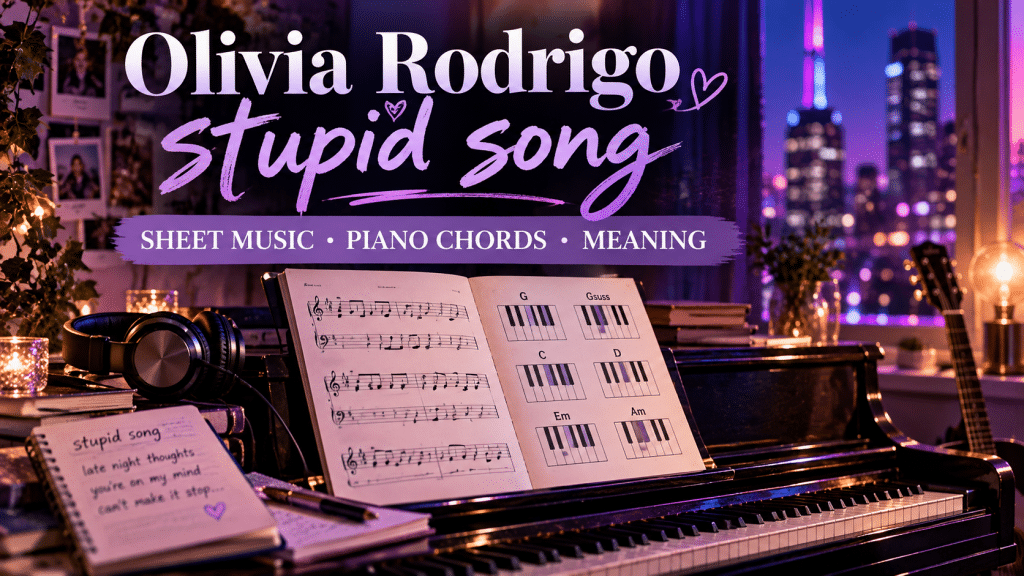
Looking for Olivia Rodrigo “Stupid Song” sheet music? This two-page melody-and-chords arrangement offers a practical way to learn the vocal melody, understand its G-major harmony and explore the energetic musical character of one of Rodrigo’s emotionally intense love songs.
Below, we’ll examine the song’s meaning and inspiration, piano chords, key signature, playing difficulty, rhythmic challenges and practice techniques. You’ll also find the official music video and information about the licensed digital score.
|
♫
|
Score Analysis
FreshSheetMusic Editorial Team
This guide examines the published two-page melody-and-chords score, including its note names, keyboard chord diagrams, rhythmic figures, melodic range and repeat structure. Song-background reporting is distinguished from editorial musical interpretation.
|
View Olivia Rodrigo “Stupid Song” Sheet Music →
Olivia Rodrigo “Stupid Song” Sheet Music at a Glance
| Song | Stupid Song |
| Artist | Olivia Rodrigo |
| Songwriters | Olivia Rodrigo and Daniel Nigro |
| Album | you seem pretty sad for a girl so in love (2026) |
| Album release | June 12, 2026 |
| Score format | Single-staff melody with lyrics, chord symbols and keyboard chord diagrams |
| Pages | 2 |
| Time signature | 4/4 |
| Tempo marking | With energy |
| Key signature | No sharps or flats; G-centered harmony with written accidentals |
| Main chords | G, Gsus, C, D, Em, Am |
| Difficulty | Early-intermediate melody reading; intermediate-level challenges at full performance speed |
| Special features | Lettered noteheads, repeated eighth notes, first/second endings, N.C. passage |
| SKU | 2049548 |
The arrangement is especially useful for players learning to read a vocal melody and interpret chord symbols. However, it is important to understand that this edition does not contain a complete, independently notated two-hand piano accompaniment.
The Story Behind Olivia Rodrigo’s “Stupid Song”
Olivia Rodrigo released “Stupid Song” as part of her third studio album, you seem pretty sad for a girl so in love, on June 12, 2026. The track was written with her longtime collaborator Daniel Nigro, whose production partnership with Rodrigo has shaped much of her recorded music.
The song’s origins are especially interesting for piano players. Rodrigo has explained that she wrote it at the piano in her New York apartment, shortly before moving out. Although the finished recording has an energetic, layered pop sound, its starting point was a much more direct piano-based composition.
In an interview discussing the making of the track, Rodrigo recalled an unexpectedly flattering encounter with a stranger during a morning walk in London. She described returning home in a joyful mood and writing about the overwhelming feeling of infatuation.
The production took considerably longer to complete than the initial songwriting. Rodrigo and Nigro experimented with how to preserve the song’s emotional sincerity while moving beyond the familiar piano-ballad approach. Rodrigo has described the production process as lasting almost a year, with a guitar idea near the bridge helping unlock the final direction.
The result combines an intimate, emotionally direct melody with a larger and more energetic arrangement.
Background reading:
MusicRadar – the making of “Stupid Song”, Pitchfork – Rodrigo discusses her songwriting, and Universal Music – album announcement.
What Is Olivia Rodrigo’s “Stupid Song” About? Meaning Explained
“Stupid Song” explores the overwhelming experience of infatuation: wanting someone so intensely that ordinary language, logic and even songwriting seem inadequate to describe the feeling.
Rather than presenting love as uncomplicated happiness, Rodrigo captures its contradictions. Attraction feels exciting and energizing, but it can also create insecurity, obsession, restlessness and emotional confusion.
The song uses physical imagery to communicate emotions that seem impossible to contain. Fire, melting, speed and unraveling all suggest that the narrator is losing her usual sense of control.
Rodrigo has also identified a literary influence: Simple Passion by Nobel Prize-winning author Annie Ernaux. The book explores an all-consuming romantic attachment and the way longing can begin to dominate everyday life.
That influence helps explain why the song feels more complicated than a conventional celebration of falling in love. The narrator is exhilarated, but she is also unsettled by the intensity of her own feelings.
The central meaning: “Stupid Song” is about love becoming so powerful and emotionally disorienting that no ordinary romantic song seems capable of expressing it fully.
Why Is It Called “Stupid Song”?
The title is deliberately self-aware. Rodrigo is a songwriter trying to communicate an extraordinary feeling through a familiar medium: a pop song.
Calling the song “stupid” does not necessarily mean she thinks the emotion is foolish. Instead, it suggests frustration with the limitations of words and music when faced with something that feels overwhelming.
The title therefore contains a paradox: she writes a love song about how a love song cannot adequately express love.
Is “Stupid Song” About a Specific Person?
Rodrigo has discussed the emotions, literary influences and songwriting experiences behind the track, but those comments do not establish one confirmed real-life person as its subject.
Listeners may connect the song with publicly discussed relationships, but such identifications should be treated as interpretation rather than confirmed biography.
How Does the Music Reflect the Lyrics?
The contrast between relatively conversational opening phrases and the more insistent, repetitive chorus supports the idea of emotions building beyond control.
The melody becomes increasingly active, while repeated notes and tightly grouped rhythms create a sense of urgency. For a pianist, the challenge is to preserve that energy without sacrificing clarity.
For Rodrigo’s discussion of the literary inspiration, see Capital FM’s reporting on the song’s meaning.
Watch Olivia Rodrigo’s “Stupid Song” Official Music Video
The official “Stupid Song” music video was directed by Mitch Ryan and filmed in New York City. It features choreography by ballet dancer Tiler Peck, with performers from New York City Ballet and American Ballet Theatre.
The visual contrast between ordinary city streets and expressive ballet movement complements the song’s themes of heightened emotion and romantic disorientation.
Watch the official video on YouTube →
Before practicing, listen to how the melody grows from more restrained phrases into repeated, emphatic notes. That contrast is useful when shaping the performance on piano or keyboard.
What Key Is Olivia Rodrigo’s “Stupid Song” Sheet Music In?
The supplied score has no sharps or flats in its printed key signature. Its harmony, however, repeatedly emphasizes G, with G major functioning as the main point of resolution.
This distinction matters because the melody includes written accidentals, particularly F-sharp. The chord symbols and melodic behavior support a G-major tonal center, even though the key signature itself is blank.
The main harmonic relationships can be understood in G major:
- G major (I): the tonal center.
- C major (IV): a contrasting major chord.
- D major (V): dominant harmony leading toward G.
- Em (vi): the relative-minor chord within G major.
- Am (ii): a minor chord that adds harmonic movement.
- Gsus: a suspended variation of the G chord.
Because the published chord diagram is labeled simply Gsus, the most reliable approach is to follow its indicated keyboard notes rather than automatically assuming every suspended G chord uses the same voicing.
What Piano Chords Are Used in “Stupid Song”?
Six chord symbols appear in the arrangement, and keyboard diagrams are provided at the beginning of the first page.
| Chord | Notes | Chord type |
|---|---|---|
| G | G–B–D | Major |
| Gsus | G–C–D (common Gsus4 voicing) | Suspended |
| C | C–E–G | Major |
| D | D–F#–A | Major |
| Em | E–G–B | Minor |
| Am | A–C–E | Minor |
For beginners, G, C and D are sensible chords to learn first. Once these feel comfortable, introduce Em and Am, then practice the suspended G variation.
The arrangement also includes an N.C. marking near the end, meaning no chord is specified for that passage.
How Difficult Is “Stupid Song” to Play on Piano?
We would classify the notated melody as early-intermediate overall, with some passages requiring intermediate-level rhythmic confidence at full speed.
The score is visually approachable because it uses one treble-clef staff and note names printed inside the noteheads. However, that simplified presentation does not mean every passage is technically easy.
The main challenges include:
- Maintaining the energetic 4/4 pulse.
- Reading repeated eighth-note groups accurately.
- Playing F-sharp accidentals without hesitation.
- Moving between lower and higher melodic registers.
- Keeping repeated chorus notes even and controlled.
- Following the first and second endings.
- Adding chord accompaniment without obscuring the melody.
A developing pianist can begin with the vocal melody alone. Performing melody and accompaniment simultaneously requires additional arrangement decisions because the score does not supply a fully written left-hand part.
Inside the “Stupid Song” Sheet Music Arrangement
1. A Single-Staff Melody with Lettered Noteheads
The score presents the vocal line on one treble-clef staff. Each notehead includes a letter name, helping learners associate written pitches with keyboard notes.
This is particularly useful for players who are still developing confidence with traditional staff notation.
2. An Energetic Opening
The first page begins with the instruction “With energy.” The melody quickly moves through short notes, including several eighth-note groups and repeated pitches.
Instead of playing every note with equal emphasis, look for the natural stress of each vocal phrase.
3. Suspended Harmony Adds Color
The Gsus chord introduces a suspended sound that differs from an ordinary G-major triad. This creates a brief sense of harmonic openness before the music moves onward.
When adding your own accompaniment, keep the suspended voicing clear so its character is not lost.
4. The Chorus Uses Repeated Notes and Faster Motion
The second page contains sustained stretches of repeated notes and closely spaced rhythmic patterns. These passages communicate the song’s heightened emotional intensity.
Repeated notes should remain rhythmically even. Avoid allowing tension in the wrist or fingers to make the melody sound forced.
5. Chromatic Accidentals Need Attention
The melody includes F-sharp notes written as accidentals. These appear frequently enough that the player should become comfortable moving between F-natural and F-sharp where the notation requires.
Practice these passages slowly before attempting the intended energetic character.
6. First and Second Endings Organize the Structure
On page one, the score contains numbered first and second endings. These direct the player through the repeated section in the proper order.
The first ending leads into the repeat, while the second ending directs the performance onward. Marking this route before playing can prevent confusion.
7. The Ending Includes a No-Chord Passage
Near the end of page two, an N.C. indication appears above the melody. This tells an accompanying player that no chord is specified during that passage.
The song then resolves to G, giving the ending a clear tonal destination.
How to Learn Olivia Rodrigo’s “Stupid Song” on Piano
- Learn the six chord shapes. Start with G, C and D, then add Em, Am and Gsus.
- Read the melody slowly. Use the lettered noteheads as a learning aid, but also pay attention to the staff positions.
- Practice the rhythm separately. Clap or count the repeated eighth-note patterns before playing them.
- Work on accidentals. Isolate phrases containing F-sharp and practice them until the changes feel natural.
- Divide the chorus into short sections. Repeated notes become easier to control when practiced in small groups.
- Add simple accompaniment. Try sustained chords or single bass notes at each chord change.
- Follow the repeat markings. Practice the first and second endings before attempting the entire piece.
- Build intensity gradually. Keep the opening comparatively conversational and let the chorus feel more urgent.
Is “Stupid Song” Good for Beginner Pianists?
The lettered noteheads and single-staff layout make this edition accessible to motivated beginners who want to learn the melody.
However, the repeated eighth notes, energetic tempo and higher-register phrases make it more demanding than a very basic beginner arrangement.
For an easier approach, play the melody at a reduced tempo and use one simple chord per change. More experienced players can develop fuller accompaniment patterns and work toward the expressive intensity of the original recording.
Where Can I Get Olivia Rodrigo “Stupid Song” Sheet Music?
FreshSheetMusic provides a licensed digital sheet music edition of Olivia Rodrigo’s “Stupid Song,” identified as SKU 2049548.
This two-page arrangement includes the vocal melody, lyrics, chord symbols, keyboard chord diagrams and lettered noteheads.
It is a useful choice for singers, beginning keyboard players and musicians who want to study the melody and harmony. If you need a fully written piano solo with both hands notated, note that this particular edition uses a melody-and-chords format instead.
Frequently Asked Questions
What is Olivia Rodrigo’s “Stupid Song” about?
It explores intense infatuation and the feeling that ordinary words or love songs cannot adequately express overwhelming romantic emotions.
What inspired Olivia Rodrigo to write “Stupid Song”?
Rodrigo has discussed an uplifting encounter during a walk in London and the literary influence of Annie Ernaux’s Simple Passion. She originally wrote the song at a piano.
Why is it called “Stupid Song”?
The title reflects the narrator’s frustration that even a love song seems inadequate to describe the intensity of her feelings.
Who wrote “Stupid Song”?
Olivia Rodrigo and Daniel Nigro are credited as songwriters.
What chords are used in “Stupid Song”?
The supplied sheet music uses G, Gsus, C, D, Em and Am.
What key is “Stupid Song” in?
The supplied arrangement has no sharps or flats in its printed key signature, but its harmony centers on G major and the melody includes written F-sharp accidentals.
Is “Stupid Song” easy to play on piano?
The lettered-note melody is approachable for developing players, but the fast repeated notes and rhythmic detail make a fluent performance more challenging.
How many pages is the sheet music?
This particular digital edition contains two pages.
Is this a complete two-hand piano arrangement?
No. It presents a single-staff melody with lyrics and keyboard chord diagrams rather than a fully notated two-hand piano solo.
Does “Stupid Song” have an official music video?
Yes. The official music video was directed by Mitch Ryan and features ballet choreography by Tiler Peck in New York City.
Ready to Play Olivia Rodrigo’s “Stupid Song”?
Explore the two-page melody-and-chords arrangement, learn its G-centered harmony and develop your own expressive piano or keyboard performance.