
Looking for Alan Jackson “Tall, Tall Trees” sheet music? This five-page piano-vocal-guitar arrangement brings one of Jackson’s most playful country hits to the keyboard, with a fully written piano accompaniment, vocal melody, guitar chord diagrams and an instrumental solo.
Whether you’re learning the song for a performance, accompanying a singer or simply enjoying classic country piano, this guide covers the chords, key, difficulty, musical structure, song meaning and fascinating story behind the recording.
|
♫
|
Score Analysis
FreshSheetMusic Editorial Team
Reviewed from the published five-page piano-vocal-guitar score, including its chord symbols, piano accompaniment, vocal line, instrumental section, repeat markings and coda.
|
View “Tall, Tall Trees” Sheet Music →
Alan Jackson “Tall, Tall Trees” Sheet Music at a Glance
| Song | Tall, Tall Trees |
| Artist | Alan Jackson |
| Songwriters | George Jones and Roger Miller |
| Alan Jackson recording | 1995 |
| Album | The Greatest Hits Collection |
| Arrangement | Piano, vocal and guitar chords |
| Pages | 5 |
| Key signature | G major (one sharp) |
| Main chords | G, C, D, D7 and A |
| Tempo | Moderately fast; no numerical BPM indicated |
| Difficulty estimate | Early-intermediate to intermediate piano |
| Special features | Spoken passage, instrumental solo, first/second endings, D.S. al Coda |
| SKU | 2220143 |
This is a more complete keyboard arrangement than a melody-and-chords lead sheet. The piano part is written on a grand staff, with an additional vocal staff above it. That makes it particularly useful for pianists accompanying a singer or studying traditional country accompaniment patterns.
The Story Behind Alan Jackson’s “Tall, Tall Trees”
Although “Tall, Tall Trees” became one of Alan Jackson’s memorable 1990s hits, he did not write the song. Its origins reach back to the 1950s, when country legends George Jones and Roger Miller collaborated as songwriters.
George Jones released the song in 1957. Roger Miller later recorded his own version for the 1970 album A Trip in the Country. For decades, the composition remained a piece of classic country history rather than a major contemporary radio hit.
That changed when Alan Jackson selected it for his 1995 compilation The Greatest Hits Collection. Jackson had encountered Miller’s recording and admired its lively character. He thought its playful, Cajun-influenced feel would suit one of the newly recorded tracks on the collection.
One of the most interesting details emerged after Jackson recorded it: he learned that George Jones was also a songwriter on the track. Jackson had already admired both musicians, so discovering that the song connected two of his country heroes gave the recording additional significance.
Jackson’s version became a major success, reaching No. 1 on Billboard’s country chart in December 1995 and spending two weeks at the top. What had begun as an older George Jones–Roger Miller composition found a new audience nearly four decades later.
Country music connection: “Tall, Tall Trees” links three generations of traditional country appeal: George Jones’s early honky-tonk recordings, Roger Miller’s witty songwriting and Alan Jackson’s 1990s revival of classic country sounds.
Further reading:
Country Music Hall of Fame – Roger Miller,
Roger Miller biography, and Alan Jackson’s official album page.
What Is “Tall, Tall Trees” About? Song Meaning Explained
“Tall, Tall Trees” is a playful love song about a man who is so devoted to someone that he promises to give her almost anything she could want. Rather than describing romance in restrained or realistic terms, the narrator makes increasingly extravagant promises.
He imagines providing luxury, travel, property and even impossible possessions. The exaggerated offers are not meant to be taken literally. They express how far he would go to make the person he loves happy.
The title itself is an example of the song’s humor. Nobody can realistically buy every tree or all the water in the seas. The impossible scale of these promises makes the devotion sound both sincere and deliberately comical.
That balance between affection and exaggeration is central to the writing style associated with Roger Miller. The song doesn’t need a tragic storyline or complicated emotional conflict; its charm comes from a narrator cheerfully admitting how completely love has won him over.
What Does the Title “Tall, Tall Trees” Mean?
The tall trees symbolize the enormous scale of the narrator’s promises. Together with the song’s other exaggerated gifts, they communicate a simple message: his affection is so strong that ordinary gestures no longer seem big enough.
It is best understood as humorous romantic hyperbole rather than a literal statement about wealth or ownership.
Why Does the Song Feel So Cheerful?
The moderately fast pulse, bright major-key harmony and repeated G–C–D movement reinforce the lyric’s lighthearted tone. Instead of using dramatic harmonic shifts, the arrangement relies on familiar country changes and rhythmic momentum.
For pianists, this suggests a performance that is lively, buoyant and rhythmically confident, rather than overly sentimental or heavy.
Watch Alan Jackson’s “Tall, Tall Trees” Official Music Video
Before learning the sheet music, watch the official music video and listen to the song’s upbeat country character. Pay particular attention to the piano, rhythmic accompaniment, vocal phrasing and instrumental breaks.
The official Alan Jackson YouTube channel identifies this as the music video for his 1995 recording. The video was uploaded to YouTube in March 2011.
What Key Is Alan Jackson’s “Tall, Tall Trees” Sheet Music In?
The published arrangement is written in G major, indicated by one sharp in the key signature: F-sharp.
The most important chords are:
Most of the song’s harmonic movement is built around the three primary chords of G major:
- G major (I) – the home chord.
- C major (IV) – adds movement away from the tonic.
- D major (V) – creates tension leading back to G.
- D7 (V7) – strengthens the dominant-to-tonic resolution.
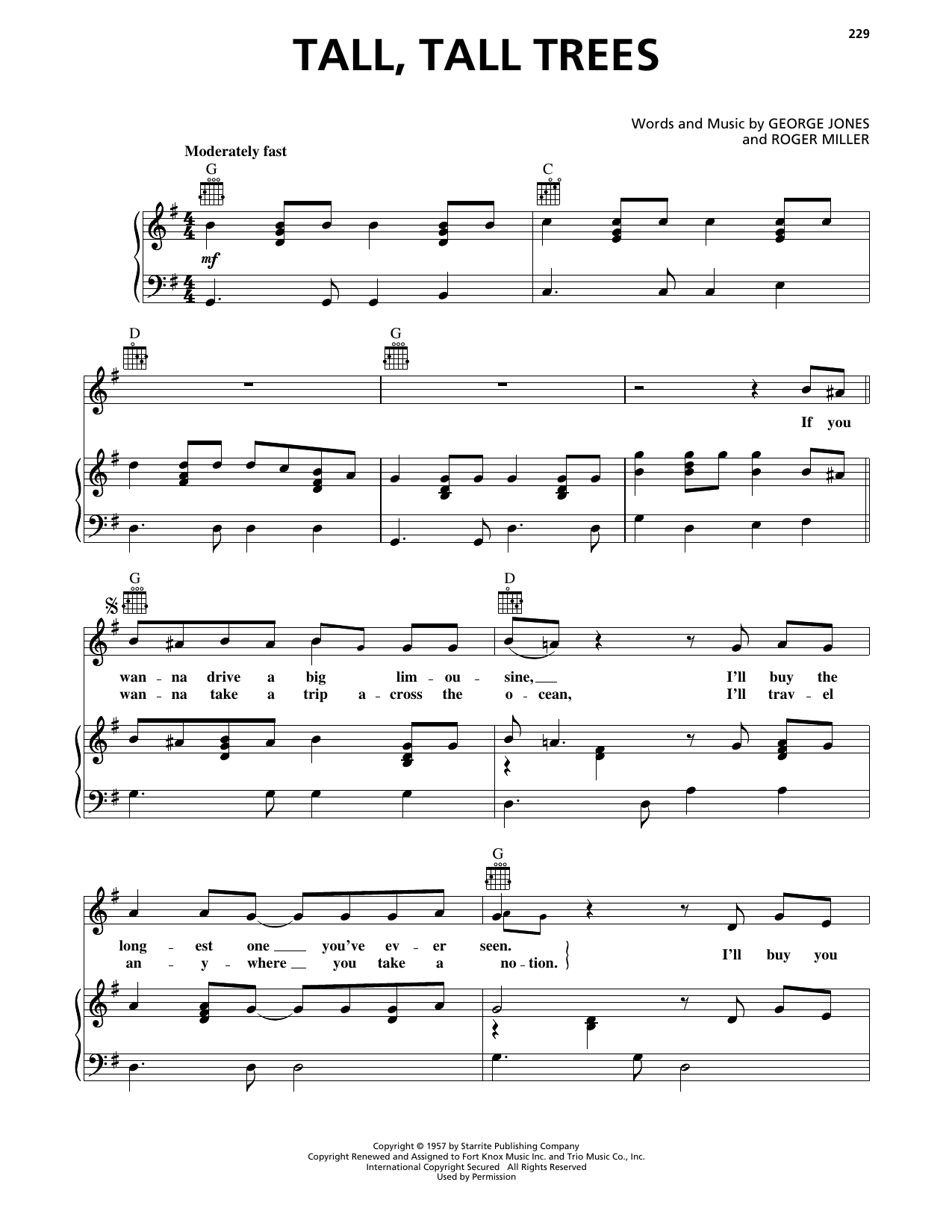
The score also includes an A major chord in the spoken transition. In the key of G, this can function as a secondary dominant, often analyzed as V/V, leading toward D.
This combination of primary chords and occasional added dominant color is characteristic of accessible traditional country harmony.
“Tall, Tall Trees” Piano and Guitar Chords
The chord diagrams printed above the vocal staff are useful for guitarists, while pianists can use the same chord symbols to understand the written accompaniment.
| Chord | Notes | Role in G major |
|---|---|---|
| G | G–B–D | Tonic (I) |
| C | C–E–G | Subdominant (IV) |
| D | D–F#–A | Dominant (V) |
| D7 | D–F#–A–C | Dominant seventh (V7) |
| A | A–C#–E | Secondary dominant (V/V) |
The appearance of C-sharp in the A major chord is worth noticing. Although the key signature contains only F-sharp, the A chord introduces an additional chromatic pitch that creates forward motion.
A useful warm-up is to practice G–C–D–G, then G–D7–G, before adding the more detailed written piano part.
How Difficult Is “Tall, Tall Trees” to Play on Piano?
Based on the five-page score, we estimate the arrangement at an early-intermediate to intermediate piano level. This is an editorial assessment rather than an official publisher grade.
The basic harmony is straightforward, but the full piano part requires more than simple block chords.
Players will encounter:
- Coordinated right-hand chord figures and left-hand bass movement.
- Frequent eighth-note accompaniment patterns.
- Changes between single notes and compact chord voicings.
- A moderately fast country feel.
- A separate instrumental solo.
- A spoken passage with rhythmic notation.
- First and second endings and D.S. al Coda navigation.
A beginner may be able to play a simplified version using G, C and D chords. Performing the complete written arrangement fluently, however, requires stronger rhythmic coordination and familiarity with reading both piano staves.
Inside the “Tall, Tall Trees” Piano Arrangement
1. A Bright Country Introduction
Page one begins with a short piano introduction before the vocal entrance. The accompaniment establishes the G-major sound immediately and uses repeated rhythmic figures to create momentum.
Practice this introduction separately. It sets the feel for everything that follows, so the beat should be stable before the singer enters.
2. A Fully Written Piano Accompaniment
The score includes a grand-staff piano part beneath the vocal line. The right hand frequently moves through small chord groupings and eighth-note figures, while the left hand provides the bass foundation.
This is useful for studying how a country piano accompaniment can remain active without overpowering the melody.
3. The Spoken Passage
On page three, the arrangement marks a section as spoken, with rhythmic X-shaped noteheads and N.C. indications.
The notation distinguishes this passage from ordinary sung melody. When accompanying a singer, maintain the pulse while allowing the spoken delivery to remain natural.
4. The Instrumental Solo
Page four introduces an instrumental solo. The vocal staff contains rests while the piano part continues with more prominent melodic and chordal figures.
This passage is an excellent practice opportunity because the keyboard moves from accompaniment into a more exposed musical role.
5. First and Second Endings
Page five contains numbered first and second endings around the instrumental section. Follow these carefully so that the repeat is played in the correct order.
Mark the endings in pencil if you are learning the piece for a live performance.
6. D.S. al Coda and the Final Ending
The score uses D.S. al Coda, which directs the performer back to the segno sign rather than all the way to the beginning.
Continue until the designated coda jump, then proceed to the separate coda passage on the final page.
The ending includes a held final chord with a fermata, allowing the performance to finish decisively.
How to Learn “Tall, Tall Trees” on Piano
- Learn the chord progression. Practice G, C, D and D7 slowly before adding the A chord from the spoken section.
- Establish the country pulse. Play the left-hand bass part alone until it feels steady and relaxed.
- Practice the right-hand figures. Work through the repeated eighth-note patterns at a comfortable tempo.
- Combine hands in short sections. Begin with the introduction, then move through the vocal sections.
- Isolate the instrumental solo. Practice it as a separate passage before connecting it to the rest of the song.
- Mark the repeat structure. Identify the segno, first and second endings, D.S. al Coda and final coda.
- Increase tempo gradually. Maintain the light country feel rather than forcing speed at the expense of clarity.
- Play along with the recording. Listen for the overall groove and how the accompaniment supports the vocal performance.
Can Beginners Play “Tall, Tall Trees”?
Beginners who already know basic major chords can learn a simplified accompaniment. The harmonic foundation is accessible because G, C and D account for much of the song.
The complete published arrangement is more demanding. It contains a separate piano accompaniment, rhythmic detail, an instrumental solo and multiple navigation markings.
For an easier version, begin with a single bass note in the left hand and a simple chord in the right hand. Once the changes feel natural, gradually introduce the written rhythmic patterns.
Where Can I Get Alan Jackson “Tall, Tall Trees” Sheet Music?
FreshSheetMusic offers a licensed digital edition of Alan Jackson’s “Tall, Tall Trees,” identified as SKU 2220143.
The five-page score includes vocal notation, lyrics, a complete two-hand piano accompaniment and guitar chord diagrams. It also preserves the instrumental solo and the repeat structure needed to perform the arrangement.
This makes it a practical choice for piano players, vocal accompanists and country musicians who want more detail than a basic chord chart.
Frequently Asked Questions
Who wrote “Tall, Tall Trees”?
George Jones and Roger Miller wrote the song in the 1950s. Alan Jackson recorded his hit version in 1995.
What is “Tall, Tall Trees” about?
It is a humorous romantic song about someone promising extravagant and even impossible gifts to the person he loves.
What does “Tall, Tall Trees” mean?
The title represents the exaggerated scale of the narrator’s promises. It is a playful way of expressing affection and devotion.
Did Alan Jackson write “Tall, Tall Trees”?
No. George Jones and Roger Miller wrote it decades before Alan Jackson recorded his 1995 version.
What key is the “Tall, Tall Trees” sheet music in?
The supplied five-page arrangement is written in G major, with one sharp in the key signature.
What chords are used in “Tall, Tall Trees”?
The main chords in this arrangement are G, C, D, D7 and A.
Is “Tall, Tall Trees” easy to play on piano?
The basic chords are beginner-friendly, but the complete written piano arrangement is better suited to early-intermediate or intermediate players.
How many pages is the sheet music?
This edition contains five pages of piano, vocal and guitar notation.
What does D.S. al Coda mean?
It means return to the segno sign, continue until the coda instruction and then jump to the separate ending.
Was “Tall, Tall Trees” a No. 1 country hit?
Yes. Alan Jackson’s version reached No. 1 on Billboard’s country chart in December 1995 and spent two weeks at the top.
Ready to Play Alan Jackson’s “Tall, Tall Trees”?
Learn the bright G-major chords, enjoy the lively country piano accompaniment and discover the musical details that helped make this classic a hit.