
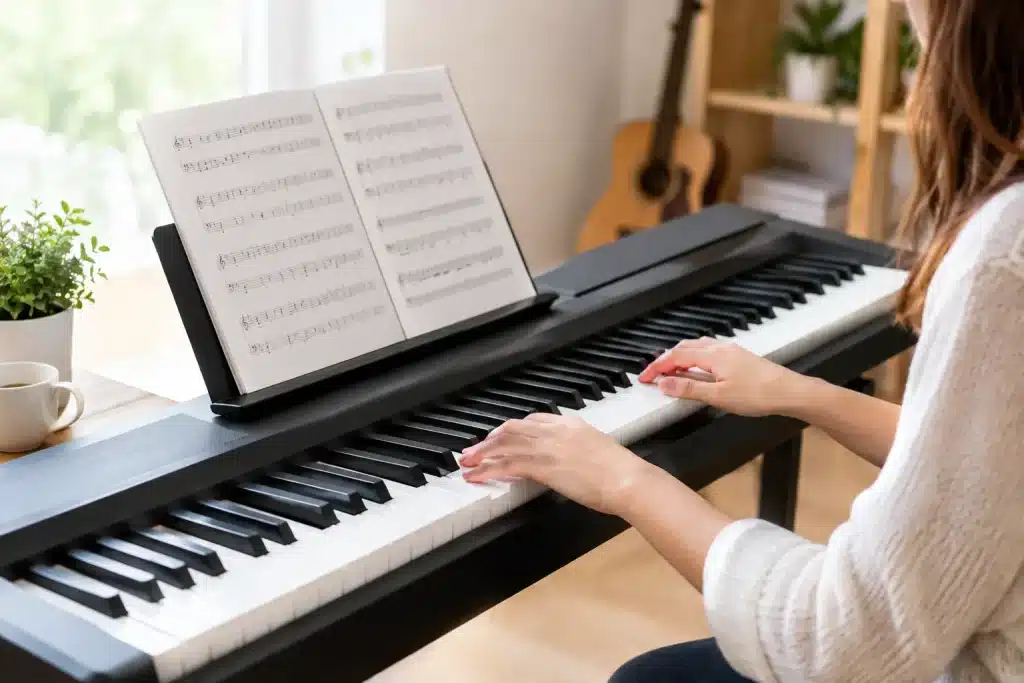
A song you recognize can make the difference between practicing because you should and sitting down because you genuinely want to play. The best popular songs for beginner piano are not always the ones with the fewest notes. They are the songs with a melody you can hear in your head, a rhythm you can feel, and an arrangement that lets your hands make progress quickly.
That last part matters. A radio recording may include layers of keyboards, guitars, vocals, bass, and production effects. A beginner-friendly piano arrangement turns those layers into something playable without losing the song people know. Start with a version that matches your current reading and hand-coordination skills, then build up from there.
What Makes a Song Beginner-Friendly?
A good first song usually has a repeating chord pattern, a melody that moves mostly by small steps, and a steady pulse. Songs in comfortable keys such as C, G, F, or A minor can reduce the number of accidentals you need to read. Simple left-hand parts also help. Playing single bass notes or basic chord shapes is far more manageable than trying to copy every detail of a full recording.
Tempo is a trade-off. A slow ballad gives you time to find notes, but it can expose uneven rhythm. A medium-tempo pop song may feel more natural, yet it asks you to keep moving. Choose the challenge that helps you practice a specific skill without making the whole piece feel out of reach.
Look for notation labeled easy piano, beginner piano, or simplified piano, but check the preview or sample details when available. Two arrangements of the same song can be dramatically different. One may use melody plus simple accompaniment, while another expects full chords, octave stretches, syncopation, or independent rhythms in both hands.
15 Popular Songs for Beginner Piano Practice
Familiar melodies that build confidence
“Let It Be” by The Beatles is a natural starting point because its melody is memorable and its harmony follows a familiar pop pattern. A simplified arrangement can introduce broken chords in the left hand without asking you to move too quickly. Focus on keeping the vocal-style melody smooth before adding more accompaniment.
“Imagine” by John Lennon works well for players learning to balance a singing right hand with quiet chords below it. The song has a calm pace, but its chord changes deserve patient practice. Start with blocked left-hand chords, then move to a flowing pattern if the arrangement includes one.
“Lean on Me” by Bill Withers is especially useful for learning chord-based playing. Its warm, direct melody and repeating harmonic ideas make it easier to hear when you have landed on the right change. It is also a good choice for singing while playing once your hands feel secure.
“Stand by Me” by Ben E. King gives beginners a dependable groove and a chord progression that appears in countless pop songs. Keep the left hand simple at first. A steady bass note on each change can sound musical long before you are ready for more active accompaniment.
“Hallelujah” by Leonard Cohen can be a rewarding early ballad when you use an accessible arrangement. The melody is expressive but not overly fast, allowing you to work on phrasing and dynamics. Be selective about the version, since more advanced arrangements often add rich chord voicings and fills.
Modern ballads worth learning slowly
“Someone Like You” by Adele is a strong choice for practicing repeated accompaniment patterns. The original piano part has a rolling feel, but a beginner arrangement can reduce it to clear chord changes and melody notes. Learn one measure at a time, especially where the hands change position.
“All of Me” by John Legend helps beginners get comfortable with a contemporary piano-ballad sound. The tune is recognizable, and the harmony repeats enough to reward careful repetition. The challenge is often rhythmic placement, so count aloud or use a metronome at a slower speed.
“Perfect” by Ed Sheeran has a gentle pulse and a melody that sits comfortably in many easy piano arrangements. It is a practical song for learning how to shape a phrase rather than playing every note at the same volume. Let the melody lead and keep the accompaniment lighter.
“A Thousand Years” by Christina Perri is ideal for a player ready to work on slow, flowing chord movement. Its patient tempo gives you room to read ahead, but do not mistake slow for effortless. Practice transitions between chords separately so the pulse does not stop when the harmony changes.
“Stay With Me” by Sam Smith is built around a clear, repeating progression that can sound full even in a simple arrangement. This makes it a useful song for practicing basic chords with consistent rhythm. If a version adds vocal-style embellishments, learn the main melody first and treat those details as optional.
Songs with rhythm and energy
“Clocks” by Coldplay is recognizable within seconds, thanks to its repeating piano figure. It can be more demanding than a ballad because the pattern needs to stay even, but a simplified version is excellent for developing coordination. Start far below the recording tempo and only speed up when the pattern feels relaxed.
“Flowers” by Miley Cyrus can work well for beginners when arranged around its chord progression and main vocal line. The song has an easygoing pop feel, but syncopated rhythms may require extra counting. Tap the rhythm away from the keyboard before trying to play both hands together.
“Roar” by Katy Perry brings more energy to early practice without requiring a complicated musical structure. The chorus is particularly satisfying once you can play the melody confidently. It is a useful option for younger learners, casual players, or anyone who stays motivated by upbeat songs.
“Shallow” by Lady Gaga and Bradley Cooper offers a strong melody and plenty of room for expression. Choose a simplified arrangement that avoids overly dense chords in the climactic sections. Build the song in layers: right-hand melody first, left-hand bass notes next, then fuller chords when ready.
“The Scientist” by Coldplay is a thoughtful next step for a beginner who is ready for recurring patterns and a slightly darker sound. The musical ideas repeat, which helps memorization, but smooth movement between positions is essential. Keep your shoulders loose and plan each hand shift before it arrives.
Choose the Arrangement, Not Just the Song
Finding a favorite title is only half the decision. The arrangement determines whether that title becomes a satisfying practice piece or an exercise in frustration. For a true beginner, melody with letter names, finger numbers, or straightforward chord symbols may be helpful. For a player who reads basic notation, an easy piano arrangement with a simplified left hand often provides the best balance of challenge and musical payoff.
Pay attention to the range of the hands. Large jumps, wide octaves, and thick chords can be difficult even when the rhythm looks simple. If you are still learning to coordinate both hands, choose music where the left hand supports the beat rather than competing with the melody.
Digital sheet music is useful here because you can select a single song that fits the skill you are working on now, view it online, and print it for your music stand. Licensed, song-specific arrangements also give you a clear version to learn instead of piecing together uncertain notes from memory. FreshSheetMusic.com is built for that practical approach: choose the song, get the notation quickly, and spend your time playing.
Make Each Beginner Piano Song Feel Manageable
When learning popular songs for beginner piano, don’t start by playing from the first measure to the last. Find the hook, chorus, or opening melody that made you choose the song, and learn that section first. A recognizable eight measures can be more motivating than a hesitant run through a full page of sheet music.
Practice each hand separately until its part feels dependable. Then combine the melody and accompaniment at a slow tempo, keeping a steady beat. If you make a mistake, continue to the end of the measure instead of restarting. Identify the tricky notes or chord, then repeat that small section. This is an easy way to practice and build coordination as you play piano.
Use dynamics early, even in easy piano songs for beginners. Playing the melody a little louder than the accompaniment makes a pop song or classic tune sound musical, not like a keyboard exercise. Once the notes and rhythm are steady, listen to the original recording or watch a piano tutorial video on YouTube for phrasing ideas. Keep the arrangement beginner-friendly and in a key that feels comfortable.
Your first piano songs don’t have to be traditional exercises you never want to hear again. Pick one song that is easy to play, one that introduces a new skill, and one of your favourite songs that makes you smile when the chorus arrives. This mix of songs for beginners makes learning piano enjoyable, builds a strong foundation, and gives you a practice routine you’re more likely to keep.
Frequently Asked Questions About Popular Songs for Beginner Piano
What are some popular songs for beginner piano?
Popular beginner-friendly choices include “Twinkle, Twinkle, Little Star,” “Let It Be” by The Beatles, “Perfect” by Ed Sheeran, and “Someone Like You” by Adele. Look for simplified arrangements with easy rhythms and a small range of notes.
How do I choose a song to learn as a beginner?
Choose a song you enjoy, then check that its arrangement uses simple chords, a steady rhythm, and manageable hand movements. Starting with an easy version can make a favorite song more approachable.
Can beginners learn popular songs on piano?
Yes. Many popular songs have simplified piano arrangements for beginners. These often reduce complex melodies and chords while keeping the song recognizable.
Should I learn the melody or chords first?
Start with whichever feels easier. Learning the melody can help you recognize the tune, while practicing basic chords lets you accompany a singer or play a fuller arrangement.
How often should I practice a new piano song?
Practice for 10 to 20 minutes most days. Work on a small section at a time, play slowly, and gradually increase your speed as you become more confident.